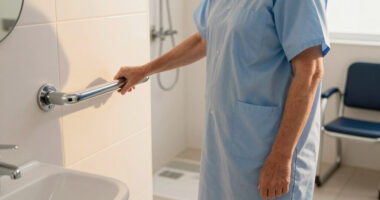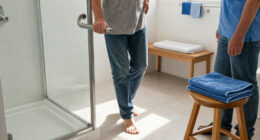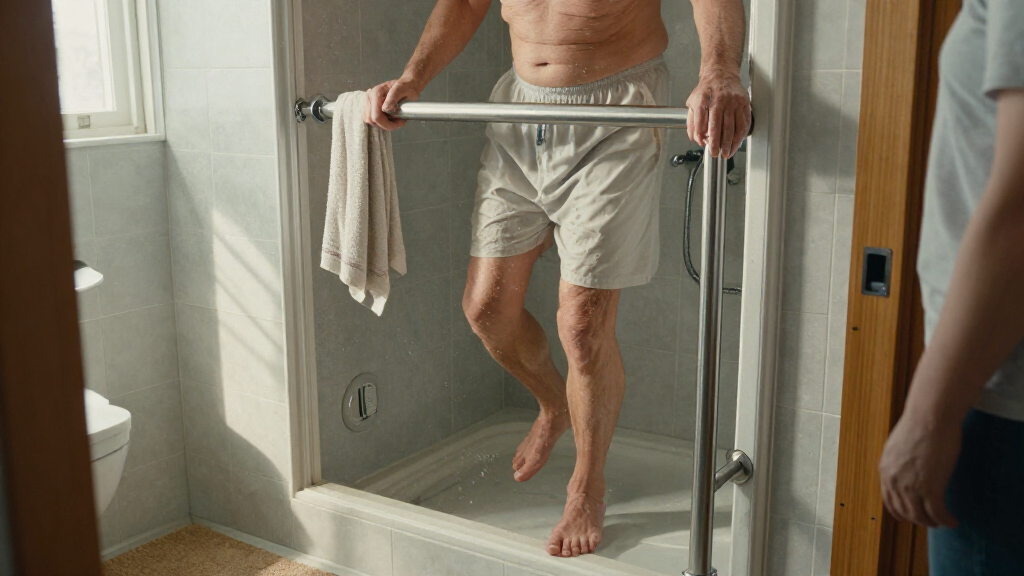
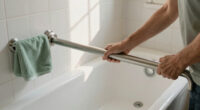
Choosing a grab bar for fall prevention means deciding whether reliable, fixed support matters more than a quick, movable installation. Permanently installed grab bars attach to wall framing or suitable reinforcement and are designed to provide a dependable handhold when properly selected and fitted. Temporary suction-cup grab bars can be placed without drilling, which may suit travel or short-term needs, but their grip depends on a smooth, compatible surface and they can release without warning. For everyday support near a shower, tub, or toilet, a correctly installed permanent bar is the safer choice. A temporary bar is better treated as a light balance aid for limited situations, not a substitute for secure weight-bearing support.

Turn quiet afternoons into listening time
- Thousands of audiobooks, podcasts and originals
- Listen on your phone, tablet or Echo — also offline
- Cancel anytime

Shower Grab Bars, 16-Inch Handles, 2-Pack, Polished Nickel
- ✔ Brand: Ravinte Hardware
- ✔ Material: Stainless steel
- ✔ Finish: Polished nickel

Stander Single Handle Non-Rotating Floor-to-Ceiling Grab Bar, No-Drill Tension-Mounted Transfer Pole, White
- ✔ Brand: Stander
- ✔ Model: 8140
- ✔ Material: Powder-coated steel

Gotega 16-Inch Anti-Slip Shower Grab Bars – 2 Pack for Seniors and Handicapped
- ✔ Brand: Gotega
- ✔ Model: AntiSlip grab
- ✔ Material: Stainless steel
At a Glance
| Criteria | Permanently installed grab bars | Temporary suction-cup grab bars | Winner |
|---|---|---|---|
| Support reliability | Can provide secure support when anchored to framing or appropriate reinforcement and installed to the manufacturer’s instructions. | Grip depends on suction cups, surface condition, and correct placement; may release suddenly. | A |
| Installation and surface needs | Requires drilling and suitable anchoring; professional installation may be appropriate if wall structure is uncertain. | No drilling, but requires a smooth, clean, nonporous surface compatible with the model. | Depends |
| Flexibility and portability | Fixed in place; location can be changed only by reinstalling. | Can be removed and repositioned, and is easier to carry while traveling. | B |
| Long-term suitability | Well suited to regular use in a home when correctly installed and checked. | More suitable for temporary or limited use than as the main daily fall-prevention support. | A |
| Cost and value | Higher initial installation cost, with lasting value for dependable daily support. | Lower upfront cost, but the convenience does not make it an equivalent safety substitute. | Depends |
| Appropriate use | Can support balance and transfers when the bar and installation are rated and positioned for the task. | May offer a handhold for light balance support where permitted by its instructions; should not be used to catch a fall or bear full body weight. | A |
Shower Grab Bars, 16-Inch Handles, 2-Pack, Polished Nickel
For a buyer who wants a familiar, fixed handhold at the shower or tub, the Ravinte two-pack is the strongest all-around fit in this lineup. Its knurled stainless steel surface is intended to give fingers purchase when wet, and the one-inch diameter provides a defined grip size. Two bars also let us plan support at more than one point, such as near an entry and along a wall, provided both locations can be mounted appropriately.Compared with Gotega, Ravinte relies on a textured metal surface rather than a silicone strip. That simpler grip treatment may suit people who prefer bare metal, while Gotega may appeal to those who want a softer, finger-shaped contact area. Ravinte’s listed length options, from 12 to 36 inches, also offer more flexibility than the supplied 16-inch Gotega bars. Its polished nickel finish looks more decorative, but water spots may be visible and require upkeep.The key tradeoff is installation: these bars must be securely wall-mounted, so they are not an easy retrofit for every bathroom. The stated 500-pound capacity per bar does not remove the need for proper attachment or make a bar a full-body support. Compared with Stander’s no-drill pole, Ravinte is better suited to a permanent shower handhold, but it cannot be repositioned without addressing the mounting points.
Pros:
- Knurled surface is designed to improve grip with wet hands.
- Two bars provide the option of support at separate locations.
- Stainless steel construction with a polished nickel finish.
- Several listed lengths allow a closer fit to the installation area.
Cons:
- Requires drilling and secure wall mounting.
- Only one listed diameter is available.
- Polished finish may show water spots.
Best for: People who need one or two permanently positioned shower or tub handholds and can arrange secure wall mounting.
Not ideal for: Renters or anyone unable to mount the bars into suitable wall structure, or users who need broad standing support rather than a handhold.
Bottom line: We recommend Ravinte as the most adaptable fixed shower choice, provided the wall can support a properly installed grab bar.
“We recommend Ravinte as the most adaptable fixed shower choice, provided the wall can support a properly installed grab bar.”
Stander Single Handle Non-Rotating Floor-to-Ceiling Grab Bar, No-Drill Tension-Mounted Transfer Pole, White
Stander fills a different need from the two wall-mounted packs: it is a floor-to-ceiling transfer pole for someone who needs a handhold while rising or steadying themselves in a room. Its tension installation avoids drilling, and the listed height range of 7 feet to 9 feet 6 inches gives it a defined fit window. That makes it a practical candidate for a bathroom outside the wet enclosure, bedroom, or living area when wall mounting is difficult.Against Ravinte and Gotega, Stander’s advantage is placement flexibility across rooms, not use inside a shower. Its two-level handle gives the user more than one hand position, whereas the short wall bars are intended for fixed points. But the pole occupies floor space, weighs 19 pounds, and depends on suitable floor and ceiling surfaces. It will not work with vaulted ceilings, and the manufacturer description rules out use inside bathtubs and showers.The stated capacity is 300 pounds, below the 500-pound figures listed for the two shower-bar options. More importantly, a tension pole is not interchangeable with an anchored grab bar: its stability depends on correct setup and compatible surfaces. We would choose it for transfers on a level floor when drilling is not feasible, but skip it for a wet bathing area or where a user needs a fixed wall-mounted grip.
Pros:
- Tension-mounted setup does not require drilling.
- Can be placed in bathroom, bedroom, or living spaces.
- Two-level handle offers alternative hand positions.
- Fits a stated ceiling height range of 7 feet to 9 feet 6 inches.
Cons:
- Cannot be used inside a bathtub or shower.
- Not compatible with vaulted ceilings.
- Its stated 300-pound capacity is lower than the two wall-bar options.
Best for: People who need a standing handhold beside a bed, toilet, or other level-floor transfer area and have a compatible flat ceiling.
Not ideal for: Anyone needing support inside a tub or shower, living under a vaulted ceiling, or seeking a low-profile wall bar.
Bottom line: We’d choose Stander when standing transfers outside the shower are the priority and the room meets its installation requirements.
“We’d choose Stander when standing transfers outside the shower are the priority and the room meets its installation requirements.”
Gotega 16-Inch Anti-Slip Shower Grab Bars – 2 Pack for Seniors and Handicapped
Gotega is the closest alternative to Ravinte for a fixed shower or tub installation, but its silicone anti-slip strip gives it a more specific appeal. The strip is shaped for finger contact, which may feel more reassuring to someone who wants a distinct grip surface rather than Ravinte’s knurled metal. Each pack contains two 16-inch bars, so we can create support at two points if the bathroom layout and wall structure allow it.Compared with Ravinte, Gotega has a brushed finish and concealed screws for a less conspicuous installed look. Its product description also mentions use in stairways and kitchens, although any location still calls for secure attachment to an appropriate surface. Ravinte provides a wider menu of listed lengths and a one-inch diameter specification; Gotega’s listing gives a 16-inch length but less dimensional detail. That makes Ravinte easier to assess when fit and grip diameter are central to the choice.Gotega lists a 500-pound capacity per bar, but the bars support only part of a person’s weight and should not be treated as a safety harness. Like Ravinte, it needs drilling and suitable wall structure, so it will not solve a no-drill installation problem the way Stander might. The silicone strip is the differentiator, yet buyers should consider whether its shape and material suit the user’s hand and cleaning preferences.
Pros:
- Silicone strip is designed to provide finger contact when wet.
- Two bars allow support at separate mounting points.
- Brushed stainless steel appearance with concealed screws.
- Listed for use in bathrooms and other locations where a mounted handhold is needed.
Cons:
- Requires drilling and appropriate wall attachment.
- Only a 16-inch length is specified in the supplied details.
- Not a full-body support or safety harness.
Best for: People seeking two fixed shower handholds who prefer a finger-contact silicone grip strip and brushed appearance.
Not ideal for: People who need a no-drill option, want several bar lengths to choose from, or require a device intended to bear a person’s full weight.
Bottom line: Gotega is a useful alternative to Ravinte when its silicone grip strip is the priority and secure wall mounting is available.
“Gotega is a useful alternative to Ravinte when its silicone grip strip is the priority and secure wall mounting is available.”
As an Amazon Associate we earn from qualifying purchases.
Key Differences
The deciding difference is how each bar stays in place. A permanent bar can transfer force into the building structure when installed with the right fasteners and support. That makes it better suited to repeated use while stepping over a tub edge, standing from a toilet, or steadying a person whose balance is uncertain. The safety benefit depends on correct location and installation: a bar fixed only to drywall may pull loose, and a poorly placed bar may be hard to reach when needed.
A suction-cup model avoids drilling and can move with the user, but it relies on an unbroken seal against a compatible surface. Grout lines, textured tile, moisture, dirt, or a slight shift can undermine that seal. Its lower price and portability can be useful for short stays or as a supplementary light handhold, but do not make it equivalent to an anchored bar. If someone may need to put substantial weight on the bar, choose a properly installed permanent model and get qualified help if the wall or placement is uncertain.
Detailed Comparison
Support reliability (Permanently installed grab bars wins — major)
Permanently installed bars win by a major margin when anchored into appropriate framing or reinforcement and fitted as directed. They provide a stable handhold for routine transfers and balance support. A suction-cup bar can appear secure yet lose its seal, so it is not a dependable choice for catching a slip or supporting full body weight. Check the product’s instructions and ratings, and never use either type beyond its stated purpose.
Installation and surface needs (moderate difference)
This depends on the home and the installation. A suction-cup bar wins for ease: it needs no holes, but only works on a compatible smooth surface. A permanent model needs drilling and secure attachment to suitable structure. That takes more effort, though a qualified installer can address uncertain wall construction and position the bar for the user’s reach.
Flexibility and portability (Temporary suction-cup grab bars wins — major)
Suction-cup bars win by a major margin for moving between locations or packing for travel. A permanent bar stays where it was installed and changing its position means another installation. Portability is useful for changing environments, but the bar must be checked and used only on surfaces and for tasks allowed by its manufacturer.
Long-term suitability (Permanently installed grab bars wins — major)
Permanently installed bars win by a major margin for ongoing daily support. Once correctly fitted, they provide a consistent handhold in the location where the user needs it. A suction-cup model requires a suitable surface and a dependable seal every time; that makes it a weaker choice as the main support for someone at frequent risk of falling.
Cost and value (moderate difference)
The better value depends on the length and seriousness of the need. Suction-cup bars cost less upfront and avoid installation charges, which can suit a brief or limited need. A permanent bar costs more initially, especially if a professional is needed, but that added expense buys more dependable support for regular use. For fall prevention where weight-bearing support may be needed, the permanent option is usually worth the extra cost.
Appropriate use (Permanently installed grab bars wins — major)
Permanently installed bars win by a major margin where a person needs support during transfers or could put substantial force on the handhold. Suction-cup bars are limited to the lighter uses allowed by their instructions and should not be treated as safety equipment for catching a fall. If the user’s strength, balance, or needs are changing, ask a clinician or occupational therapist about placement and other bathroom changes.
Permanently installed grab bars: Pros and Cons
Pros:
- More dependable support when attached to suitable structure and installed correctly.
- Suited to regular use in a fixed location.
- Can be selected and positioned for specific transfers and reach needs.
Cons:
- Requires drilling and appropriate wall anchoring.
- May require professional installation, adding cost.
- Cannot be moved easily if the user’s needs or room layout change.
Temporary suction-cup grab bars: Pros and Cons
Pros:
- Installs without drilling on a compatible surface.
- Portable and repositionable for temporary needs or travel.
- Usually costs less upfront.
Cons:
- Suction can fail if the surface, seal, or placement is unsuitable.
- Not appropriate for catching a fall or supporting full body weight.
- Needs repeated checks and may not work on textured tile, grout, or other incompatible surfaces.
Who Should Choose What
Choose Permanently installed grab bars if:
- The bar will be used daily beside a shower, tub, or toilet.
- The person may place substantial weight on the bar while standing or transferring.
- You can install it into suitable structure or arrange qualified installation.
Choose Temporary suction-cup grab bars if:
- You need a portable handhold for a short stay or travel and have a compatible smooth surface.
- The intended use is limited to light balance assistance permitted by the product instructions.
- Drilling is not possible and you understand that the bar is not a replacement for anchored support.
Skip both if: Neither is a complete solution if the user needs hands-on assistance, a mobility aid, or a broader bathroom safety plan. Ask a clinician or occupational therapist to assess the space and the person’s needs.
Value for Money
A suction-cup bar is cheaper and easier to install, but that saving is worthwhile only when the need is temporary and the bar will serve a limited purpose on a compatible surface. For routine fall prevention, the cost of a permanently installed bar is justified by the more dependable support it can provide when correctly anchored. Include installation in the budget if the wall structure is uncertain. Do not use a low price as a reason to accept an unreliable handhold for weight-bearing support.
Final Verdict
For most people who need regular fall-prevention support at home, choose a permanently installed grab bar. Its main advantage is a stable, consistent handhold when the bar is correctly rated, positioned, and attached to suitable structure. Choose a suction-cup bar only for temporary or portable light-balance use on a surface its manufacturer approves; do not rely on it to catch a fall or hold full body weight. The deciding factor is how much support the user may need: when substantial force is possible, pay for secure installation.
Frequently Asked Questions
Can a suction-cup grab bar prevent a fall?
It may offer a light handhold if the surface is compatible and the product is used as directed, but its seal can release. Do not rely on it to catch a fall or support full body weight. For substantial support, use a correctly installed permanent bar.
Are permanent grab bars safe if I install them myself?
They can be safe when attached to suitable framing or reinforcement with the right hardware and installed according to the manufacturer’s instructions. If you cannot confirm the wall structure or choose an appropriate location, use a qualified installer.
Where should a bathroom grab bar go?
Placement depends on the user, the task, and the room. Bars near a toilet, tub, or shower should be reachable during the movement they support. A clinician or occupational therapist can help identify useful positions for a person’s reach and balance needs.
Is a more expensive grab bar worth the extra cost?
For regular weight-bearing support, a well-chosen permanent bar and proper installation are usually worth the extra cost because they provide a more dependable anchor. A lower-cost suction model makes sense for portability or a temporary, limited handhold, not as an equivalent safety option.
Halloween Picks
halloween
As an affiliate, we earn on qualifying purchases.