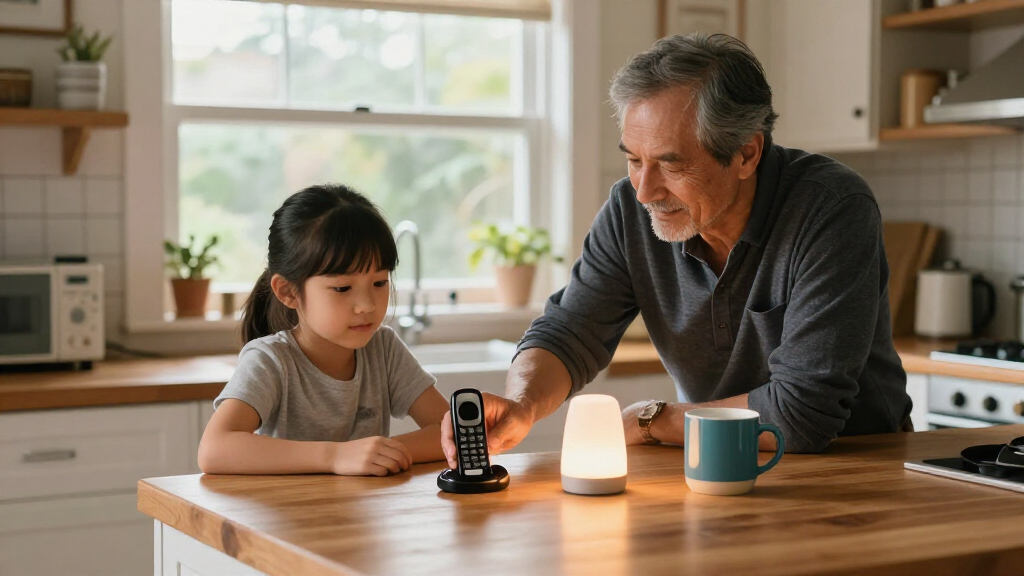

This checklist is for caregivers and families making a home easier to navigate for someone living with dementia. It covers practical daily routines, home safety, and independence, while recognizing that the right choices depend on the person, their living space, and the support available.

Get comfort and care essentials delivered free — and shop member deals
- Fast, free delivery on millions of items
- Access to Prime Big Deal Days deals on October 6–7
- Prime Video, Amazon Music and more included
Each section focuses on one product category or a simple organizing aid. The recommendations include a large-display digital clock, medication dispenser, stove knob covers, door sensor, adaptive dinnerware, and picture labels. These items serve different needs, so consider them individually rather than treating the list as a one-size-fits-all setup.
Use the checklist as a starting point: identify a specific challenge, check that a product fits the person’s abilities and home, and involve them in the decision where possible. For devices affecting medication or household safety, confirm how they work and whether someone can monitor, maintain, and respond to them.
Large-Display Digital Clock
A clock that clearly shows the time, day, and date can help make daily routines easier to follow. This pick, the Soobest 12” Dementia Clocks for Seniors Extra Large Digital Date Day C, is listed as a large-display digital clock. Before choosing it, think about where it will be placed and whether the person can comfortably see the display from their usual chair, bed, or kitchen table.
A common mistake is focusing on a large screen without checking whether its information is easy for the intended user to interpret. Consider the person’s eyesight, lighting conditions, preferred viewing angle, and comfort with digital displays. Check the product’s instructions for its power needs, setup, and how the date and day are presented. If the person finds extra information distracting, compare the display with their needs rather than assuming more information is always better.
Place the clock somewhere consistent and visible, then observe whether it supports the person’s routine. Keep any setup instructions and check whether settings need attention after a power interruption. The best choice is one that suits the person’s vision, habits, and familiar surroundings, not just the size stated in the product name.
What to look for:
- A display that is readable from the intended viewing distance
- Clear presentation of the time, day, and date
- A viewing angle suited to the planned location
- Power and setup instructions that a caregiver can manage
- A display layout that feels understandable rather than distracting
Soobest 12” Dementia Clocks for Seniors Extra Large Digital Date Day Clock
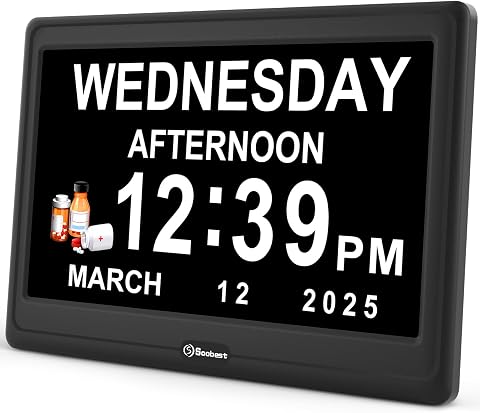
This large 12-inch HD digital clock is designed for seniors, offering versatile display modes including time, date, and day of the week, with adjustable brightness and auto-dimming features. It supports up to 20 alarms, multiple languages, and seasonal time adjustments, making it a helpful tool for daily reminders and routine management.
Pros:
- Large HD display with multiple viewing modes for easy readability
- Supports up to 20 alarms with flexible scheduling
- Auto dimming and adjustable brightness protect eyes and enhance visibility
- Multiple language options and seasonal time adjustments for convenience
Cons:
- Requires power outlet and batteries for full functionality
- Some users may find the numerous features complex to set up initially
- Batteries not included for memory backup
Best for: Someone who benefits from a prominent time-and-date display
Not ideal for: Someone who finds digital information confusing or visually distracting
Bottom line: Check visibility and display clarity in the intended room before making this clock part of the daily routine.
Automatic Pill Dispenser
Medication routines can involve multiple steps, so an automatic dispenser may be worth considering when organizing doses is a challenge. The listed pick is the 42-Day Automatic Pill Dispenser with App Control, LCD Display, Digital. Its name indicates an app-controlled, LCD-display dispenser, but caregivers should review the instructions to understand its functions, setup, and any monitoring requirements before relying on it.
Do not assume that a dispenser will independently confirm a dose was taken or resolve every medication-management concern. Check how medication is loaded, how the device signals the next step, what happens if a dose is missed, and whether the app can be managed by the caregiver. Consider the person’s ability to interact with the controls and alerts. Ask a pharmacist or clinician whether the device is suitable for the person’s medication routine, especially if doses require special handling.
Match the device to the actual prescription schedule and the household’s caregiving plan. Confirm that the person or caregiver can use it consistently, and decide who will refill it and respond to any alerts. An automatic dispenser should support—not replace—an agreed plan for medication oversight and follow-up.
What to look for:
- Instructions for loading and organizing the prescribed medication
- Controls and alerts the intended user or caregiver can understand
- Clear information about app setup and caregiver access
- Guidance for missed doses, errors, or device interruptions
- Compatibility with the medication routine confirmed with a pharmacist or clinician
42-Day Automatic Pill Dispenser with App Control, LCD Display, Digital Lock, and

This automatic pill dispenser has three trays with 14 dose slots each, for up to 42 days of once-daily medication. Users can set schedules on the device with voice guidance or through the app, which also tracks doses and sends missed-dose alerts.
Pros:
- Offers both on-device and remote app setup
- Tracks dosage history and can alert caregivers to missed doses
- Multiple alert options and a digital lock
- Sealed storage includes a desiccant pack
Cons:
- Listing’s stated supply durations are inconsistent: twice- and three-times-daily use are both listed as 14 days
- Not intended for assisted living facilities, nursing homes, or other regulated institutions
Best for: A household that can set up and monitor a digital dispenser
Not ideal for: Someone whose medication plan requires handling the device cannot support
Bottom line: Confirm the dispenser’s operation with the medication plan and assign a caregiver to manage setup and follow-up.
Stove Safety Shut-Off Device
Stove-related concerns deserve careful attention because a product that covers a knob is not necessarily a device that shuts off the appliance. The listed pick, Stove Knob Safety Covers – 5 Pack Heat Resistant, is described as heat-resistant knob covers. Its name does not establish that it detects danger or automatically turns off a stove, so caregivers should verify its purpose and limitations before treating it as a safety measure.
Check that the covers fit the specific stove knobs and can be installed and removed as intended. Stove designs vary, and a cover that does not fit securely may not serve its intended role. Review the manufacturer’s instructions for installation, access, and heat-related guidance. A common mistake is relying on a cover alone without considering the person’s cooking habits, the stove type, and whether supervision or another safety plan is needed.
Before using the covers, consider whether they could interfere with safe access for another household member or complicate ordinary cooking. If the concern is unattended cooking, ask an appropriate home-safety professional or clinician about options suited to the appliance and household. Treat these covers as one possible part of a broader stove-safety plan, not as proof that the stove will shut off automatically.
What to look for:
- Fit with the exact stove knob shape and dimensions
- Installation and removal instructions that suit the household
- Clear product guidance on heat exposure and intended use
- A design that does not create access problems for other household members
- A separate plan for unattended cooking or stove shut-off concerns
Stove Knob Safety Covers – 5 Pack Heat Resistant

These stove knob safety covers feature a dual-button child safety lock, making it difficult for children to open while allowing adults to operate the stove easily. Made from heat-resistant plastic, they protect your stove knobs from grease and spills, and are quick to install with strong adhesive strips.
Pros:
- Childproof dual-button safety lock
- Heat-resistant and durable material
- Easy to install and remove without residue
- Semi-transparent design for visibility
Cons:
- Only fits certain knob types with open bottoms
- Adhesive may not hold well on textured surfaces
- Not suitable for sealed or non-flat knobs
Best for: Households seeking covers that fit their stove’s knobs
Not ideal for: Anyone expecting the covers alone to automatically shut off a stove
Bottom line: Verify fit and intended function, and pair knob covers with a broader plan for cooking safety.
Door Alarm Sensor
A door sensor can be part of a caregiver’s plan for noticing when a door opens, but its usefulness depends on the device setup and who receives and responds to an alert. The listed pick is the YoLink LoRa Smart Door Sensor Starter Kit. Check the starter-kit instructions to understand what components are included, how the system is configured, and what additional equipment or setup may be needed for the intended use.
Before choosing a sensor, consider which door needs attention, where the sensor can be installed, and whether the person might notice or remove it. Review the alert method, connectivity requirements, and what happens if a phone, network, or other system component is unavailable. Do not assume that a notification guarantees someone will see it promptly. Decide in advance who is responsible for monitoring alerts and what they should do if a door opens.
Test the setup in the actual home and confirm that alerts reach the intended caregiver. Also consider privacy, household routines, and whether the sensor could cause unnecessary disruption. A sensor can support awareness, but it does not physically prevent someone from leaving or replace direct supervision when needed. Build it into a clear response and communication plan rather than relying on the device by itself.
What to look for:
- A clear list of what the starter kit includes
- Installation guidance for the chosen door and frame
- Connectivity and alert requirements that suit the home
- A reliable plan for who receives and responds to notifications
- A backup approach for connectivity or device interruptions
YoLink LoRa Smart Door Sensor Starter Kit

The YoLink LoRa Smart Door Sensor Starter Kit includes one hub and four sensors with up to 5 years of battery life. It offers long-range open-air connectivity, customizable alerts, and device pairing for comprehensive home security and automation.
Pros:
- Long-range connectivity up to 1/4 mile
- Extended battery life of up to 5 years
- Easy installation with QR code and mounting tape
- Supports device pairing for offline operation
Cons:
- Requires a YoLink Hub for full functionality
- Limited to 2.4 GHz WiFi for setup
- May be complex for non-technical users
Best for: Caregivers who can monitor and respond to door alerts
Not ideal for: Households expecting a sensor to prevent someone from leaving
Bottom line: Test the alert path and assign a responder before depending on this sensor for awareness.
Adaptive Dinnerware Set
Eating tools should match the person’s abilities and the way they prefer to prepare food. The listed pick is the Adaptive One-Handed Cutting Board Set with Ulu Knife. Its name describes a one-handed cutting board set with a Ulu knife, making it a product to examine when one-handed food preparation is a relevant need.
Do not assume that a tool labeled adaptive will work for every person or kitchen. Consider hand strength, coordination, vision, grip comfort, and whether the person can use the knife safely. Check the product’s instructions, dimensions, cleaning guidance, and the way the board is intended to stay in place. Where possible, have the person try the setup with supervision and choose foods and tasks that match their current abilities. Consult an occupational therapist or another qualified professional for individualized advice if safety or function is uncertain.
Think about where the set will be stored and whether it can be used on the household’s usual work surface. A tool that is hard to clean, position, or retrieve may not become part of the routine. The goal is to support participation without creating pressure to use a method that feels uncomfortable. Prioritize safe handling, fit, and user preference over the product category alone.
What to look for:
- Board dimensions suited to the available counter space
- Instructions for stabilizing and using the board
- A knife grip and cutting method the person can manage safely
- Cleaning guidance that fits the household routine
- A supervised trial with familiar food-preparation tasks
Adaptive One-Handed Cutting Board Set with Ulu Knife

This bamboo cutting board set is designed to help with one-handed food preparation. Suction cups stabilize the board on smooth surfaces, while 10 stainless steel spikes and a raised back edge help hold food in place.
Pros:
- Suction cups help keep the board stable on smooth surfaces
- Spikes and a raised edge help secure food while cutting
- Curved rocker knife supports one-handed chopping
- Detachable knife base makes storage easier
Cons:
- Suction cups are intended for smooth surfaces
- Board size measurements are approximate
Best for: Someone who wants to explore one-handed food preparation
Not ideal for: Someone who cannot use the knife or board safely
Bottom line: Check comfort and safe handling with a supervised trial before making this set part of meal preparation.
Picture Label Stickers
Picture labels can make everyday items easier to identify when words alone are not the most helpful cue. Since no specific product is listed for this slot, choose labels based on the person’s vision, reading ability, familiar vocabulary, and comfort with pictures. The most useful labels are often those that provide simple, recognizable cues for items the person uses regularly.
A common mistake is labeling too many things at once or using images the person does not recognize. Start with a small number of frequently used cupboards, drawers, or personal items. Match pictures to the actual contents, keep labels at an easy-to-see height, and use consistent wording where words are helpful. Consider contrast, print size, and whether a photograph or a simple illustration is more familiar to the person.
Ask the person what makes sense to them and observe whether the labels help without creating clutter. Replace labels when storage changes, and avoid placing cues where they could cause confusion about items that look alike. Labels are an organizing aid, not a substitute for support when someone needs help. A small, consistent set tailored to the person is a better starting point than a whole-home labeling project.
What to look for:
- Images or photos the person readily recognizes
- Large, clear labels with useful contrast
- Consistent wording and picture style
- Placement near the items the person needs to find
- A small starting set that can be adjusted based on the person’s response
If you are choosing what to address first, start with the most immediate everyday concern and the smallest practical change that could help. Compare options only after identifying the specific need, then check fit, setup, and who will maintain or monitor the item. For medication and household safety, seek professional guidance when the product’s role or limitations are unclear.
There is no single checklist that suits every person or home. Try one change at a time, notice what feels useful to the person, and revise the setup as needs and routines change. A thoughtful, person-centered approach can make home supports more understandable and easier for caregivers to manage.
Fall Picks
fall essentials
As an affiliate, we earn on qualifying purchases.