
For families seeking door alarms for Alzheimer’s or other forms of dementia, my best overall pick is the Caregiver Pager Door Alarms for Dementia Patients, because its three sensors and two receivers can cover multiple exits and alert caregivers in separate rooms. The Heath Zenith Wireless Entry Alert Chime Kit is a simpler choice for a local audible alert, while the Daytech Wi-Fi Door Sensor Alarm suits caregivers who want phone notifications and ringtone choices. The main tradeoff is between straightforward alerts that work locally and connected systems that can notify someone away from the receiver. Keep reading for the full breakdown, including where each design may fall short for a person living with dementia.

Get comfort and care essentials delivered free — and shop member deals
- Fast, free delivery on millions of items
- Access to Prime Big Deal Days deals on October 6–7
- Prime Video, Amazon Music and more included
Complete the kit


Key Takeaways
- Multi-door coverage sets the lead pick apart: The Caregiver Pager bundle includes three sensors and two receivers, a more caregiver-oriented arrangement than single-area chimes.
- Local alerts and phone alerts serve different routines: Heath Zenith and several SanJie chimes focus on audible in-home notifications, while Daytech and other Wi-Fi models add app-based alerts.
- Door identification can reduce caregiver guesswork: SanJie’s door-identification chime is distinctive for homes where knowing which entrance opened matters as much as hearing a sound.
- Simple stick-on alarms trade flexibility for immediacy: The five-pack Window & Door Alarm and Sanjie 125dB sensors can suit basic door coverage, but they do not offer the same caregiver-focused notification approach as pager or app systems.
- Range, sound choices, and sensor count are not interchangeable: Long-range chimes, multi-sensor kits, and adjustable alarm volume solve different problems; the right choice depends on the home’s layout and who needs to receive the alert.
| Window & Door Alarm 5-Pack for Kids Safety and Home Security, White |  | Best for Simple, Loud Coverage | Unit count: 5 alarms | Alert type: Entry control | Sensor technology: Contact | VIEW ON AMAZON | See Our Full Breakdown |
| Heath Zenith SL-7368-02 Wireless Entry Alert Chime Kit |  | Best for a Basic Receiver Chime | Model: SL-7368-02 | Sensor technology: Contact sensor | Maximum range: 100 feet | VIEW ON AMAZON | See Our Full Breakdown |
| Caregiver Pager Door Alarms for Dementia Patients and Home Security, Wireless Door Sensor System (Three Sensors, Two Receivers) |  | Best Overall for Multi-Exit Caregiver Alerts | Included components: Three sensors and two receivers | Detection range: 260 feet | Sensor type: Magnetic door/window sensors | VIEW ON AMAZON | See Our Full Breakdown |
| Daytech Wi-Fi Door Sensor Alarm with Phone Notifications and 20 Ringtones |  | Best for Remote Phone Notifications | Connectivity: 2.4GHz Wi-Fi | Package contents: Two sensors and one chime | Alarm volume: Up to 110 dB | VIEW ON AMAZON | See Our Full Breakdown |
| SanJie Wireless Door Chime with Door Identification |  | Best for Identifying Which Door Opened | Maximum range: 600 feet open area; 100 feet indoors | Volume levels: 5, up to 110 dB | Tones: 40 | VIEW ON AMAZON | See Our Full Breakdown |
| PILSAMAS Wi-Fi Smart Door and Window Alarms for Dementia Wandering Seniors |  | Best for Multi-Entry App Monitoring | Included components: Receiver, four sensors, and remote | Sensor technology: Contact sensor | Maximum range: 328 feet | VIEW ON AMAZON | See Our Full Breakdown |
| SanJie 2-in-1 Door Chime and Alarm System with IP55 Waterproof Sensor |  | Best for Outdoor or Exposed Entries | Sensor technology: Contact sensor | Sensor protection: IP55 waterproof | Wireless range: 800 feet | VIEW ON AMAZON | See Our Full Breakdown |
| SanJie Wireless Door Chime Alarm System (2 Sensors + 1 Receiver) |  | Best for Two-Entry Coverage | Included components: Two sensors and one receiver | Sensor technology: Contact/magnetic | Maximum range: 500 feet | VIEW ON AMAZON | See Our Full Breakdown |
| SanJie WiFi Door Chime and Alarm Sensor with App Notifications |  | Best for Customizable Entry Delays | Connectivity: 2.4GHz Wi-Fi; 5GHz not supported | Power: One AAA battery, included | Listed battery life: Up to two years at 40 openings per day | VIEW ON AMAZON | See Our Full Breakdown |
| Door Chimes When Door Opens with 800 FT Range, 40 Chimes & 5 Volumes |  | Best for Long-Range Local Alerts | Wireless range: 800 feet | Chimes: 40 | Volume: Five levels, 0–110dB | VIEW ON AMAZON | See Our Full Breakdown |
| Sanjie Door Window Alarm Sensors, 5 Pack, 125dB, Volume Control |  | Best for Multiple Exit Points | Sensor count: 5 | Alarm volume: 125 dB | Sensor type: Contact sensor | VIEW ON AMAZON | See Our Full Breakdown |
| Wireless Door Chime System with 2 Sensors and 1 Receiver |  | Best for Flexible, Lower-Intensity Alerts | Components: 2 sensors and 1 receiver | Chime melodies: 58 | Volume levels: 5, from 0 to 110 dB | VIEW ON AMAZON | See Our Full Breakdown |
| door alarms for alzheimer | Mounting |
|---|---|
| Window & Door Alarm 5-Pack for | — |
| Heath Zenith SL-7368-02 Wirele | — |
| Caregiver Pager Door Alarms fo | — |
| Daytech Wi-Fi Door Sensor Alar | Door/window mount with 3M tape |
| SanJie Wireless Door Chime wit | Adhesive sensor or tabletop receiver |
| PILSAMAS Wi-Fi Smart Door and | Door and window mount |
| SanJie 2-in-1 Door Chime and A | Adhesive or screws |
| SanJie Wireless Door Chime Ala | Double-sided adhesive tape |
| SanJie WiFi Door Chime and Ala | Adhesive tape |
| Door Chimes When Door Opens wi | Door mount with adhesive strips or screws |
| Sanjie Door Window Alarm Senso | Door/window mount with double-sided tape |
| Wireless Door Chime System wit | — |
More Details on Our Top Picks
Window & Door Alarm 5-Pack for Kids Safety and Home Security, White
For households that want a direct, local warning at several exits, this five-sensor pack offers broader basic coverage than the single-sensor Heath Zenith SL-7368-02. Each alarm sounds at 120 dB when its contact separates, which can alert someone at home without relying on a phone or Wi-Fi. That simplicity may suit caregivers who need an immediate cue when a door or window opens. The tradeoff is that every sensor sounds locally: there is no remote receiver or phone notification, so the caregiver needs to be close enough to hear it. I’d choose this for dementia safety only when a loud sound is an appropriate alert and the person will not be distressed by it. Batteries are not included, and the volume cannot be tailored.
Pros:- Five alarms allow coverage across several doors and windows
- 120 dB alert sounds when a sensor opens
- Wireless, adhesive installation avoids wiring
- Low-battery indicator helps flag maintenance needs
Cons:- Two AAA batteries per alarm are not included
- No remote control, receiver, or phone notifications
- Loudness cannot be adjusted beyond the listed 90/120 dB settings
Best for: Caregivers who want straightforward, loud alerts on several doors or windows and can hear the alarms from nearby rooms
Not ideal for: Caregivers who need quiet monitoring, remote alerts, or a receiver that reports activity from across the home
- Unit count:5 alarms
- Alert type:Entry control
- Sensor technology:Contact
- Audible noise:120 dB
- Power source:2 AAA batteries per alarm; not included
- Dimensions:4.18 x 1.2 x 0.6 inches
- Weight:0.27 kg
Our verdict“Choose this pack for multiple nearby exits when a very loud local alert is preferable to app-based or receiver-based monitoring.”
Heath Zenith SL-7368-02 Wireless Entry Alert Chime Kit
The Heath Zenith SL-7368-02 is the simplest receiver-based option here: a magnetic contact sensor triggers a plug-in chime, giving a caregiver an alert away from the door rather than a siren mounted at the exit. Its 100-foot stated range can suit a modest home, and installation needs no wiring. Compared with the Caregiver Pager Door Alarms system, though, this kit is much more limited: it includes just one sensor and does not offer multiple melodies, adjustable volume, or expansion details. That makes it easier to keep straightforward, but less useful when several exits need monitoring. I’d use it as a basic door-opening cue, not as a complete wandering-safety plan; it has no stated phone alerts or advanced monitoring features.
Pros:- Plug-in chime receiver gives an alert away from the sensor
- Wireless installation requires no wiring
- Stated transmission range is up to 100 feet
- One C battery is included
Cons:- Kit includes only one sensor
- Basic chime functionality lacks listed volume or melody customization
- Caregivers must be within chime range to hear the alert
Best for: Caregivers monitoring one frequently used door who want a simple receiver chime in a nearby room
Not ideal for: Households that need several monitored exits, customizable alerts, or phone notifications for a caregiver away from home
- Model:SL-7368-02
- Sensor technology:Contact sensor
- Maximum range:100 feet
- Power source:Battery powered; one C battery included
- Voltage:12 V DC
- Mounting type:Door mount
- Warranty:1 year
Our verdict“Pick this kit for a single door and a nearby caregiver who wants a basic receiver chime rather than multi-sensor or app-based monitoring.”
Caregiver Pager Door Alarms for Dementia Patients and Home Security, Wireless Door Sensor System (Three Sensors, Two Receivers)
This is the strongest fit in this group for a caregiver who needs to monitor several exits from more than one room. The package pairs three sensors with two receivers, and its stated 260-foot range exceeds the Heath Zenith SL-7368-02’s 100-foot range. Five volume levels, multiple melodies, and LED indicators give caregivers more ways to make an alert noticeable, including for someone with hearing difficulty. The system also supports expansion up to 20 sensors per receiver, making it more adaptable than a fixed one-sensor chime. Its limits matter: receivers need standard outlets, sensors rely on magnetic contact, and incorrect placement can cause false alerts. I’d rank it first for in-home dementia monitoring among these five, while treating it as an alert aid rather than a substitute for supervision.
Pros:- Three sensors and two receivers cover multiple exits and listening areas
- Stated detection range reaches 260 feet
- Five volume levels and multiple melodies allow alert customization
- Expandable to up to 20 sensors per receiver
Cons:- Receivers require standard electrical outlets
- Magnetic sensors may not suit every door type or placement
- Poor sensor alignment can trigger false alarms
Best for: Families caring for a person with dementia who need alerts from several doors and want receivers in multiple rooms
Not ideal for: Caregivers who need smartphone notifications, battery-powered receivers, or sensors for doors that cannot use magnetic contacts
- Included components:Three sensors and two receivers
- Detection range:260 feet
- Sensor type:Magnetic door/window sensors
- Number of melodies:58
- Volume levels:5
- Expansion:Up to 20 sensors per receiver
- Receiver power:Plugs into a standard outlet
Our verdict“For dementia caregivers monitoring several exits inside the home, this is my leading pick when outlet-powered receivers and magnetic sensors suit the layout.”
Daytech Wi-Fi Door Sensor Alarm with Phone Notifications and 20 Ringtones
When a caregiver cannot stay within hearing distance of a chime, the Daytech’s app notifications add a remote alert that the Heath Zenith SL-7368-02 does not provide. It also pairs local chimes with an adjustable alarm up to 110 dB, so the household can choose a sound level rather than rely on a fixed, very loud siren. The delay mode may help reduce alerts from brief openings, while device sharing lets multiple caregivers receive notifications. The kit includes two sensors and a chime, but depends on 2.4GHz Wi-Fi and is not recommended for metal doors. Phone call and SMS alerts require a paid subscription, so I would not choose it if those are the required notification method. For dementia care, its remote reach is useful, but it still depends on a working network and phone access.
Pros:- Sends app notifications alongside local chimes
- Two sensors and one chime are included
- Five adjustable volume levels range from silent to 110 dB
- Delay mode can help avoid alerts from brief door openings
Cons:- Works only with 2.4GHz Wi-Fi
- Phone call and SMS alerts require a paid subscription
- Not recommended for metal doors
Best for: Caregivers who want app alerts about two monitored doors or windows when they may be elsewhere in the home or away
Not ideal for: Households without reliable 2.4GHz Wi-Fi, people with metal doors, or caregivers who require calls or texts without a subscription
- Connectivity:2.4GHz Wi-Fi
- Package contents:Two sensors and one chime
- Alarm volume:Up to 110 dB
- Volume levels:5 adjustable levels
- Ringtones:20 options
- Power source:One AAA battery
- Battery life:Up to 2 years
- Mounting:Door/window mount with 3M tape
Our verdict“Choose Daytech over a basic receiver chime when remote app notifications matter and the home has compatible Wi-Fi and doors.”
SanJie Wireless Door Chime with Door Identification
For a caregiver watching more than one entrance, the SanJie receiver’s numbered door identification answers a useful question that the three-sensor Caregiver Pager system does not specify: which sensor triggered. It supports up to 14 sensors per receiver, with 40 tones and five volume levels, so a larger setup can distinguish entrances and tailor the sound. Its stated range reaches 600 feet in open areas, but the indoor figure is only 100 feet; that makes placement in a real home more relevant than the headline range. Unlike Daytech, it does not list phone notifications, so the caregiver must be close enough to hear or see the receiver. It also is not suitable for metal doors. I’d choose it when identifying an exit matters more than remote alerts.
Pros:- Numbered display identifies which sensor or door opened
- Receiver supports up to 14 sensors
- Five volume levels and 40 tones offer alert choices
- Sensor battery life is listed as up to 2 years
Cons:- Not suitable for metal doors
- Indoor range is listed at 100 feet, far below the open-area figure
- No phone notification feature is listed
Best for: Caregivers monitoring multiple non-metal doors who need the receiver to identify which entrance opened
Not ideal for: People who need app alerts, have metal doors, or need dependable long-range coverage through indoor walls
- Maximum range:600 feet open area; 100 feet indoors
- Volume levels:5, up to 110 dB
- Tones:40
- Sensor capacity:Up to 14 sensors per receiver
- Receiver capacity:Up to 20 receivers per sensor
- Power source:AC receiver; CR2450 sensor battery
- Sensor battery life:Up to 2 years
- Mounting:Adhesive sensor or tabletop receiver
Our verdict“Select SanJie when knowing which of several doors opened is the priority and a caregiver can remain within receiver range.”
PILSAMAS Wi-Fi Smart Door and Window Alarms for Dementia Wandering Seniors
For caregivers who need alerts from several exits, the PILSAMAS Wi-Fi system pairs four contact sensors with a receiver and remote, while its app adds activity history that can help track door and window openings. Its 328-foot range and local chime give it both at-home and remote-monitoring functions, without cameras or audio—an advantage for privacy when supporting a person with dementia. Compared with the SanJie WiFi Door Chime and Alarm Sensor, PILSAMAS includes more sensors in the box and emphasizes history logs; SanJie instead offers customizable delay modes and a stated battery-life estimate for one sensor. The tradeoff is a 2.4GHz Wi-Fi requirement and four AAA batteries for the sensors. I’d choose it for multiple monitored openings, but not if the household needs a simpler, Wi-Fi-free setup.
Pros:- Four sensors support monitoring multiple entry points from one kit.
- App alerts and history logs offer remote visibility into activity.
- Local chimes provide an alert inside the home.
- No camera or audio supports a more private monitoring setup.
Cons:- Requires 2.4GHz Wi-Fi; 5GHz networks are not supported.
- The sensors require four AAA batteries.
- App-based setup and connectivity add complexity compared with a standalone chime.
Best for: Caregivers monitoring several doors or windows who want app alerts and activity history while preserving privacy.
Not ideal for: Households using only 5GHz Wi-Fi, or caregivers who want a basic chime without app setup and sensor batteries.
- Included components:Receiver, four sensors, and remote
- Sensor technology:Contact sensor
- Maximum range:328 feet
- Connectivity:Wi-Fi
- Battery requirement:Four AAA batteries, included
- Mounting:Door and window mount
- Item dimensions:3.3 x 1 x 3.3 inches
- Color:White
Our verdict“Choose PILSAMAS if dementia care calls for app-based monitoring and history across several openings, and your home has 2.4GHz Wi-Fi.”
SanJie 2-in-1 Door Chime and Alarm System with IP55 Waterproof Sensor
The IP55 waterproof sensor makes this SanJie a practical fit for an entry exposed to rain or moisture, such as a covered exterior door. Its Chime, Alarm, and Mute modes let caregivers choose between a less startling notification and a louder warning, with volume reaching 110dB. Compared with the SanJie Wireless Door Chime Alarm System, this model has a longer stated range—800 feet versus 500—and a sensor described as suitable for indoor and outdoor use. It has only one sensor listed, though, while the other SanJie kit includes two, which may matter when monitoring several exits used by a person with dementia. Installation can use adhesive or screws, but the sensor needs precise alignment within 1.18 inches, and metal doors or frames may interfere. I’d favor it for a single damp or distant entry, not for multi-door coverage.
Pros:- IP55-rated sensor is suited to indoor and outdoor use.
- Three modes allow a choice between chime, alarm, and mute.
- Stated 800-foot wireless range can suit larger properties.
- Mounts with adhesive or screws, offering a no-drill option.
Cons:- Only one sensor is listed, limiting out-of-box coverage.
- Sensor and magnet alignment must be precise, within 1.18 inches.
- Metal doors or frames may cause interference.
Best for: Caregivers who need to monitor one exposed or distant entry and want selectable chime, alarm, and mute modes.
Not ideal for: Families monitoring several exits at once, or homes with metal doors or frames that may interfere with the sensor.
- Sensor technology:Contact sensor
- Sensor protection:IP55 waterproof
- Wireless range:800 feet
- Modes:Chime, Alarm, and Mute
- Chime selection:30 chimes
- Volume:Five levels, up to 110dB
- Battery type:AAA
- Mounting:Adhesive or screws
Our verdict“Pick this SanJie for a single exposed entry where weather resistance and a long wireless range matter more than multi-door coverage.”
SanJie Wireless Door Chime Alarm System (2 Sensors + 1 Receiver)
For a caregiver who wants alerts from two separate openings without configuring an app, this kit includes two magnetic sensors and one receiver. The receiver plays one of 26 tones, and each sensor can use a distinct ringtone, making it easier to identify which door or window opened—a useful distinction when a person with dementia has access to more than one route outside. Compared with the PILSAMAS Wi-Fi system, SanJie skips app alerts and activity logs but avoids dependence on Wi-Fi; compared with the single-sensor SanJie IP55 model, it offers broader coverage straight from the box. Its 500-foot range is shorter than either of those systems’ stated ranges. The receiver also needs a standard AC outlet, and adhesive mounting may not hold on every surface. This is the more straightforward choice for two nearby entry points, not remote caregiver monitoring.
Pros:- Two sensors support monitoring two entry points from the start.
- Distinct ringtones can help identify which opening triggered an alert.
- Tool-free adhesive installation avoids drilling.
- Receiver plugs into AC power, so it does not rely on receiver batteries.
Cons:- The receiver must be placed near a standard AC outlet.
- Adhesive may not suit every surface.
- No app alerts or activity history are listed.
Best for: Caregivers who want to distinguish two monitored doors or windows with local alerts and no Wi-Fi setup.
Not ideal for: Families who need phone notifications, activity history, flexible receiver placement, or coverage beyond the stated 500-foot range.
- Included components:Two sensors and one receiver
- Sensor technology:Contact/magnetic
- Maximum range:500 feet
- Chime tones:26
- Volume:Five adjustable levels, up to 110dB
- Receiver power:120V AC
- Sensor battery:12V battery, included
- Mounting:Double-sided adhesive tape
Our verdict“Choose this kit for simple, local alerts from two entry points when identifying the specific opening matters more than app access.”
SanJie WiFi Door Chime and Alarm Sensor with App Notifications
The standout here is the customizable delay mode: it can help reduce alerts during normal entry and exit, while the app and indoor chime still notify caregivers when the sensor detects an opening. That balance may suit dementia care households where a door is used often but an unexpected opening needs attention. Unlike the PILSAMAS Wi-Fi system, this SanJie lists a delay feature and an estimated battery life of up to two years based on 40 openings per day; PILSAMAS instead includes four sensors and history logs. This SanJie includes one sensor, so it is better suited to a single monitored door than a multi-exit setup. It also requires 2.4GHz Wi-Fi, and phone call or text alerts need a paid subscription. I’d favor it when delay settings matter, but not when several exits need coverage from one kit.
Pros:- App notifications and an indoor chime provide remote and local alerts.
- Customizable delay modes can reduce interruptions during routine entry and exit.
- Adhesive installation requires no drilling or wiring.
- Battery life is listed as up to two years based on 40 openings per day.
Cons:- Supports 2.4GHz Wi-Fi only, not 5GHz.
- Phone call and text message alerts require a paid subscription.
- One sensor limits out-of-box monitoring to a single opening.
Best for: Caregivers monitoring one frequently used door who want app alerts, a local chime, and a way to reduce routine-entry alerts.
Not ideal for: Households needing multiple sensors, 5GHz Wi-Fi compatibility, or phone and text alerts without a paid subscription.
- Connectivity:2.4GHz Wi-Fi; 5GHz not supported
- Power:One AAA battery, included
- Listed battery life:Up to two years at 40 openings per day
- Alarm volume:Up to 110dB
- Chime options:20 chimes and five volume levels
- Mounting:Adhesive tape
- Sensor type:Contact sensor
- Control method:Mobile app
Our verdict“Choose this SanJie for one frequently used door when app access and adjustable delay behavior are more useful than multi-sensor coverage.”
Door Chimes When Door Opens with 800 FT Range, 40 Chimes & 5 Volumes
For a large home or property where caregivers need to hear a door alert from far away, this model offers an 800-foot stated range and five volume levels, including a silent mode. Its 40 chime choices provide more sound options than the SanJie two-sensor kit, which lists 26 tones and a 500-foot range, but this product’s description does not specify how many sensors are included. That makes it harder to judge its value for monitoring multiple exits used by a person with dementia. It also has no listed app alerts or activity history, unlike the PILSAMAS and app-enabled SanJie systems. The portable, battery-powered unit can mount with adhesive strips or screws, though it depends on a CR123A battery rather than a wired power option. I’d choose it for a long-range local alert, not remote caregiver updates.
Pros:- Stated 800-foot range suits larger properties.
- Five volume levels include a silent mode.
- Forty chime choices allow sound customization.
- Adhesive strips or screws give mounting options.
Cons:- The product data does not specify the number of included sensors.
- Battery-powered operation requires eventual CR123A replacement.
- No app notifications or activity logs are listed.
Best for: Caregivers who need a loud or silent local door alert across a large property and do not need phone notifications.
Not ideal for: Families seeking app alerts, event history, or clearly specified multi-sensor coverage for several exits.
- Wireless range:800 feet
- Chimes:40
- Volume:Five levels, 0–110dB
- Power:One CR123A battery, included
- Mounting:Door mount with adhesive strips or screws
- Dimensions:3.1 x 3.1 x 3.1 inches
- Weight:4.2 ounces
- Color:White
Our verdict“Pick this model for customizable local alerts over a long range, but choose a documented multi-sensor or app-connected system for broader dementia-care monitoring.”
Sanjie Door Window Alarm Sensors, 5 Pack, 125dB, Volume Control
For households monitoring several doors or windows, this five-sensor set covers more locations than the two-sensor Wireless Door Chime System with 2 Sensors and 1 Receiver. Its 125dB alarm is designed to make an opening hard to miss, which may suit caregivers who need a direct audible alert when a dementia patient approaches an exit. Tape mounting also avoids drilling and keeps setup simple. The tradeoff is that these sensors emphasize a loud local alarm rather than a receiver-based chime with a visual indicator, so they may be less suitable if alerts need to be heard from another room or kept quiet. The set uses 15 included 12V batteries, creating more battery upkeep across the five units, and indoor use is recommended.
Pros:- Five sensors can cover several potential exit points
- 125dB alarm provides a strong audible warning
- Double-sided tape supports quick, drill-free installation
- Adjustable volume offers some control over alert intensity
Cons:- The five sensors require 15 batteries, adding ongoing replacement work
- No separate receiver or visual alert is specified
- Recommended for indoor use, limiting placement options
Best for: Caregivers who want loud alerts on several indoor doors, windows, or cabinets and can check battery status regularly
Not ideal for: Households that need a quiet visual alert, a separate receiver, or outdoor monitoring
- Sensor count:5
- Alarm volume:125 dB
- Sensor type:Contact sensor
- Power:Battery powered; 15 included 12V alkaline batteries
- Mounting:Door/window mount with double-sided tape
- Maximum range:300 meters
- Dimensions:3 × 2 × 3 inches
Our verdict“Choose this set if a caregiver needs loud alerts at multiple indoor openings; choose the Wireless Door Chime System instead if a receiver and visual indicator matter more.”
Wireless Door Chime System with 2 Sensors and 1 Receiver
This system suits caregivers who want a receiver-based alert instead of relying only on a sensor-mounted siren. The receiver offers five volume levels up to 110 dB, 58 melodies, and an LED indicator for situations where sound is muted. Its stated 500-foot range may help cover a larger home, while the two pre-paired sensors make setup straightforward. Compared with the Sanjie five-pack, it monitors fewer openings and does not specify a 125dB alarm at each sensor; in return, it gives caregivers more control over how alerts are delivered. That flexibility can be useful for dementia care, but this is still a door-and-window chime system, not a motion detector or dedicated caregiver pager. Sensor battery details are not provided.
Pros:- Receiver provides alerts beyond the sensor location
- LED indicator can show alerts when sound is muted
- Five volume levels and 58 melodies allow alert customization
- Stated 500-foot wireless range supports use across larger spaces
Cons:- Includes only two sensors, fewer than the Sanjie five-pack
- Sensor battery type and expected life are not specified
- Monitors door and window openings rather than general movement
Best for: Caregivers who want a receiver with adjustable audible or visual alerts for one or two monitored doors or windows
Not ideal for: Families monitoring many exit points, needing motion detection, or wanting clearly specified sensor battery requirements
- Components:2 sensors and 1 receiver
- Chime melodies:58
- Volume levels:5, from 0 to 110 dB
- Wireless range:500 feet
- Visual alert:LED indicator
- Installation:3M double-sided tape or screws
- Expansion:Expandable with additional sensors
Our verdict“Pick this system if receiver placement, adjustable chimes, and a visual alert suit your caregiving routine better than the Sanjie set’s louder, multi-sensor approach.”
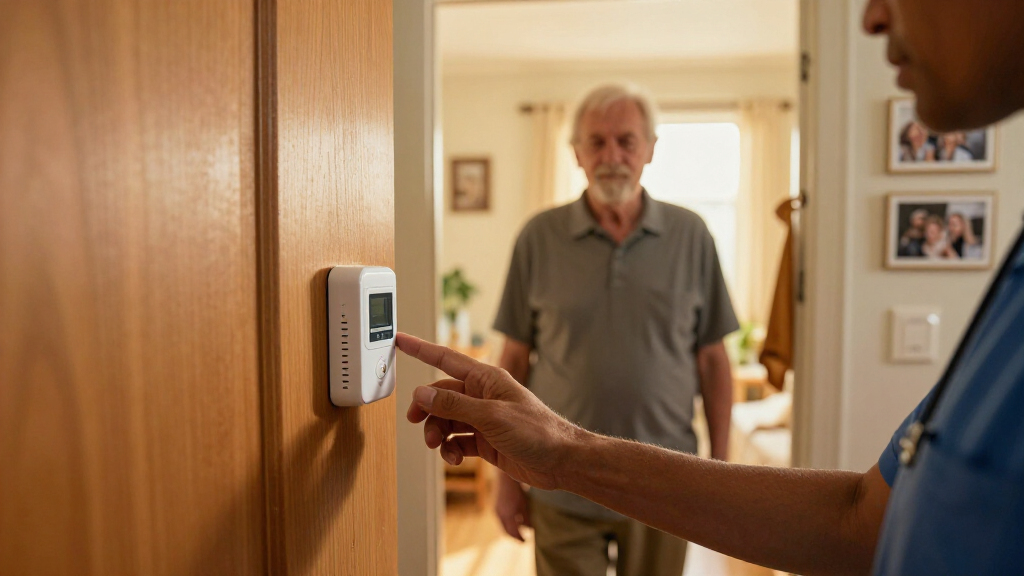
How We Picked
I ranked these door alarms by how well their stated designs match dementia-care routines: alerting a caregiver promptly, covering the doors that matter, and making the alert usable without adding unnecessary steps. Sensor and receiver counts, local chime or alarm behavior, phone notification support, door identification, range claims, sound choices, and weather protection all informed the comparison. I gave more weight to caregiver usefulness than to a high decibel figure or a long feature list on its own.
The order reflects meaningful differences in coverage and alert delivery, not a claim that any alarm can prevent wandering or replace supervision. Multi-sensor caregiver systems lead because they can cover several exits and reach caregivers around the home. Local chimes rank well for simple household awareness, while Wi-Fi models fit caregivers who need remote notifications but depend on connectivity and app setup. Basic stick-on alarms remain useful for narrow needs, yet offer fewer caregiver-specific options.
Factors to Consider When Choosing Door Alarms For Alzheimers
Choosing a door alarm for dementia care is less about selecting the loudest device and more about matching the alert to the person, the caregiver, and the home. These broader decisions can prevent a system from being ignored, missed, or difficult to maintain.
Choose who needs to receive the alert
Start by deciding whether someone is usually within hearing distance of the door. A local chime may be enough when a caregiver is at home, but it cannot alert someone who is outside or elsewhere without a receiver or phone notification. Wi-Fi alerts can extend awareness, though they depend on a working network, phone access, and suitable app settings. A pager-style setup may make more sense when caregivers move between rooms and need a dedicated receiver. Avoid buying connected features simply because they sound more advanced; they only help if someone will reliably notice and respond to them.
Map the exits before choosing sensor count
Walk through the home and identify the doors that pose the greatest risk, including less-used side or patio doors. Count the entry points that need monitoring, then check how many sensors the kit includes and whether extra sensors can be added. A bundle with several sensors can reduce gaps, but placing sensors on every door may create a stream of alerts that caregivers learn to ignore. Think about interior doors and household traffic too: routine opening and closing can make a system noisy. Begin with the exits that matter most and expand only if the alert pattern remains manageable.
Match the alert to hearing, sleep, and daily routines
A sound that is noticeable during the day may be missed through a closed bedroom door or during sleep. Adjustable volume, ringtone choice, and receiver placement can help tailor an audible alert, but louder is not automatically better for everyone in the home. A piercing alarm could startle the person with dementia or cause distress, while a gentle chime might not reach a caregiver. Consider who will hear the signal, where they spend time, and whether a visual or phone alert is needed alongside sound. If the person may become upset by alarms, prioritize discreet caregiver notification and discuss the approach with their care team.
Check the door, sensor placement, and environment
Door alarms rely on correct alignment and a stable mounting surface, so inspect the gap and frame before selecting a model. A sensor can fail to register an opening if it is installed too far from its paired magnet or is knocked out of position during routine use. For an exposed entrance, look for a stated weather-resistance rating rather than assuming an indoor sensor can handle moisture. Adhesive mounting is quick, but the surface may affect how securely a unit stays in place. Test every monitored door after installation and repeat the check after cleaning, repairs, or seasonal changes.
Decide whether remote notifications are worth the upkeep
Wi-Fi systems can help a caregiver who is not always near a receiver, but they bring setup and maintenance beyond placing a sensor. Check whether the alert depends on a particular app, a stable internet connection, account access, and phone notification permissions. A phone set to silent or an app whose notifications are disabled can defeat the purpose. Local chimes avoid some of that dependence, though they are useful only when someone is close enough to hear them. Choose the alert path that fits the caregiver’s actual routine, and decide in advance who will check connectivity and batteries.
Plan for testing, battery changes, and backup supervision
Door alarms are one layer of a safety plan, not a substitute for supervision, secure routines, or clinical advice. Ask how the device signals a low battery, how often the system should be tested, and whether a backup alert is available if the receiver or network fails. Keep spare batteries where caregivers can find them and assign responsibility for routine checks. A simple test—opening each monitored door and confirming the intended person receives the alert—can catch placement or notification problems early. Avoid assuming a newly installed alarm will continue working without periodic checks.
Frequently Asked Questions
Should I choose a local chime or a phone-notification door alarm?
Choose a local chime when a caregiver is usually at home and can hear a receiver from the rooms they use. A phone-notification model may suit caregivers who need alerts while away, but it depends on internet access, app permissions, and a phone that is available to receive the notification. Some households may benefit from using local sound as the primary alert and a connected system for added awareness. Decide based on where the caregiver will be when a door opens, not on the number of features listed. Test alerts in the actual rooms and routines where they need to work.
How many door sensors should I install for someone with dementia?
There is no fixed number; cover the exits that present a realistic concern for that person and household. Include doors that are easy to miss, such as a side entrance, but do not automatically add sensors to every door if routine activity would create constant alerts. Too many notifications can lead caregivers to tune them out. Start with the highest-priority exits, confirm alerts are received, and add coverage if the care plan or movement patterns call for it. Revisit the layout when routines or living arrangements change.
Can a door alarm stop a person with dementia from leaving?
No. A door alarm can notify a caregiver that a monitored door has opened, but it does not physically prevent someone from leaving or guarantee that an alert will be heard. Treat it as one part of a broader safety plan that may include supervision, clinician guidance, and household changes suited to the person. Choose a notification method that reaches the responsible caregiver promptly and test it regularly. If wandering risk is immediate, contact the person’s care team for advice rather than relying on an alarm alone.
Will a loud alarm be better than a chime for dementia care?
Not always. A very loud alarm may carry farther, but it could startle or distress the person, and a caregiver might find a softer sound easier to live with over repeated alerts. A chime can be more suitable when someone is nearby and can respond quickly, while a louder signal may help in a noisy or larger home. The right choice depends on hearing, room layout, time of day, and the person’s response to sound. Try the alert at a safe volume and observe whether both caregiver and resident can tolerate it.
What should I do if the Wi-Fi or phone alert stops working?
First, check the sensor battery, network connection, app permissions, and phone notification settings; any of these can interrupt alerts. Open the monitored door and confirm the expected notification arrives rather than assuming the system has reconnected. If the household relies on remote alerts, consider whether a local receiver or another backup method is needed when the internet or phone is unavailable. Assign one caregiver to perform routine checks so a silent failure is less likely to go unnoticed. Keep the alarm within a larger supervision plan, not as the only safeguard.
Conclusion
For a household monitoring several exits, I would start with the Caregiver Pager Door Alarms for Dementia Patients as best overall because its multiple sensors and receivers align closely with caregiver coverage needs. The Window & Door Alarm 5-Pack is my best value-style choice for straightforward coverage across several doors, while the Daytech Wi-Fi Door Sensor Alarm is the best premium-style fit for caregivers who want phone notifications and sound choices. For beginners who prefer a local, uncomplicated alert, the Heath Zenith Wireless Entry Alert Chime Kit is the clearest starting point. Choose SanJie Wireless Door Chime with Door Identification when identifying which entrance opened matters, or a weather-resistant SanJie 2-in-1 system for an exposed sensor location. Whichever model fits, test each alert and keep supervision and routine checks in the safety plan.
Cold & flu season Picks
humidifiers
As an affiliate, we earn on qualifying purchases.