The best indoor walkers for seniors balance steady support with enough maneuverability for hallways, doorways, and daily routines. My best overall pick is the Drive Medical Two-Button Folding Walker with Wheels for its straightforward folding frame and front wheels, while the VOCIC Z32 Narrow Indoor Rollator stands out for tighter spaces and the Medline Steel Rollator for shoppers who want a seat. The main tradeoff is between a compact, supportive frame and a rollator that moves more freely but needs room and controlled handling. Glide tips, tennis balls, wheel size, and frame width can also change how easily a walker moves across indoor floors. Read on for the full comparison and help matching each design to your home and mobility needs.

Turn quiet afternoons into listening time
- Thousands of audiobooks, podcasts and originals
- Listen on your phone, tablet or Echo — also offline
- Cancel anytime
Complete the kit


Key Takeaways
- The roundup’s strongest all-around fit is the Drive Medical Two-Button Folding Walker with Wheels: it favors stable, simple indoor movement over a built-in seat or rollator-style convenience.
- The VOCIC Z32 is the clearest choice for narrow indoor routes because its design centers on compact maneuvering and a tray, while larger rollators such as the VOCIC Z21 prioritize outdoor-capable wheels and a seat.
- Seat-equipped rollators, including the Medline Steel Rollator and HOMLAND Foldable Rollator, suit users who need rest stops, but they call for more attention to turning space and safe braking.
- Several traditional folding walkers in this lineup differ more by their contact points than by their basic frame: front wheels, ski glides, and precut tennis balls affect how they move over flooring and thresholds.
- Adjustability is a recurring strength across the HOMENURSE Z3 options and other folding frames, but fit should be checked against the user’s height, doorway clearance, and ability to control a moving walker.
| Drive Medical Two-Button Folding Walker with Wheels |  | Best for Steady, Supported Indoor Steps | Frame material: Aluminum | Weight capacity: 350 lb | Front wheel size: 5 in | VIEW LATEST PRICE | See Our Full Breakdown |
| VOCIC Z21 Rollator Walker for Seniors with Seat, 8-Inch All-Terrain Wheels, 350 lb Capacity |  | Best for Seated Breaks and Varied Surfaces | Weight: About 22 lb | Weight capacity: 350 lb | Wheel size and type: 8 in; puncture-proof | VIEW LATEST PRICE | See Our Full Breakdown |
| Soundfuse Lightweight Foldable 3-Wheel Walker for Seniors |  | Best Lightweight Rollator for Level Floors | Frame material: Aluminum | Weight: 10.2 lb | Weight capacity: 260 lb | VIEW LATEST PRICE | See Our Full Breakdown |
| Medline Steel Rollator Walker with Seat, 350 lb Capacity, Burgundy |  | Best Value Seat-and-Storage Rollator | Frame material: Steel | Weight capacity: 350 lb | Product weight: 16.5 lb | VIEW LATEST PRICE | See Our Full Breakdown |
| VOCIC Z32 Narrow Indoor Rollator Walker with Tray |  | Best for Narrow Indoor Spaces | Width: 22 in | Folded dimensions: 37 × 12 × 22 in | Weight: 14 lb | VIEW LATEST PRICE | See Our Full Breakdown |
| Lightweight Folding Standard Walker with Front Wheels and Glide Tips |  | Best for Lightweight Lifting | Frame material: Aluminum alloy | Weight: 3.3 lb | Weight capacity: 350 lb | VIEW LATEST PRICE | See Our Full Breakdown |
| Vive Mobility Lightweight Folding Walker with Wheels |  | Best for Maneuvering Beyond the Home | Weight: 9.5 lb | Weight capacity: 300 lb | Handle height: 33–39 in | VIEW LATEST PRICE | See Our Full Breakdown |
| Loyoda Folding Walker with 2 Precut Tennis Balls and 5-Inch Wheels |  | Best for Floor-Friendly Glide Tips | Frame material: Aluminum | Weight capacity: 350 lb | Height adjustment: 32–38 in | VIEW LATEST PRICE | See Our Full Breakdown |
| HOMLAND Foldable Rollator Walker with Seat |  | Best for Indoor Rest Stops | Weight: 16 lb | Seat dimensions: 12 × 12 in | Handle height: 30–34.5 in | VIEW LATEST PRICE | See Our Full Breakdown |
| WonderLUX Folding Walker with Basket and Ski Glides |  | Best for Adjustable Width | Width: 17.7–25.8 in | Height range: 30.7–37.7 in | Height adjustment: 8 levels | VIEW LATEST PRICE | See Our Full Breakdown |
| HOMENURSE Z3 Folding Walker with Wheels and Ski Glides, Adjustable Width and Height |  | Best for Narrow Doorways | Frame material: Aluminum | Weight: 6.8 lb | Weight capacity: 350 lb | VIEW LATEST PRICE | See Our Full Breakdown |
| Medline Lightweight Two-Button Folding Walker with 5-Inch Wheels |  | Best for Simple Storage | Material: Aluminum | Weight: 6 lb | Weight capacity: 300 lb | VIEW LATEST PRICE | See Our Full Breakdown |
| Lightweight Aluminum Walker with Wheels for Seniors |  | Best for Buyers Who Need a Basic Rolling Frame | Material: Aluminum | Weight capacity: Up to 350 lb | Wheels: Yes | VIEW LATEST PRICE | See Our Full Breakdown |
| HOMENURSE Z3 Adjustable Folding Walker with 5-Inch Wheels and Precut Tennis Glide Balls |  | Best for Protecting Indoor Floors | Frame material: Aluminum | Weight: 6.8 lb | Weight capacity: 350 lb | VIEW LATEST PRICE | See Our Full Breakdown |
| Folding Walker for Seniors with Front Wheels, Height Adjustable, 300 lb Capacity |  | Best for One-Handed Folding | Frame material: Aircraft-grade aluminum alloy | Height adjustment: 30.7–37.4 in; 8 positions | Recommended user height: 5.4–6.6 ft | VIEW LATEST PRICE | See Our Full Breakdown |
| indoor walkers for senior | Weight capacity | Weight | Frame material |
|---|---|---|---|
| Drive Medical Two-Button Foldi | 350 lb | — | Aluminum |
| VOCIC Z21 Rollator Walker for | 350 lb | About 22 lb | — |
| Soundfuse Lightweight Foldable | 260 lb | 10.2 lb | Aluminum |
| Medline Steel Rollator Walker | 350 lb | — | Steel |
| VOCIC Z32 Narrow Indoor Rollat | — | 14 lb | — |
| Lightweight Folding Standard W | 350 lb | 3.3 lb | Aluminum alloy |
| Vive Mobility Lightweight Fold | 300 lb | 9.5 lb | High-strength aluminum |
| Loyoda Folding Walker with 2 P | 350 lb | — | Aluminum |
| HOMLAND Foldable Rollator Walk | 300 lb | 16 lb | — |
| WonderLUX Folding Walker with | 350 lb | 6.8 lb | — |
| HOMENURSE Z3 Folding Walker wi | 350 lb | 6.8 lb | Aluminum |
| Medline Lightweight Two-Button | 300 lb | 6 lb | — |
| Lightweight Aluminum Walker wi | Up to 350 lb | — | — |
| HOMENURSE Z3 Adjustable Foldin | 350 lb | 6.8 lb | Aluminum |
| Folding Walker for Seniors wit | 300 lb | — | Aircraft-grade aluminum alloy |
More Details on Our Top Picks
Drive Medical Two-Button Folding Walker with Wheels
For someone who wants a walker that provides more support than a rollator, this two-button folding walker is a practical indoor choice. Its aluminum frame keeps the design lightweight, while the front wheels let it move forward without lifting the entire frame at every step. Compared with the Medline Steel Rollator, it has no seat or storage, but its simpler frame may suit users who prioritize support while standing and walking over taking seated breaks. The rear glide caps slide rather than roll, which can help keep movement controlled but may feel less smooth across some floor surfaces. Height adjustment and contoured grips add useful fit options, though the product information does not give an adjustment range. I’d choose it for basic indoor mobility, not for hands-free rolling or carrying belongings.
Pros:- Aluminum frame offers a lighter alternative to the steel Medline rollator.
- Front wheels reduce the need to lift the whole walker during forward movement.
- Two push-button releases make folding straightforward.
- Adjustable height and contoured vinyl grips support a more tailored fit.
Cons:- Rear glide caps slide rather than roll, which may feel less smooth on some floors.
- No seat or storage is specified.
- The height adjustment range is not provided.
Best for: Seniors who want a lightweight, height-adjustable walker with front wheels and prefer a supportive frame over a rollator seat.
Not ideal for: People who need a seat, built-in storage, or all four points of the walker to roll smoothly across the floor.
- Frame material:Aluminum
- Weight capacity:350 lb
- Front wheel size:5 in
- Height:Adjustable; range not specified
- Folding mechanism:Two push-button releases
- Hand grips:Contoured vinyl
- Rear supports:Glide caps
Our verdict“Choose this walker for supported indoor walking with front-wheel assistance, but pick a rollator if seated rests or storage matter more.”
VOCIC Z21 Rollator Walker for Seniors with Seat, 8-Inch All-Terrain Wheels, 350 lb Capacity
The Z21 is the most adaptable choice here for users who need both rolling support and a place to rest. Its 8-inch puncture-proof wheels are larger than the 6-inch wheels on the Medline Steel Rollator, making the VOCIC a better fit for moving across varied surfaces and small obstacles. A supportive seat and backrest add a pause point that the Drive Medical Two-Button Folding Walker does not provide, while adjustable seat and handle heights cover a stated user-height range of 4 ft 11 in to 6 ft 3 in. The tradeoff is weight: at about 22 lb, it may be harder to lift into a vehicle than the lighter Medline. Its three braking modes offer more control options, but the frame must be fully locked and checked before use.
Pros:- 8-inch puncture-proof wheels are larger than the Medline rollator’s 6-inch wheels.
- Seat and backrest provide a place to rest during walks.
- Adjustable seat and handles suit users from 4 ft 11 in to 6 ft 3 in.
- Three braking modes offer free movement, slowing, and stopping options.
Cons:- At about 22 lb, it may be difficult for some users to lift or carry.
- The frame, brakes, and fasteners need checking before use.
- Its folded dimensions still require storage space of 31.5 × 23.6 × 13.8 in.
Best for: Seniors who want a seated rest option, larger wheels for mixed surfaces, and adjustable fit across a broad height range.
Not ideal for: Users who need to carry a walker frequently or want a simpler frame with less setup and fewer brake modes.
- Weight:About 22 lb
- Weight capacity:350 lb
- Wheel size and type:8 in; puncture-proof
- Recommended user height:4 ft 11 in–6 ft 3 in
- Seat height:20–22 in; 3 levels
- Handle height:31.5–36.6 in; 5 levels
- Braking modes:Free, deceleration, and stop
- Folded dimensions:31.5 × 23.6 × 13.8 in
- Folding design:3-second quick fold
Our verdict“Pick the Z21 if you need larger wheels and a supportive seat, and can manage its heavier frame and pre-use checks.”
Soundfuse Lightweight Foldable 3-Wheel Walker for Seniors
At 10.2 lb, the Soundfuse is the easiest option in this group to lift and carry, making it appealing for users who want a rollator without the heft of the VOCIC Z21, which weighs about 22 lb. Its three-wheel layout and tool-free folding design favor quick storage and transport, while five handle-height settings offer a defined fit range of 34–38 inches. The tradeoff is stability and use conditions: this model is intended for level indoor and outdoor surfaces, so it is a more focused choice than the Z21 with its larger all-terrain wheels. It also lacks the seated rest offered by the Z21 and the Medline Steel Rollator. The 260 lb capacity is lower than those two alternatives, and safe operation depends on the user’s physical, visual, and cognitive ability to manage the brakes.
Pros:- At 10.2 lb, it is substantially lighter than the VOCIC Z21.
- Folds without tools for storage and transport.
- Five handle-height settings span 34–38 in.
- Dual brakes and a removable storage bag support controlled use and carrying small items.
Cons:- 260 lb weight capacity is lower than the 350 lb capacity of the Z21 and Medline rollator.
- Designed for level surfaces rather than rough or uneven ground.
- No seat is specified, and safe use requires the ability to operate its brakes.
Best for: Seniors who can safely operate a three-wheel walker and want a light, foldable option for level floors and easy transport.
Not ideal for: Users who need a seat, a higher weight capacity, or a walker intended for uneven ground or users unable to operate its brakes reliably.
- Frame material:Aluminum
- Weight:10.2 lb
- Weight capacity:260 lb
- Handle height:34–38 in
- Height settings:5
- Wheel diameter:8 in
- Brakes:Dual brake system; squeeze to slow and push down to lock
- Storage:Removable bag
- Intended surfaces:Level indoor and outdoor surfaces
Our verdict“Choose the Soundfuse if low carry weight and compact transport matter more than a seat, higher capacity, or uneven-surface use.”
Medline Steel Rollator Walker with Seat, 350 lb Capacity, Burgundy
The Medline gives indoor walkers the essentials: a padded seat and backrest, under-seat storage, locking brakes, and a folding frame. At 16.5 lb, it is lighter than the VOCIC Z21 but heavier than the 10.2 lb Soundfuse; that middle ground makes sense for users who want a seat without choosing the heaviest rollator here. Its 6-inch wheels are smaller than the Z21’s 8-inch wheels, so I’d favor the Medline for ordinary indoor movement rather than frequent travel over uneven surfaces. The 12 × 12-inch seat is another meaningful fit limit: it may feel restrictive for users who need a wider resting area. Handle adjustment from 31 to 35 inches offers some flexibility, although the listed range is narrower than the Z21’s. This is a straightforward seated option, not the most adaptable one.
Pros:- Padded seat, backrest, and under-seat storage support rest breaks and small-item carrying.
- 350 lb weight capacity matches the VOCIC Z21.
- At 16.5 lb, it is lighter than the Z21.
- Adjustable handles and locking brakes support fit and controlled stopping.
Cons:- The 12 × 12 in seat may be narrow for some users.
- 6-inch wheels are smaller than the Z21’s 8-inch wheels and may be less suited to uneven surfaces.
- Steel construction weighs more than the Soundfuse’s 10.2 lb aluminum frame.
Best for: Seniors who want a foldable rollator with a seat and under-seat storage for routine indoor walks.
Not ideal for: Users who need a wider seat, larger wheels for uneven surfaces, or the lighter carry weight of a compact three-wheel walker.
- Frame material:Steel
- Weight capacity:350 lb
- Product weight:16.5 lb
- Handle height:31–35 in
- Seat dimensions:12 × 12 in
- Wheel diameter:6 in
- Brakes:Locking brakes
- Storage:Under-seat storage
- Frame:Foldable
Our verdict“Choose the Medline for a practical indoor rollator with a seat and storage, but opt for the Z21 if larger wheels or broader seat-height adjustment matter more.”
VOCIC Z32 Narrow Indoor Rollator Walker with Tray
The Z32 stands apart from the seated VOCIC Z21 by focusing on indoor maneuverability and carrying items from room to room. Its 22-inch width is narrower than many rollators, while the tray, mesh compartment, and two pockets make it useful for moving a drink or personal belongings without relying on hand-carrying. At 14 lb, it is also lighter than the Z21, though the Z32 has no seat listed and a lower 242 lb capacity. Quiet, non-slip PU tires and adjustable foam handles suit indoor floors, but its 8-inch wheels and storage add-ons do not make it the most compact option once equipped. The stated user-height range tops out at 75 inches, which also narrows its fit. I’d favor it for household use over outdoor versatility or seated rest breaks.
Pros:- 22-inch width is designed for maneuvering through tighter indoor spaces.
- Tray, 17.5 L mesh compartment, and two pockets help carry household items.
- 14 lb frame is lighter than the VOCIC Z21.
- Quiet, non-slip PU tires are suited to indoor flooring.
Cons:- 242 lb maximum load capacity is below the 350 lb capacity of the Z21 and Medline.
- No seat is specified for resting during a walk.
- Tray and storage compartments can add bulk in especially tight spaces, and recommended user height stops at 75 in.
Best for: Seniors who need a narrow indoor walker for moving through doorways and carrying household items on a tray.
Not ideal for: Users taller than 75 inches, those needing a seat, or buyers who require a capacity above 242 lb.
- Width:22 in
- Folded dimensions:37 × 12 × 22 in
- Weight:14 lb
- Maximum load capacity:242 lb
- Tire diameter and material:8 in; PU
- Tread width:1.5 in
- Handle adjustment:5 steps; maximum height over 41 in
- Recommended user height:59–75 in
- Storage:17.5 L mesh compartment, two pockets, and tray
Our verdict“Choose the Z32 for narrow indoor routes and hands-free item carrying, but select a seated rollator if rest breaks or higher capacity are priorities.”
Lightweight Folding Standard Walker with Front Wheels and Glide Tips
At 3.3 pounds, this standard walker is the easiest option in this group to lift into a car or move aside when it is not in use. Its front wheels and tool-free replaceable glide tips let users adapt the contact points to different indoor floor surfaces, while eight height settings provide more fit options than a simple fixed-height frame. Compared with the WonderLUX Folding Walker with Basket and Ski Glides, it weighs less, but it does not offer adjustable width or a storage bag. The 350-pound capacity is substantial for a lightweight frame, though the fixed 18.9-inch width may be awkward in especially tight passages. Dual quick-release buttons make folding straightforward, but some assembly is still required.
Pros:- Very light 3.3-pound frame is easy to lift and transport.
- Front wheels and replaceable glide tips suit different floor surfaces.
- Eight height settings allow a more tailored fit.
- Folds using dual quick-release buttons.
Cons:- Fixed 18.9-inch width cannot be adjusted for tight spaces.
- Requires some assembly.
Best for: Seniors who need a very light standard walker they can lift for car transfers and want glide options for varied indoor floors.
Not ideal for: People who need a seat, built-in storage, or adjustable width to fit narrow doorways and rooms.
- Frame material:Aluminum alloy
- Weight:3.3 lb
- Weight capacity:350 lb
- Height range:30.7–37.7 in
- Height settings:8
- Width:18.9 in
- Mobility features:Front wheels and replaceable glide tips
- Folding mechanism:Dual-side quick-release buttons
Our verdict“Choose this walker if low lifting weight matters more than storage features or adjustable width.”
Vive Mobility Lightweight Folding Walker with Wheels
This model suits seniors who want one walker for indoor routes and occasional outdoor paths. Its 6-inch all-terrain wheels are larger than the 5-inch wheels on the Loyoda Folding Walker, which may help with thresholds and rougher surfaces, while hand brakes give the user a way to control rolling. The narrow, open frame is designed to leave stride space and help in compact areas; one-step folding with a lock also makes storage less fiddly. At 9.5 pounds, however, it is much heavier than the 3.3-pound Lightweight Folding Standard Walker. It also has no seat, so it is less suited to anyone who needs regular resting stops. Its 300-pound capacity is lower than several standard walkers here.
Pros:- Six-inch wheels are designed for indoor and outdoor surfaces.
- Hand brakes add control when slowing or stopping.
- Narrow open frame supports stride clearance in smaller spaces.
- Folds in one step and locks closed for transport.
Cons:- No seat for resting during longer outings.
- At 9.5 pounds, it is heavier to lift than the standard walkers in this group.
- 300-pound capacity is lower than the 350-pound options.
Best for: Seniors who want a pre-assembled wheeled walker with hand brakes for indoor use and occasional outdoor travel.
Not ideal for: Users who need a seat for frequent rests, want the lightest frame for lifting, or require a capacity above 300 pounds.
- Weight:9.5 lb
- Weight capacity:300 lb
- Handle height:33–39 in
- Wheel size:6 in
- Frame material:High-strength aluminum
- Frame design:Narrow, open frame
- Folding:One-step folding with locking system
- Assembly:Pre-assembled
Our verdict“Pick the Vive if you want a rolling walker with brakes and larger wheels, and do not need a seat.”
Loyoda Folding Walker with 2 Precut Tennis Balls and 5-Inch Wheels
The Loyoda pairs 5-inch wheels with two included precut tennis glide balls, giving buyers a ready-made option for fitting glide accessories rather than sourcing them separately. Those balls are intended to help protect floors, a useful detail for seniors moving a walker around finished indoor surfaces. Its 350-pound capacity matches the WonderLUX and the Lightweight Folding Standard Walker, but the available data does not state the Loyoda’s own weight, so I cannot rank it as confidently for lifting and transport. Compared with the Vive Mobility Lightweight Folding Walker, it has no described hand brakes or larger all-terrain wheels. Height adjusts from 32 to 38 inches and it folds with a trigger release, though the tennis balls may need installation.
Pros:- Includes two precut tennis glide balls intended to help protect floors.
- Five-inch wheels support movement around the home.
- Height adjusts from 32 to 38 inches.
- Aluminum frame folds for storage and transport.
Cons:- Walker weight is not specified, making lifting effort harder to judge.
- Tennis glide balls may need to be installed.
- No hand brakes are listed, unlike the Vive Mobility walker.
Best for: Seniors who want a folding walker with included floor-friendly glide balls and a 350-pound capacity.
Not ideal for: Buyers who need a known low frame weight, hand brakes, or larger wheels for outdoor routes and uneven ground.
- Frame material:Aluminum
- Weight capacity:350 lb
- Height adjustment:32–38 in
- Wheel size:5 in
- Included accessories:2 precut tennis glide balls
- Folding mechanism:Trigger release
- Testing:SGS ISO 11199-1:1999
Our verdict“Choose the Loyoda if included glide balls and a 350-pound capacity matter more than a specified low weight or braking features.”
HOMLAND Foldable Rollator Walker with Seat
Unlike the standard walkers in this group, the HOMLAND is a four-wheel rollator with a padded seat and removable backrest. That makes it the better fit for seniors who need a place to pause during household walks or trips through the neighborhood. The under-seat bag also gives small belongings a home, a feature absent from the Vive and the other folding standard walkers here. Its 16-pound weight is a tradeoff: it is far heavier to lift than the 3.3-pound Lightweight Folding Standard Walker, and the listed 300-pound capacity is below that model’s 350-pound limit. The stated wheel spacing is designed for many standard doorways, but fit is not guaranteed in every home. It is not intended for slopes, stairs, or curbs.
Pros:- Padded 12 × 12-inch seat and removable backrest provide a resting place.
- Under-seat bag stores personal items.
- Handle height adjusts from 30 to 34.5 inches.
- Folds for storage and transport, with wheel spacing intended for many standard doorways.
Cons:- At 16 pounds, it is much heavier to lift than standard folding walkers.
- Not intended for use on slopes, stairs, or curbs.
- Moisture, high humidity, and extreme temperatures may damage the walker.
Best for: Seniors who want a seat and small-item storage for indoor walking and routes with suitable, level surfaces.
Not ideal for: People who need a lightweight frame to lift often, need a walker for stairs or curbs, or want a capacity above 300 pounds.
- Weight:16 lb
- Seat dimensions:12 × 12 in
- Handle height:30–34.5 in
- Width between front wheels:21.9 in
- Width between rear wheels:24.4 in
- Weight capacity:300 lb
- Storage:Under-seat bag with reflective strips
- Backrest:Removable
Our verdict“Choose the HOMLAND if a built-in seat and storage matter more than low weight or stair-and-curb use.”
WonderLUX Folding Walker with Basket and Ski Glides
The WonderLUX stands out for a feature most standard walkers here lack: adjustable width from 17.7 to 25.8 inches. That range may help a senior fit the frame through a narrow indoor route or widen it for a different space, although changing width requires moving the wheels from outside to inside. At 6.8 pounds, it is heavier than the Lightweight Folding Standard Walker but still designed to be lifted and folded, and its 350-pound capacity matches that lighter option. The removable compartmentalized bag and combination of 5-inch wheels with ski glides give it more storage and surface flexibility than the basic Loyoda. The tradeoff is added setup complexity, and it has no seat for users who need to rest while walking.
Pros:- Width adjusts from 17.7 to 25.8 inches for different spaces.
- Removable compartmentalized bag keeps small items accessible.
- Five-inch wheels and two ski glides offer different contact options.
- Folds by lifting the handles and supports up to 350 pounds.
Cons:- Changing width requires swapping the wheels from outside to inside.
- At 6.8 pounds, it is heavier than the 3.3-pound Lightweight Folding Standard Walker.
- No seat is listed for resting.
Best for: Seniors whose indoor routes vary in width and who want a folding walker with removable storage and alternate glides.
Not ideal for: Users who need a seat, prefer a fixed-width walker with simpler setup, or do not want to reposition wheels to adjust width.
- Width:17.7–25.8 in
- Height range:30.7–37.7 in
- Height adjustment:8 levels
- Suggested user height range:5 ft 2 in–6 ft 5 in
- Weight:6.8 lb
- Weight capacity:350 lb
- Wheels:5 in
- Storage:Removable bag with multiple compartments
Our verdict“Pick the WonderLUX if adjustable width and storage are worth a more involved wheel setup and the absence of a seat.”
HOMENURSE Z3 Folding Walker with Wheels and Ski Glides, Adjustable Width and Height
The HOMENURSE Z3 is the strongest fit here for seniors whose walker needs to pass through tight doorways or hallways: its width adjusts from 17.7 to 25.8 inches, unlike the fixed 26-inch base of the Folding Walker for Seniors with Front Wheels. That flexibility can make a real difference in a compact home, though changing the width means repositioning the wheels rather than making a quick adjustment. Its 6.8-pound aluminum frame folds for storage and supports up to 350 pounds, while front wheels and ski glides allow forward movement indoors. Eight height settings cover a broad listed user-height range, but the stated range may still leave some people without a suitable fit. Compared with the simpler Medline Lightweight Two-Button Walker, this model offers width adjustment and a higher stated capacity, but has a less straightforward setup.
Pros:- Adjustable width can help it fit through narrow doorways and hallways.
- Lightweight 6.8-pound aluminum frame supports up to 350 pounds.
- Folds for storage and travel.
- Front wheels and included ski glides support forward movement indoors.
Cons:- Changing the width requires moving the wheels between inside and outside positions.
- The listed user-height range may not fit every senior.
- Its folding and width-adjustment steps may be less convenient than a simpler fixed-width design.
Best for: Seniors in homes with narrow doorways who want an adjustable-width walker and need a listed capacity above 300 pounds.
Not ideal for: People who want to change walker width frequently or whose height falls outside the stated 5 ft 2 in–6 ft 5 in range.
- Frame material:Aluminum
- Weight:6.8 lb
- Weight capacity:350 lb
- Adjustable width:17.7–25.8 in
- Adjustable height:30.7–37.7 in; 8 settings
- Wheels:5 in front wheels
- Included accessories:2 ski glides
- Recommended user height:5 ft 2 in–6 ft 5 in
Our verdict“Choose the HOMENURSE Z3 if narrow passages and a higher listed capacity matter more than quick width adjustments.”
Medline Lightweight Two-Button Folding Walker with 5-Inch Wheels
The Medline makes the most sense for seniors who want a light, straightforward walker that folds in sections for storage or passage through a cramped room. At 6 pounds, it is lighter than the HOMENURSE Z3, and its independent side-folding design can make it easier to stow without handling a broad frame. Height-adjustable legs and ergonomic grips support everyday indoor use; side cross braces add reinforcement. The tradeoff is a 300-pound capacity, below the Z3’s 350 pounds, and its 5-inch wheels are not presented as an all-surface option. The listed height range is also narrower than the Z3’s, so fit should take priority over the convenience of the folding mechanism. Compared with the one-button Folding Walker for Seniors, Medline offers separately folding sides, but not the same stated one-handed button operation.
Pros:- Light 6-pound aluminum frame is easier to handle for storage.
- Each side folds independently for compact storage and maneuvering.
- Height-adjustable legs and ergonomic grips support a tailored fit.
- Side cross braces add structural reinforcement.
Cons:- The 300-pound capacity is lower than the HOMENURSE Z3’s 350-pound limit.
- The listed 5-inch wheels may not suit every indoor surface.
- The stated user-height range excludes some shorter and taller adults.
Best for: Seniors who need a light walker that can fold at each side for storage or moving through tight indoor spaces, and who fit the listed height range.
Not ideal for: Users needing more than 300 pounds of capacity, a wider stated height range, or wheels suited to varied surfaces.
- Material:Aluminum
- Weight:6 lb
- Weight capacity:300 lb
- Height range:32–38 in
- Wheel size:5 in
- Grip width:17 in
- Folding mechanism:Two-button; sides fold independently
- Intended user height:5 ft 5 in–6 ft 4 in
Our verdict“Pick the Medline if easy, section-by-section folding and low frame weight matter more than higher capacity or a broader fit range.”
Lightweight Aluminum Walker with Wheels for Seniors
This walker is the most bare-bones choice in this group: the supplied details confirm an aluminum frame, wheels, and capacity up to 350 pounds, but give no dimensions, adjustment range, folding information, or included accessories. That makes it harder to match to a senior’s doorway clearance, height, or storage needs than the HOMENURSE Z3, which specifies eight height settings and adjustable width. Its stated capacity is higher than the Medline Lightweight Two-Button Walker’s 300 pounds, but that advantage does not settle whether the frame will fit or fold conveniently. I would treat this as a candidate only when a basic wheeled walker is the goal and the missing fit and handling details can be confirmed before purchase. The sparse specifications are the main drawback, not a minor omission.
Pros:- Aluminum construction is identified as lightweight.
- Wheels support rolling movement.
- Stated capacity is up to 350 pounds, matching the HOMENURSE Z3’s listed limit.
Cons:- No height range or adjustment details are provided.
- No width, folding, or storage specifications are supplied.
- Wheel size and included glides or other accessories are unspecified.
Best for: Seniors seeking a basic wheeled aluminum walker with a stated 350-pound capacity who can confirm fit and folding details before buying.
Not ideal for: Buyers who need published height or width adjustments, a known folded size, or clear information about wheels and accessories.
- Material:Aluminum
- Weight capacity:Up to 350 lb
- Wheels:Yes
Our verdict“Consider this only if a basic rolling aluminum frame suits your needs and you can verify fit and folding details first.”
HOMENURSE Z3 Adjustable Folding Walker with 5-Inch Wheels and Precut Tennis Glide Balls
This HOMENURSE Z3 package is the clearest choice for seniors who want glide options suited to indoor floors: it includes two ski glides and two precut tennis glide balls, while the other Z3 listing includes ski glides only. The tennis balls can help reduce direct frame contact with flooring, but both glide styles are aimed at indoor movement, not a varied outdoor route. Like its sibling, it adjusts from 17.7 to 25.8 inches wide and has eight height settings, so it can suit narrow passages and a broad range of user heights. Width changes still require swapping wheel positions, which is less convenient than a fixed setup. Compared with the basic Lightweight Aluminum Walker, this model provides much more specific fit and accessory information, though that extra versatility brings more setup choices.
Pros:- Includes ski glides and precut tennis glide balls for indoor movement options.
- Adjustable width can help it pass through narrow doorways.
- Eight height settings and a stated 5 ft 2 in–6 ft 5 in user-height range support fit customization.
- Lightweight 6.8-pound aluminum frame supports up to 350 pounds.
Cons:- Tennis glide balls and ski glides are intended for indoor surfaces.
- Changing width requires moving the wheels between inside and outside positions.
- The stated height range may not suit every user.
Best for: Seniors who mainly walk indoors and want both ski glides and tennis glide balls for different floor surfaces.
Not ideal for: People who regularly use a walker outdoors or want to adjust width without repositioning wheels.
- Frame material:Aluminum
- Weight:6.8 lb
- Weight capacity:350 lb
- Adjustable width:17.7–25.8 in
- Height adjustment:30.7–37.7 in; 8 levels
- Recommended user height:5 ft 2 in–6 ft 5 in
- Wheels:5 in
- Included accessories:2 ski glides and 2 precut tennis glide balls
Our verdict“Choose this Z3 package over the ski-glide-only version if you want extra glide options for indoor floors.”
Folding Walker for Seniors with Front Wheels, Height Adjustable, 300 lb Capacity
Among these options, this walker has the most clearly described quick-fold feature: a one-handed button with a locking mechanism lets a senior fold it without the Medline’s two-button, independently folding-side process. Its 5-inch front wheels, anti-slip sled pads, and handles support indoor movement, while the 26-inch base provides a fixed footprint rather than the HOMENURSE Z3’s adjustable width. That fixed width may suit users who do not need narrow-doorway customization, but it offers less flexibility in compact homes. The 300-pound capacity also trails both Z3 models’ 350-pound limit. Eight height positions and mostly assembled delivery may reduce setup effort, though the stated user-height range rules out some buyers.
Pros:- One-handed folding button and locking mechanism support convenient storage.
- Eight height positions allow adjustment within the listed range.
- Front wheels and anti-slip sled pads support indoor movement.
- Arrives 80% pre-assembled, with no tools required.
Cons:- The 300-pound capacity is lower than either HOMENURSE Z3 model’s stated limit.
- Fixed 26-inch base lacks the Z3’s adjustable-width option.
- The recommended height range may exclude shorter or taller seniors.
Best for: Seniors who want a quick one-handed folding mechanism, a fixed-width frame, and a walker that arrives mostly assembled.
Not ideal for: People who need a capacity above 300 pounds, adjustable width for narrow doorways, or a fit outside the stated 5.4–6.6 ft height range.
- Frame material:Aircraft-grade aluminum alloy
- Height adjustment:30.7–37.4 in; 8 positions
- Recommended user height:5.4–6.6 ft
- Weight capacity:300 lb
- Front wheel size:5 in
- Base width:26 in
- Folding mechanism:One-handed button with locking mechanism
- Assembly:80% pre-assembled; no tools required
Our verdict“Choose this model if one-handed folding and easier setup matter more than a higher capacity or adjustable width.”
How We Picked
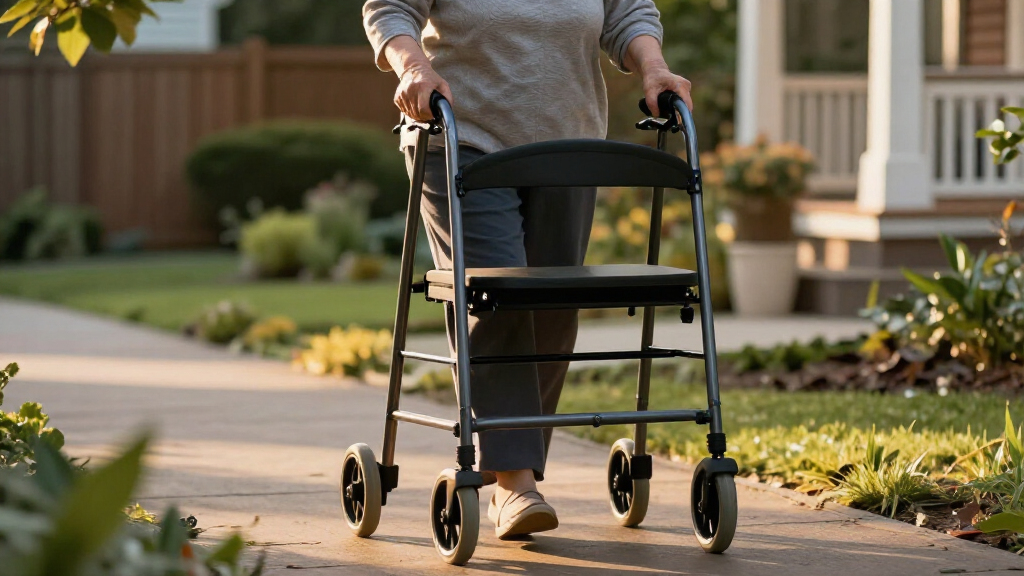
I ranked these indoor walkers for seniors by how well their designs address common home-use needs: stable support, predictable movement on indoor surfaces, manageable turning, practical folding, and useful adjustments. I also considered whether a seat or tray adds meaningful convenience, how wheel and glide configurations may affect movement, and whether a product’s stated capacity or narrow-frame design helps distinguish its intended user. Since the supplied product information does not establish every measurement or clinical feature, I avoid treating a product name as proof of performance.
The order favors options with a clear indoor role and a balance of support and day-to-day usability. Traditional two-wheel walkers rank ahead for users who want a straightforward frame with controlled movement; compact rollators rise for buyers who need a seat or tighter turning footprint, while larger-wheel rollators make more sense when surfaces extend beyond smooth rooms. Similar models are separated by their stated configuration—such as wheel size, glide style, tray, or adjustability—rather than by claims that cannot be verified from the provided details.
| indoor walkers for senior | Frame material |
|---|---|
| Drive Medical Two-Button Foldi | Aluminum |
| VOCIC Z21 Rollator Walker for | — |
| Soundfuse Lightweight Foldable | Aluminum |
| Medline Steel Rollator Walker | Steel |
| VOCIC Z32 Narrow Indoor Rollat | — |
| Lightweight Folding Standard W | Aluminum alloy |
| Vive Mobility Lightweight Fold | High-strength aluminum |
| Loyoda Folding Walker with 2 P | Aluminum |
| HOMLAND Foldable Rollator Walk | — |
| WonderLUX Folding Walker with | — |
| HOMENURSE Z3 Folding Walker wi | Aluminum |
| Medline Lightweight Two-Button | — |
| Lightweight Aluminum Walker wi | — |
| HOMENURSE Z3 Adjustable Foldin | Aluminum |
| Folding Walker for Seniors wit | Aircraft-grade aluminum alloy |
Factors to Consider When Choosing Indoor Walkers For Seniors
Choosing an indoor walker is less about collecting features and more about matching the frame’s movement to the home and the user’s habits. I would start with safety and fit, then decide whether a seat, tray, or faster-rolling design solves a real daily problem.
Match the Frame to the User’s Support Needs
A walker should support the user’s actual balance and mobility needs, not simply feel easy to push in a store aisle. A standard folding frame generally moves in a more deliberate way because the user advances it step by step; a rollator rolls continuously and depends on the user’s ability to manage its speed and brakes. That difference matters more than whether a model looks lighter or has extra accessories. If the user has recently fallen, has trouble standing upright, or cannot reliably use hand brakes, ask a clinician or physical therapist which style is appropriate. Avoid choosing a rollator just because a seat seems useful if its rolling movement is difficult to control.
Measure the Home Before Choosing a Width
Measure the narrowest doorway, bathroom entrance, and hallway turn the walker must pass through, then compare those dimensions with the product’s actual outside width. A frame that clears a straight doorway may still be awkward at a tight corner or beside a bed. Check the turning area around tables and kitchen counters too, since daily routes often include more turns than long, open stretches. Compact designs such as narrow indoor rollators can help in confined rooms, but a narrow frame is not automatically the right fit if it feels unstable or restricts the user’s stance. Do not rely on words like “narrow” or “compact” without confirming measurements.
Choose Wheels and Glides for the Floor
Wheel and glide choices affect how much effort is needed to move the walker and how it behaves at floor transitions. Front wheels let a two-wheel frame roll forward while its rear legs remain in contact with the floor, a mix that may feel more controlled than a four-wheel rollator. Ski glides and tennis balls are alternatives to bare rear tips, but they can behave differently across carpet, tile, and thresholds. Soft or uneven flooring can make small wheels harder to push, while hard floors may expose rough or noisy glide movement. If possible, test the intended configuration on the user’s usual route and replace worn tips or glides before they compromise contact with the floor.
Treat a Seat and Brakes as a Safety Decision
A seat is helpful only when the user can bring the rollator to a full stop, engage its brakes, and sit down without losing balance. The presence of a seat does not make every rollator suitable for someone who needs a stable frame to lean on. Check how the brakes are operated and whether the user can squeeze and release them comfortably with both hands. Think about where resting is needed and whether the rollator can be parked without blocking a doorway or creating a trip hazard. When hand strength or memory is a concern, get professional guidance before selecting a seat-equipped rolling model.
Check Fit, Folding, and Storage Together
Height adjustment should place the handles where the user can stand upright with relaxed shoulders and a slight bend in the elbows; a poor fit can encourage leaning or overreaching. Confirm the listed adjustment range rather than assuming every adjustable model suits every height. Folding can make a walker easier to store or transport, but the release mechanism must be manageable for the person who will operate it. Also check whether folding requires removing a tray, basket, or other accessory. A frame that stores neatly but is difficult for the user or caregiver to open safely may be a poor everyday match.
Use Capacity and Accessories as Practical Checks
Compare the user’s weight with the manufacturer’s stated capacity and leave a sensible margin rather than choosing a model at its limit. Capacity alone does not tell you whether the frame will fit, feel steady, or suit the user’s movement pattern. A tray can reduce trips while carrying a drink or small items, but it may add bulk and should not become a substitute for a stable way to transport heavier objects. Baskets and seats also affect how a walker is handled and stored. Prioritize accessories that solve a repeated task, and confirm that they do not interfere with folding, turning, or safe use.
Frequently Asked Questions
Is a two-wheel walker safer indoors than a rollator?
Not for every person: the safer choice depends on balance, strength, coordination, and the ability to control the device. A two-wheel walker with rear tips often moves in a more measured way, while a rollator can travel continuously and requires reliable brake use. A user who needs to bear weight through the frame may need a different design from someone who mainly wants balance support and a place to rest. A physical therapist can assess walking pattern and transfer ability in a way a product description cannot. Try the walker on the actual indoor route before relying on it throughout the home.
Should I choose a walker with front wheels or one with tennis balls or ski glides?
Choose based on the floor, the user’s strength, and how much control is needed during each step. Front wheels reduce the need to lift the front of the frame, while rear tennis balls or ski glides can make a standard walker slide more easily. Glides may feel different on carpet than on smooth flooring, and worn or poorly fitted tips can reduce dependable contact. These attachments do not turn a standard walker into a rollator; the user still advances the frame deliberately. If the user struggles to lift or move the frame, ask a clinician to help compare configurations rather than relying on accessory names alone.
How can I tell whether a rollator will fit through my home’s doorways?
Measure the narrowest clear opening with the door in the position it will normally be used, and compare it with the rollator’s outside width. Include hallway corners, bathroom approaches, and space beside furniture, since passing through a doorway is only one part of maneuvering. Allow room for the user’s hands and the frame to turn without scraping walls or catching on door trim. A narrow model may help, but check its full dimensions and the user’s stance before buying. If the product listing does not provide measurements, seek them from the manufacturer rather than estimating from photos.
Does a built-in seat make an indoor rollator a better choice?
A seat can be valuable when the user needs planned rest stops and can safely park the rollator, operate its brakes, and sit down. It adds little benefit if the user cannot manage the brakes or needs a stationary frame for substantial weight support. A seat-equipped model may also take up more turning and storage space than a simpler folding walker. Consider where the user would actually sit and whether there is room to stop without blocking a route. A therapist or clinician can help judge whether a rollator’s rolling behavior is appropriate.
What should I verify before ordering an adjustable folding walker?
Check the handle-height range, outside width, stated weight capacity, and the type of wheels or rear contact tips included. Confirm that the user can reach the release mechanism and fold or open the frame without losing balance. Look for instructions on assembly and routine checks, including how to spot loose fasteners or worn tips. If the walker will be used around thresholds or on mixed flooring, verify that its wheel and glide setup suits those surfaces. When the fit or intended level of support is uncertain, have a rehabilitation professional review the measurements and model before purchase.
Conclusion
For a dependable starting point, I recommend the Drive Medical Two-Button Folding Walker with Wheels as the best overall choice for shoppers seeking a straightforward indoor frame. The Lightweight Folding Standard Walker with Front Wheels and Glide Tips is my best value direction for buyers who want a basic, adaptable setup, while the VOCIC Z21 Rollator is the premium-style pick for users who benefit from a seat and larger all-terrain wheels. Beginners who prefer a measured step-by-step frame should look first at the Drive Medical or Medline Lightweight Two-Button Folding Walker, rather than starting with a continuously rolling design. For tight rooms, choose the VOCIC Z32 Narrow Indoor Rollator; for users who need a rest seat, compare the Medline Steel and HOMLAND rollators. Before deciding, check the user’s fit, doorway measurements, brake ability, and clinician guidance—those details matter more than adding features the user may not need.