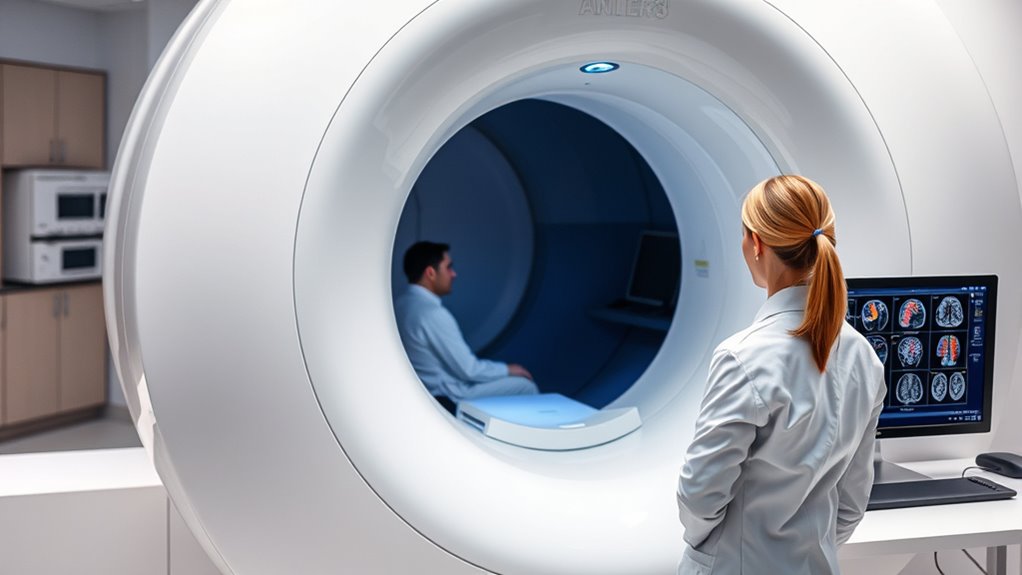

When you undergo neuroimaging and cognitive testing, you’ll lie still inside MRI or fMRI machines while your brain is scanned to show its structure and activity. You’ll also complete tasks like recalling sequences or solving puzzles to assess your mental abilities. The process is designed to guarantee your comfort, with clear instructions and support throughout. If you keep exploring, you’ll discover how these tests can provide valuable insights into your brain’s health and function.
Key Takeaways
- Participants lie still inside MRI or fMRI machines while brain images are captured during mental tasks.
- Neuroimaging reveals active brain regions, blood flow changes, and structural details.
- Cognitive tests assess abilities like memory, attention, and problem-solving through specific tasks.
- The combined approach offers comprehensive insights into brain function and performance.
- Clear instructions and support ensure participant comfort, with results aiding diagnosis and treatment planning.
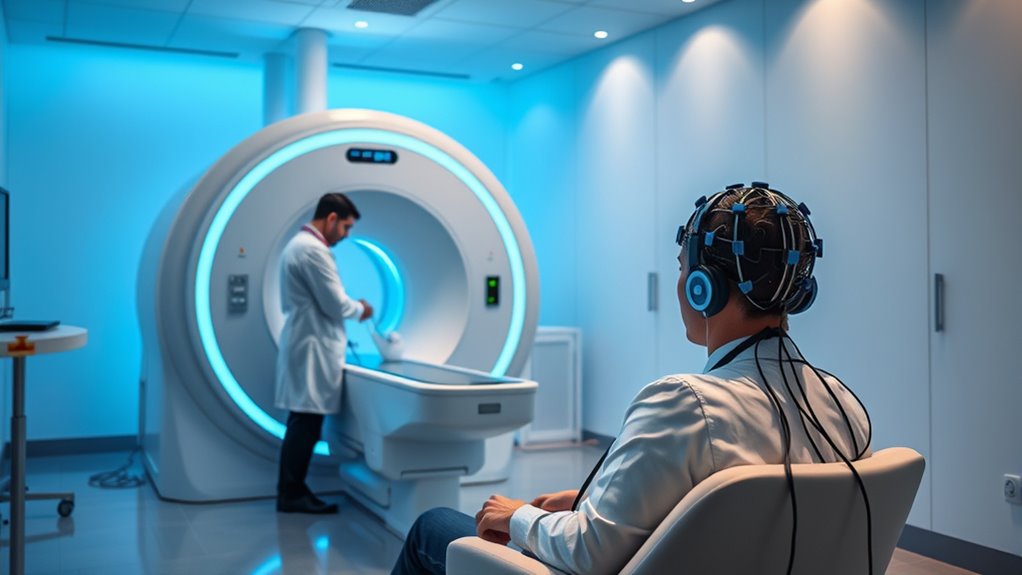
Neuroimaging and cognitive testing are essential tools for understanding how the brain supports mental functions. When you undergo these assessments, you’ll gain insight into how specific areas of your brain activate during various tasks and mental processes. These methods help researchers and clinicians identify patterns of brain activity that relate to cognition, emotion, and behavior. Expect a combination of advanced imaging techniques and structured test procedures designed to capture a holistic picture of your brain’s functioning.
During neuroimaging, you’ll typically lie still inside a scanner, such as an MRI or fMRI machine. These devices use powerful magnets and radio waves to produce detailed images of your brain’s structure and function. As you perform different tasks, the scanner records changes in brain activity, highlighting which regions are active during specific mental activities. For instance, if you’re asked to solve a problem or recall memories, the scanner detects increased blood flow or oxygen use in relevant areas, revealing how your brain responds in real-time.
During neuroimaging, you lie still while the scanner captures brain activity during various tasks.
Cognitive testing involves a series of test procedures that evaluate your mental abilities, including memory, attention, problem-solving, and language skills. These tests are usually administered by a psychologist or trained technician and are designed to measure your performance on tasks that tap into different cognitive domains. You might be asked to remember sequences, solve puzzles, or respond to visual or auditory stimuli. These tests help determine your cognitive strengths and weaknesses, providing essential data for diagnosis or treatment planning.
When combined, neuroimaging and cognitive testing allow for a more complete understanding of your brain’s health and function. For example, if neuroimaging shows reduced activity in a particular region, cognitive tests might reveal corresponding deficits, confirming a diagnosis or guiding intervention strategies. Additionally, recent advancements in high-resolution imaging have improved the detail and accuracy of brain scans, enhancing our ability to detect subtle changes in brain activity. Test procedures are carefully structured to ensure consistency and reliability, often involving standardized tasks that allow comparisons across individuals or groups.
Throughout the process, you can expect clear instructions and support from the staff conducting the assessments. They’ll explain what you’re expected to do, ensure your comfort, and monitor your responses. The data collected from brain activity during imaging and from your performance on test procedures work together to provide a holistic picture of how your brain supports your mental functions. Ultimately, these insights can help inform treatment options, track progress, or deepen your understanding of your own mind.

Scan Brain Radiologist Radiologic MRI Technologist MRI Tech Long Sleeve T-Shirt
Superpower? I Scan Brains! Celebrate your passion for the radiology field with a design that speaks to both…
As an affiliate, we earn on qualifying purchases.
As an affiliate, we earn on qualifying purchases.
Frequently Asked Questions
How Long Does Each Neuroimaging Session Typically Last?
A neuroimaging session usually lasts between 30 to 60 minutes, depending on the imaging types involved. If you’re undergoing an MRI, expect about 30 to 45 minutes, while PET scans might take a bit longer, up to 60 minutes. The session duration can vary based on the specific tests, the complexity of the procedure, and your comfort level. Be prepared for some time, but rest assured, the process is generally straightforward.
Are There Any Risks Associated With Neuroimaging Procedures?
There are minimal risks with neuroimaging procedures. You might be exposed to low levels of radiation during certain scans like CTs, but it’s generally safe. If contrast agents are used, there’s a small chance of allergic reactions or contrast risks, especially for those with kidney issues. Always inform your doctor about your medical history to mitigate risks, and they’ll ensure the procedure is as safe as possible for you.
Can Cognitive Testing Detect Early Signs of Neurological Diseases?
Imagine your mind as a quiet garden, holding subtle signs of change. Cognitive testing can often catch early detection signals of neurological diseases, revealing the faint whispers of trouble before they bloom fully. By focusing on these subtle signs, doctors can intervene sooner, potentially slowing progression. So, yes, cognitive testing is a valuable tool that helps identify the earliest hints of neurological issues, giving you a better chance at managing your health early on.
What Should I Do to Prepare Before Undergoing Neuroimaging?
Before neuroimaging, you should follow some preparation tips, like avoiding caffeine or certain medications if your doctor advises. Check for any dietary restrictions, such as fasting if required, and wear comfortable, loose clothing without metal. Leave jewelry or accessories at home, and arrive early to relax. Following these steps helps guarantee clear images and accurate results, making your neuroimaging experience smoother and more effective.
How Are Results From Neuroimaging and Cognitive Tests Used Clinically?
Think of your brain as a busy city, with neuroimaging acting like a map that highlights traffic flow, revealing where activity is high or low. You understand that the results guide doctors through the maze, improving diagnostic accuracy. Your brain activity patterns help pinpoint issues, enabling tailored treatment plans. These insights serve as a compass, steering your healthcare towards precision, ensuring you get the most effective care possible.

R FOR NEUROSCIENCE: EEG Analysis, fMRI Modeling, and Brain Connectivity Analysis with Machine Learning, Signal Processing, and Neuroimaging in R (THE APPLIED DATA SCIENCE WITH R SERIES)
As an affiliate, we earn on qualifying purchases.
As an affiliate, we earn on qualifying purchases.
Conclusion
As you explore neuroimaging and cognitive testing, you’ll discover how these tools reveal the mind’s hidden stories. Sometimes, a simple scan uncovers unexpected insights, like finding a familiar face in a crowd. These coincidences remind you that your brain holds surprises at every turn, waiting to be uncovered. Embrace the journey—you never know when a small discovery might change everything you thought you knew about yourself.

PlexusDx Cognition & Brain Health Genetic Test | 120+ DNA Reports Including Brain Fog, Memory, Attention, and Overall Cognitive Function | Custom Supplement and Lifestyle Recommendations
WHAT YOU GET: DNA reports related to Cognitive Problems, Short-Term Memory Impairment, Brain Fog, Attention, Dyslexia, Cognitive Decline,…
As an affiliate, we earn on qualifying purchases.
As an affiliate, we earn on qualifying purchases.

SereniBrain EEG Neurofeedback Headband for Meditation & Brainwave Monitoring, Real-Time Brain Activity Tracker with App, Train Focus, Relaxation & Sleep Preparation
Real-Time EEG Neurofeedback Headband for Brainwave Monitoring: Monitor your brain activity in real time using advanced EEG sensors….
As an affiliate, we earn on qualifying purchases.
As an affiliate, we earn on qualifying purchases.