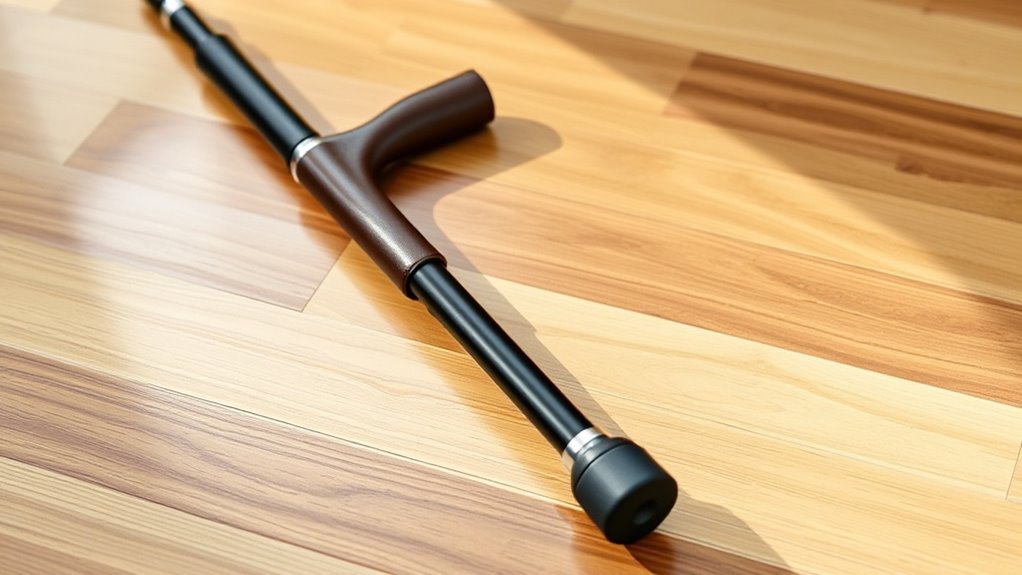

Walking canes for balance differ most in how much ground contact they offer, how easily they fold, and how much support they provide during each step. My best overall pick is the HurryCane Freedom Edition, whose folding design and pivoting base suit people who want a portable cane that can stand on its own. For a broader support footprint, the PELEGON Quad Cane is a standout, while the Rehand Walking Cane is a strong option for people who value a soft grip and travel bag. The main tradeoff is portability versus a wider, more stable base, with handle comfort and height fit also affecting everyday use. Read on for all 15 picks and guidance on matching a cane to your balance needs.

Turn quiet afternoons into listening time
- Thousands of audiobooks, podcasts and originals
- Listen on your phone, tablet or Echo — also offline
- Cancel anytime
Complete the kit


Key Takeaways
- Portable balance support is the main strength of the HurryCane and Rehand folding designs; folding makes storage easier, but does not replace a correctly fitted cane or clinical guidance.
- The PELEGON and Medline quad cane models favor a broader support footprint over compact storage, making them more relevant when standing stability matters more than folding the cane into a bag.
- Not every self-standing design offers the same kind of support: a pivoting tip, a quad base, and a cane that simply stands upright have different contact patterns and handling demands.
- Handle design separates comfort-focused picks from straightforward options: dual handles can help with sit-to-stand tasks, while an offset or ergonomic grip may suit buyers seeking a familiar, single-hand hold.
- Special features do not resolve fit or mobility needs: the TIRAROME adds an alarm and light, but height, safe technique, and whether a cane is enough support still matter more.




| walking canes for balance | Material | Color | Weight |
|---|---|---|---|
| Walking Cane for Men and Women | High quality material; specific material not stated | — | — |
| Adjustable Walking Cane with 4 | Aluminum alloy | — | — |
| HONEYBULL Walking Cane for Men | Aluminum | Red | — |
| Vive Folding Cane | Anodized aluminum | — | — |
| Medline Aluminum Quad Cane wit | Aluminum | — | — |
| HurryCane Freedom Edition Fold | Aluminum | Black | 16 ounces |
| Foldable Walking Cane for Men | Aluminum | Black | 1.4 pounds |
| KingPavonini Foldable Walking | Aluminum alloy | Purple | 1.08 pounds |
| Medline Aluminum Offset Walkin | Aluminum | Black | 1.1 pounds |
| Rehand Walking Cane for Men & | — | Black | 0.45 kg |
| PELEGON Quad Cane | — | Black (listed) | 2.1 lbs |
| TIRAROME Walking Cane for Men | — | — | 1.3 lbs |
| Rehand Foldable Adjustable Wal | — | Natural Black | — |
| KINGGEAR Self Standing Walking | Aviation aluminum | — | 1.1 lbs |
| LIXIANG Folding Walking Cane f | Aluminum and rubber | Black | — |
More Details on Our Top Picks
Walking Cane for Men and Women – Adjustable, Folding, Self-Standing, Portable, and Comfortable
For shoppers whose main fit concern is height, this cane’s 40-to-49-inch adjustment range sets it apart from the shorter options here. The HONEYBULL, for example, adjusts from 30 to 36 inches, while the Vive spans 33 to 37 inches; those ranges may suit many users but cannot reach as tall. A folding, self-standing design also makes this a practical everyday or travel choice when you want to set the cane down without laying it on the floor. Its slip-resistant tip adds a basic point of contact for walking support. The tradeoff is limited detail about the construction material and overall weight, so buyers have less information for judging carrying comfort and long-term durability. I’d also factor in the possibility that a replacement tip may need to be purchased separately.
Pros:- 40-to-49-inch height range accommodates users taller than the ranges listed for the HONEYBULL and Vive.
- Folds for storage and travel.
- Self-standing design makes it easier to park beside a chair.
- Slip-resistant tip offers traction on everyday walking surfaces.
Cons:- Material and item weight are not specified, making durability and carry comfort harder to judge.
- May feel heavy to users who carry a cane for long periods.
- Replacement tip may require a separate purchase.
Best for: Taller adults who need a folding cane with a height range beyond the HONEYBULL and Vive models.
Not ideal for: Buyers who need detailed weight or material specifications before choosing, or anyone who wants included replacement tips.
- Height range:40 to 49 inches
- Maximum weight:300 pounds
- Material:High quality material; specific material not stated
- Folding:Yes
- Self-standing:Yes
- Tip:Slip-resistant rubber
Our verdict“Choose this model if you need unusually generous height adjustment in a folding cane and can accept limited construction details.”
Adjustable Walking Cane with 4-Pronged Base and Dual Handles for Seniors
This cane is the lineup’s clearest fit for someone who needs help both while walking and when rising from a chair. Its dual handles provide a second grip point for standing assistance, while the four-pronged base offers a broader support footprint than the single-tip Vive folding cane. That extra base contact can be useful for users who value a planted feel, though it does not replace a properly fitted mobility aid or professional guidance. At 32 to 37.5 inches, its adjustment range is narrower than the 40-to-49-inch range of the first cane in this group. The aluminum alloy frame folds for transport, but the base and extra handle structure make it less minimal than a basic cane, and adjustment may take more effort than a simple shaft design.
Pros:- Four-pronged base provides a wider support footprint than a single-tip cane.
- Dual handles offer a grip point for standing assistance.
- Aluminum alloy construction supports up to 300 pounds.
- Folds for storage and transport.
Cons:- May be heavier and bulkier than basic folding canes such as the Vive.
- Adjustment can require more effort than a straightforward shaft design.
- Its height range is substantially shorter than the first cane in this group.
Best for: Older adults or people recovering from surgery who want a quad base and a second handle to assist with standing.
Not ideal for: Users seeking the lightest, simplest cane for frequent carrying, or those whose height falls outside the 32-to-37.5-inch range.
- Material:Aluminum alloy
- Weight capacity:300 pounds
- Height adjustment:32 to 37.5 inches
- Base:Four-pronged quad base
- Handles:Dual handles
- Foldable:Yes
Our verdict“Pick this model if standing from a seated position and a broader base matter more than keeping your cane lightweight and minimal.”
HONEYBULL Walking Cane for Men & Women, Foldable Free Standing Cane
Among these five options, the HONEYBULL puts the most emphasis on portability without giving up a self-standing base. At 0.44 kg and a folded length of 12.5 inches, it is easier to pack than a conventional rigid cane, and its 30-to-36-inch adjustment range covers many users who do not need the much taller reach of the first cane listed here. The pivoting tip is intended to keep ground contact as the cane angle changes, a useful distinction from the Vive’s standard slip-resistant tip. Its three-pronged base can stand on its own, but a multi-point base may feel less nimble in tight spaces than the single-tip Vive. The 36-inch maximum can also rule it out for taller users, and the rubber handle may wear with prolonged use.
Pros:- Lightweight at 0.44 kg.
- Folds to 12.5 inches for compact storage.
- Pivoting tip is designed to maintain ground contact as the cane tilts.
- Three-pronged free-standing base and adjustable 30-to-36-inch height.
Cons:- Maximum height of 36 inches may not fit taller users.
- Three-pronged base can take more room than the Vive’s single-tip design.
- Rubber handle may wear over time.
Best for: Travelers and everyday cane users who prioritize low carry weight, compact folding, and a pivoting tip.
Not ideal for: Taller users needing more than 36 inches of height, or buyers who want a simpler, narrow single-tip cane for crowded spaces.
- Material:Aluminum
- Handle material:Rubber
- Base material:Aluminum
- Height adjustment:30 to 36 inches
- Folded size:12.5 inches
- Item weight:0.44 kg
- Base and tip:Three-pronged free-standing base with pivoting tip
- Color:Red
Our verdict“Choose the HONEYBULL if you want a compact, lightweight cane with a pivoting tip and your required height is within its range.”
Vive Folding Cane – Collapsible Walking Stick for Men and Women
The Vive is the straightforward pick for buyers who want a portable cane without a quad base or extra standing-assistance handle. Its secure locking mechanism and adjustable aluminum shaft offer a simple format, while the ergonomic grip is intended to reduce hand fatigue during routine use. Compared with the HONEYBULL, the Vive has a single slip-resistant tip rather than a pivoting, free-standing base; that keeps its design simpler, but gives up the HONEYBULL’s self-standing convenience and pivoting contact. Its 33-to-37-inch range is also only slightly broader at the upper end than the HONEYBULL’s. The main limit is a 250-pound capacity, below the 300-pound ratings listed for the other four canes in this group. Terrain-specific tips may also need to be bought separately.
Pros:- Folds compactly for purses and carry-ons.
- 33-to-37-inch adjustment in one-inch increments.
- Locking mechanism is designed to secure the adjustable frame.
- Ergonomic grip and lightweight aluminum construction support portable daily use.
Cons:- 250-pound capacity is lower than the 300-pound ratings of the other listed canes.
- Single-tip design lacks the wider support footprint of quad-base models.
- Different terrain tips may require separate purchases.
Best for: Adults who want a compact, adjustable aluminum cane for routine walking and easy storage in a purse or carry-on.
Not ideal for: Users who need a capacity above 250 pounds, a self-standing quad base, or a cane configured for varied terrain.
- Material:Anodized aluminum
- Maximum weight support:250 pounds
- Height adjustment:33 to 37 inches
- Adjustment increments:1 inch
- Folded length:Compact; fits into purses and carry-ons
- Grip:Ergonomic
- Tip:Slip-resistant
- Lock:Secure locking mechanism
Our verdict“The Vive suits buyers who want a simple, packable cane for everyday support and do not need a quad base or higher weight capacity.”
Medline Aluminum Quad Cane with Small Base, 300 lb Capacity, for Balance, Knee Injuries, Leg Surgery Recovery & Mobility
The Medline is a practical middle ground for buyers who want more than a single-tip cane but do not want the larger footprint implied by some quad-base designs. Its small quad base gives four points of contact in a compact format, while the 29-to-38-inch range is broader than the 32-to-37.5-inch adjustment on the dual-handle quad cane. A foam handle adds a softer grip, and the listed rubber pads provide traction on slippery surfaces. Unlike that dual-handle model, the Medline does not offer a second grip for pushing up from a chair, so it is less tailored to standing assistance. The small base may also be less sure-footed on uneven ground than a larger-base cane, making this a better match for smoother routes and indoor use.
Pros:- Small quad base offers multiple contact points in a compact footprint.
- Height adjusts from 29 to 38 inches.
- Supports up to 300 pounds.
- Foam grip and rubber pads add comfort and traction.
Cons:- Small base may provide less stability on uneven terrain than a larger quad base.
- No second handle for standing assistance, unlike the dual-handle quad cane.
- Quad base is less minimal to carry than the single-tip Vive.
Best for: Adults recovering from knee or leg injuries who want a height-adjustable quad cane with a compact base for indoor and smoother-surface walking.
Not ideal for: People who routinely walk on uneven terrain or need a second handle to help rise from a chair.
- Material:Aluminum
- Weight capacity:300 pounds
- Height adjustment:29 to 38 inches
- Base type:Small quad base
- Handle:Foam grip
- Pads:Rubber pads
- Number of items:1
Our verdict“Choose the Medline if you want a compact quad base and broad height adjustment for steadier walking on mostly even surfaces.”
HurryCane Freedom Edition Foldable Walking Cane with T Handle
The HurryCane suits people who want a cane that can be put away between walks without taking up much room. Its 13.7-inch folded size and ability to stand independently when folded make it convenient beside a chair or in a travel bag. The SteadiGrip base is designed to provide a stable contact point, while the adjustable aluminum frame lets users set the cane up to 37.5 inches. Compared with the Medline Aluminum Offset Walking Cane, this model is easier to pack away, but the Medline offers a familiar offset grip and a longer stated height range. The HurryCane’s main tradeoff is its 37.5-inch height limit, which may not fit taller users; its folding mechanism may also feel less solid than a nonfolding cane. I’d choose it for portability, not for the most rigid-feeling support.
Pros:- Folds to 13.7 inches for easier storage and transport.
- SteadiGrip base is designed to provide added stability during use.
- Adjustable height allows a fit up to 37.5 inches.
- Can stand independently when folded.
Cons:- Maximum height of 37.5 inches may be too short for some users.
- The folding mechanism may feel less sturdy than a fixed-frame cane.
- Listed only in black.
Best for: Adults who need balance support and want a compact cane that can stand when folded and store easily between outings.
Not ideal for: Taller users who need a cane above 37.5 inches or buyers who prioritize a simple, rigid, nonfolding construction.
- Material:Aluminum
- Handle material:Rubber
- Base material:Resin
- Extended length:37.5 inches
- Folded size:13.7 inches
- Weight:16 ounces
- Color:Black
Our verdict“Choose the HurryCane if compact storage matters more than a higher maximum height or the feel of a rigid cane.”
Foldable Walking Cane for Men & Women, Adjustable, Lightweight Alloy, Anti-Slip, Self-Standing Mobility Aid
Among these five options, this cane’s clearest advantage is its 40-to-49-inch adjustment range, which extends higher than the HurryCane Freedom Edition’s 37.5-inch maximum. That makes it worth a look for taller users who need a folding cane rather than a short, compact model. Its self-standing design and carrying strap also help when moving between rooms or packing for an outing, while the rubber base is intended to grip a range of surfaces. The tradeoff is that the supplied folded-size figure is 40 inches, so it is not as compact as the HurryCane when stored. Its plastic handle may also be less comfortable for some hands than the Rehand cane’s soft-grip handle. I’d favor it for extra height reach, not for the smallest travel footprint or a contoured grip.
Pros:- Adjusts from 40 to 49 inches to accommodate taller users.
- Rubber base is designed to provide traction on varied surfaces.
- Self-standing design makes it easier to set down between uses.
- Carrying strap supports portability.
Cons:- The stated 40-inch folded size is less compact than the HurryCane’s 13.7-inch folded size.
- Plastic handle may not suit every hand shape or grip preference.
- Maximum height may still be insufficient for users taller than its stated range.
Best for: Taller adults who need an adjustable folding cane with a height range that reaches above many compact models.
Not ideal for: Buyers who want a particularly small folded cane or who need a more ergonomically shaped handle for extended use.
- Material:Aluminum
- Handle material:Plastic
- Base material:Rubber
- Extended length:49.2 inches
- Folded size:40 inches
- Weight:1.4 pounds
- Color:Black
Our verdict“Pick this cane if you need a taller adjustment range and can accept a less compact fold and a basic plastic handle.”
KingPavonini Foldable Walking Cane for Men and Women, Adjustable, Heavy Duty 350 lbs, Ergonomic Handle, Self-Standing Quad Base, Travel Bag Included
The KingPavonini stands apart for buyers who put a stated capacity of 350 pounds high on their checklist. Its wide, self-standing quad base provides a broader support footprint than the Medline Aluminum Offset Walking Cane’s single rubber pad, which may appeal to users seeking more contact points at the floor. The aluminum-alloy frame weighs 1.08 pounds and folds for transport, and its ABS-and-TPR handle adds a softer material component than the plastic handle on the taller adjustable cane in this lineup. The compromise is fit: its 25.5-to-32.5-inch height range is comparatively short, so many taller users should look elsewhere. The product data also notes that the folding mechanism may feel stiff and that the handle may not suit every hand size. I’d prioritize its capacity and quad base over adjustability or easy folding.
Pros:- Stated weight capacity of 350 pounds.
- Self-standing quad base offers multiple floor contact points.
- Lightweight aluminum-alloy construction at 1.08 pounds.
- ABS-and-TPR handle combines firm and softer grip materials.
Cons:- Height adjusts only from 25.5 to 32.5 inches, limiting fit for taller users.
- Folding mechanism may feel stiff.
- Handle shape may not fit all hand sizes comfortably.
Best for: Users who need a folding cane with a stated 350-pound capacity and prefer a self-standing quad base.
Not ideal for: Taller users who need a cane above 32.5 inches or anyone who wants a folding mechanism that operates with minimal effort.
- Material:Aluminum alloy
- Handle material:ABS and TPR
- Base material:Rubber
- Height adjustment:25.5 to 32.5 inches
- Weight:1.08 pounds
- Weight capacity:350 pounds
- Color:Purple
Our verdict“Choose the KingPavonini when its higher stated capacity and quad base matter more than a taller adjustment range or effortless folding.”
Medline Aluminum Offset Walking Cane
For someone who wants straightforward balance support rather than a folding travel design, the Medline takes the simpler route. Its offset foam grip and wrist strap offer a familiar way to hold and manage the cane, while the rubber pad provides a direct contact point with the ground. The 29-to-38-inch height range is longer than the KingPavonini’s stated range, though it does not reach as high as the 49.2-inch maximum listed for the adjustable folding cane. At 1.1 pounds, it is still relatively light, but it lacks the compact folding convenience offered by the HurryCane and Rehand. This model is described as intended for minimal support, so I would not choose it when a wide quad base or substantial mobility assistance is the priority. Its appeal is a basic, adjustable cane with an offset grip, not extra standing stability.
Pros:- Height adjusts from 29 to 38 inches.
- Offset handle has a foam grip and wrist strap.
- Rubber pad provides a direct, non-slip ground contact point.
- Aluminum construction weighs 1.1 pounds.
Cons:- Designed for minimal support rather than substantial assistance.
- Does not fold for compact storage like the HurryCane or Rehand.
- Offset grip may feel unfamiliar to users accustomed to straight handles.
Best for: Adults who need light balance assistance and prefer a conventional, adjustable offset cane with a wrist strap.
Not ideal for: People who need a self-standing quad base, a folding cane for travel, or more than minimal balance support.
- Material:Aluminum
- Handle type:Offset with foam grip
- Base type:Rubber pad
- Height range:29 to 38 inches
- Weight:1.1 pounds
- Weight capacity:300 pounds
- Color:Black
Our verdict“Choose the Medline for everyday, light balance support if you prefer an offset grip and do not need a folding or quad-base cane.”
Rehand Walking Cane for Men & Women – Foldable, Adjustable, Lightweight, Self-Standing Pivot Cane with Soft Handle Grip and Travel Bag
The Rehand is the most appealing fit here for buyers who need a wide adjustment range in a folding cane. Its listed range of 78 to 96 cm is paired with a stated user-height fit from about 5 to 6.5 feet, making it more adaptable than the HurryCane, which tops out at 37.5 inches. The pivoting quad base is designed to keep multiple points in contact with the ground, and the self-standing feature is useful when setting the cane aside. At 0.45 kg, it is also easy to carry with the included travel bag. The tradeoff is that a pivoting base and folding structure may be more involved than the Medline’s simple rubber pad and fixed shaft. Some users may also find the grip uncomfortable over longer stretches. I’d choose Rehand for fit flexibility and travel, not for a guaranteed hand-feel.
Pros:- Broad stated adjustment range of 78 to 96 cm.
- Pivoting quad base is designed to maintain multiple points of ground contact.
- Folds and weighs 0.45 kg for easier carrying.
- Self-standing design and included travel bag support storage and transport.
Cons:- Some users may find the grip uncomfortable during extended use.
- Foldable pivot-base construction is more complex than the Medline’s simple fixed cane design.
- Only black is listed, and no warranty information is provided in the supplied product details.
Best for: Adults roughly 5 to 6.5 feet tall who want an adjustable, portable cane with a self-standing pivot base.
Not ideal for: Buyers who prefer a basic fixed cane, need a handle known to suit their specific grip, or want color choices beyond black.
- Materials:Aluminum, PA, polypropylene, and TPR
- Handle materials:Polypropylene and TPR
- Base materials:PA and TPR
- Adjustable height range:78 to 96 cm
- Weight:0.45 kg
- Maximum user height:6.4 feet
- Color:Black
Our verdict“Pick the Rehand if you need broad height adjustment and portable quad-base support, provided its grip suits your hand.”
PELEGON Quad Cane (300 lb) – Adjustable Walking Cane with Large 4-Pronged Base for Extra Balance & Stability, Suitable for Seniors, Men & Women
I’d rank the PELEGON Quad Cane for buyers who want a wider base of support and are comfortable with a less compact cane. Its four-pronged base and anti-slip rubber tips offer more ground contact than a standard single-point cane, while its 29.5-to-38.4-inch adjustment range accommodates a broad range of fits. At 2.1 pounds, it remains relatively light for a quad cane, and the 300-pound capacity is higher than the TIRAROME’s 250-pound limit. The tradeoff is maneuverability: the larger base can feel cumbersome in tight hallways or around furniture, especially compared with KINGGEAR’s more compact 4.3-inch quad base. I’d choose PELEGON for steady indoor walking on open paths, but not for someone who prioritizes easy turning or a slim profile.
Pros:- Four-pronged base provides a broader contact area than a single-point cane.
- Adjusts from 29.5 to 38.4 inches for a flexible fit.
- Supports up to 300 pounds while weighing 2.1 pounds.
- Anti-slip rubber tips add grip at the points of contact.
Cons:- The larger base can be awkward in tight spaces and during close turns.
- At 2.1 pounds, it is heavier than the 1.1-pound KINGGEAR cane.
- The provided product information lists only black.
Best for: People who want a four-pronged base, need a height adjustment range that reaches 38.4 inches, and have room to maneuver indoors or outdoors.
Not ideal for: Users moving through narrow hallways or crowded spaces who need a compact base that clears furniture easily.
- Weight:2.1 lbs
- Maximum support weight:300 lbs
- Adjustable height:29.5–38.4 in
- Base type:Four-pronged quad base
- Tip material:Anti-slip rubber
- Color:Black (listed)
Our verdict“Choose PELEGON if a wide quad base matters more to you than compact handling in tight spaces.”
TIRAROME Walking Cane for Men & Women, Smart Cane with Alarm & Light
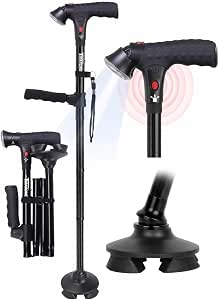
The TIRAROME Smart Cane is the feature-led choice here: its adjustable LED light can illuminate the path ahead, and its one-touch alarm offers a way to call attention in an emergency. The second handle is also useful for people who need leverage when rising from a chair, a task a basic quad cane like the PELEGON does not specifically address. It folds to 13 inches and weighs 1.3 pounds, making it easier to store or carry than the 2.5-pound LIXIANG. Those conveniences come with limits: the stated height range is 34–38 inches, the capacity is 250 pounds, and the listing gives conflicting user-height guidance. The self-standing pivot base is not the same broad-footprint design as KINGGEAR’s quad base, so buyers seeking a wide planted stance may prefer that simpler option.
Pros:- Adjustable LED light helps illuminate the path in low-light conditions.
- One-touch alarm adds an emergency signaling feature.
- Second handle provides leverage when standing from a seated position.
- Folds to 13 inches and weighs 1.3 pounds for storage and transport.
Cons:- The listed 34–38-inch size range may not fit shorter users, and the product description gives conflicting height guidance.
- Its 250-pound capacity is below the 300-pound PELEGON and KINGGEAR limits.
- The self-standing pivot base does not provide the same broad footprint as a traditional quad base.
Best for: Taller users who want a folding cane with a light, emergency alarm, and a second grip to help with standing from a chair.
Not ideal for: People who need a height below 34 inches, a capacity above 250 pounds, or a conventional wide quad base for a broader stance.
- Weight:1.3 lbs
- Maximum support weight:250 lbs
- Listed size:34–38 in
- Folded size:13 in
- Light:45-degree adjustable LED
- Alarm power:2 AAA batteries
- Shaft material:Aircraft-grade aluminum
- Height adjustment:5 adjustment levels
Our verdict“Pick TIRAROME if you value a light, alarm, and sit-to-stand grip more than a broad quad base or a wider height range.”
Rehand Foldable Adjustable Walking Cane with All Terrain Tip and Travel Bag
For buyers whose balance concerns include varied outdoor surfaces, the Rehand Foldable Cane stands out for its shock-absorbing, all-terrain base. That design is more relevant to uneven routes than the PELEGON’s standard four-pronged base, while the eight height settings give more opportunities to fine-tune the fit than the five levels listed for TIRAROME. It also folds to 14 inches and comes with a travel bag, making it practical to pack between walks. The product data has a notable inconsistency: its listed item weight is 500 milligrams, which is implausible for an aluminum cane, so I would not rely on that figure when judging carry weight. Its handle shape may not suit every grip, and a pivoting all-terrain tip is not necessarily the best match for someone who specifically wants a broad, fixed quad base.
Pros:- All-terrain, shock-absorbing base is designed for varied surfaces.
- Eight height settings offer multiple fit adjustments.
- Folds to 14 inches and includes a travel bag.
- Handle uses PP and TPR materials for a shaped grip.
Cons:- The listed 500-milligram item weight is implausible, so the actual carry weight is unclear from the provided data.
- The handle design may not suit users who prefer a different grip shape.
- An all-terrain tip may not meet the preference for a broad, traditional quad base like PELEGON’s.
Best for: Adults who walk on a mix of paved and uneven surfaces and want a folding cane with multiple height settings and a travel bag.
Not ideal for: Buyers who need a verified lightweight figure, prefer a fixed quad base, or know that a molded PP and TPR handle does not suit their grip.
- Adjustable height:2 ft 7 in–3 ft 2 in (78–96 cm)
- Maximum height recommendation:6.5 ft
- Listed item weight:500 milligrams
- Folded size:14 in
- Materials:Aluminum, polypropylene, rubber, and TPR
- Handle material:PP and TPR
- Base material:Rubber
- Color:Natural Black
Our verdict“Choose Rehand for adjustable support on varied routes, but verify its actual weight and handle fit before relying on it for travel.”
KINGGEAR Self Standing Walking Cane Quad Base for Seniors
The KINGGEAR Self Standing Cane is my pick for buyers who want quad-base support without carrying as much weight as the PELEGON: it weighs 1.1 pounds versus PELEGON’s 2.1. Its 4.3-inch quad base is also a defined, relatively compact footprint, which may be easier to place near furniture than a larger base. The height adjusts from 31 to 36 inches, and the EVA foam handle adds cushioning for the hand. Compared with the LIXIANG, KINGGEAR supports up to 300 pounds rather than 250, though LIXIANG reaches 37 inches and folds for storage. KINGGEAR folds too, but its shorter adjustment range may rule it out for taller users, and even a compact quad base takes more room during steps and turns than a single-point cane.
Pros:- Weighs 1.1 pounds, lighter than the PELEGON and LIXIANG.
- Quad base provides four points of contact and measures 4.3 inches in diameter.
- Supports up to 300 pounds.
- Folds for transport and has an EVA foam padded handle.
Cons:- Height range of 31–36 inches is narrower than PELEGON’s and stops short of LIXIANG’s 37-inch maximum.
- The quad base remains bulkier to maneuver than a single-point cane.
- The provided specifications do not state the folded size or the exact height-locking mechanism.
Best for: Users who want a foldable quad cane with a 300-pound capacity and low listed weight for everyday balance support.
Not ideal for: People taller than the cane’s listed adjustment range or those who need the compact movement of a single-point cane.
- Material:Aviation aluminum
- Weight:1.1 lbs
- Load capacity:300 lbs
- Height adjustment:31–36 in
- Base diameter:4.3 in
- Base type:Quad base
- Handle:EVA foam padded
- Foldable:Yes
Our verdict“Choose KINGGEAR if you want a particularly light, foldable quad cane and its 31–36-inch adjustment range fits you.”
LIXIANG Folding Walking Cane for Seniors & Adults, Adjustable, Heavy Duty, Quad Canes with 3 Footings
The LIXIANG Folding Walking Cane suits buyers who want a folding cane with extra base components included and a height range that extends to 37 inches. That makes it a more flexible fit than KINGGEAR for someone near the upper end of that model’s 36-inch limit, although KINGGEAR weighs considerably less at 1.1 pounds compared with LIXIANG’s 2.5. LIXIANG’s rubber grip and rubber base keep the materials straightforward, and the cane adjusts from 29 to 37 inches. Its listed capacity is 250 pounds, so PELEGON and KINGGEAR are stronger choices for buyers needing a 300-pound limit. The product data does not explain how the included extra bases attach or when to use them, so I would not assume they change the cane’s stability without checking the instructions.
Pros:- Height adjusts from 29 to 37 inches, reaching lower and higher than KINGGEAR’s listed range.
- Folding design supports storage and travel.
- Includes extra base components, according to the product description.
- Aluminum and rubber construction uses durable, familiar materials.
Cons:- At 2.5 pounds, it is heavier than the 1.1-pound KINGGEAR and 1.3-pound TIRAROME.
- Its 250-pound capacity is lower than the 300-pound PELEGON and KINGGEAR limits.
- The provided details do not specify how the extra bases fit or differ.
Best for: Users who want a folding cane with a 29–37-inch height range and appreciate having extra base components for replacement or setup options.
Not ideal for: People who need a 300-pound capacity, prioritize a particularly light cane, or want detailed information on how the extra bases are used.
- Height range:29–37 in
- Weight capacity:250 lbs
- Item weight:2.5 lbs
- Extended length:37 in
- Material:Aluminum and rubber
- Handle material:Rubber
- Base material:Rubber
- Color:Black
Our verdict“Pick LIXIANG if you need its 29–37-inch range and extra base components, but look elsewhere for a lighter cane or a 300-pound capacity.”

How We Picked
I ranked these walking canes by how well their stated designs address common balance-related priorities: dependable contact with the ground, useful base shape, adjustability, grip design, portability, and practical features such as self-standing construction. I gave more weight to the kind of support a buyer can reasonably infer from the cane’s design than to extras that do not directly improve balance. A wide quad base and a folding pivot tip can both be useful, but they serve different preferences and are not interchangeable.
The order reflects the balance between stability, everyday usability, and tradeoffs. The HurryCane leads for its combination of folding convenience and pivoting contact; quad-base options rank well for buyers who prioritize a broader footprint. More specialized designs, such as dual-handle, all-terrain-tip, and alarm-and-light models, are ranked for the needs they target rather than treated as universal upgrades. Product descriptions do not establish that a cane is suitable for every user, so fit, safe use, and advice from a clinician remain part of the decision.
| walking canes for balance | Material | Color |
|---|---|---|
| Walking Cane for Men and Women | High quality material; specific material not stated | — |
| Adjustable Walking Cane with 4 | Aluminum alloy | — |
| HONEYBULL Walking Cane for Men | Aluminum | Red |
| Vive Folding Cane | Anodized aluminum | — |
| Medline Aluminum Quad Cane wit | Aluminum | — |
| HurryCane Freedom Edition Fold | Aluminum | Black |
| Foldable Walking Cane for Men | Aluminum | Black |
| KingPavonini Foldable Walking | Aluminum alloy | Purple |
| Medline Aluminum Offset Walkin | Aluminum | Black |
| Rehand Walking Cane for Men & | — | Black |
| PELEGON Quad Cane | — | Black (listed) |
| TIRAROME Walking Cane for Men | — | — |
| Rehand Foldable Adjustable Wal | — | Natural Black |
| KINGGEAR Self Standing Walking | Aviation aluminum | — |
| LIXIANG Folding Walking Cane f | Aluminum and rubber | Black |
Factors to Consider When Choosing Walking Canes For Balance
Before choosing a cane, decide what kind of help you need during a step and when standing still. A cane can provide a point of contact and support, but the wrong height, base, or technique can make walking less secure. These broader checks can help narrow the options without treating any one design as right for everyone.
Match the Base to the Support You Need
A single tip keeps a cane relatively narrow and easy to place, while a quad base gives it multiple contact points. That wider footprint may appeal to someone who wants the cane to stand on its own or feel more planted, but the legs can catch on tight turns, rugs, or narrow spaces. A pivoting tip follows the ground differently from a fixed multi-prong base, so the two styles should not be assumed to offer the same feel. Think about your usual walking surfaces and how much room you have to place the cane beside you. If you have frequent near-falls or need substantial weight support, ask a physical therapist whether a cane is an adequate aid rather than assuming a larger base solves the problem.
Get the Height and Hand Fit Right
Adjustability helps a cane fit different users, but a long adjustment range does not guarantee a good fit for you. A cane that is too short can encourage a forward lean; one that is too tall can make the shoulder rise and the grip awkward. Check the maker’s height guidance and ask a clinician to confirm the setting if you are unsure. The hand grip matters for longer walks: a soft or shaped handle may feel different from a basic T or offset grip, especially for users with hand pain or reduced grip strength. Avoid choosing by appearance alone, and check whether the handle suits the hand you will use and feels secure without forcing a tight grasp.
Weigh Folding Convenience Against Setup
Foldable canes are easier to stow in a car, bag, or closet, which can make them a practical choice for occasional outings. They also add joints and a setup step, so check that the cane locks or assembles securely according to its instructions before putting weight on it. A rigid cane may be simpler for frequent use at home, even if it is less convenient to carry. Self-standing designs can reduce the hassle of finding somewhere to lean a cane, but standing upright on its own is a convenience feature, not proof of greater walking stability. Choose portability when storage and travel are regular needs, not merely because folding sounds like an upgrade.
Check the Base Against Your Routes
Rubber tips and multi-prong bases are affected by the surfaces where you walk. Smooth indoor flooring, uneven pavement, grass, and wet paths place different demands on contact and traction. An all-terrain tip may suit people who regularly leave smooth indoor routes, but it does not make every outdoor surface safe. Quad-cane legs can provide a broader footprint yet require more clearance around furniture and doorways. Consider the actual routes you use, including thresholds and stairs, and ask a clinician or mobility specialist about hazards specific to your routine. Replace worn tips or damaged parts as directed instead of relying on a cane whose contact points have become unreliable.
Decide Whether Extra Features Solve a Real Problem
Dual handles, travel bags, lights, and alarms can address particular daily needs, but they do not all contribute directly to balance. A second handle may help some users rise from a chair, while an alarm or light may offer practical convenience in low light or when calling for help. Those features add complexity and may require extra setup or upkeep, so consider whether you will use them consistently. Do not pay for a feature as a substitute for a suitable base, secure grip, or correct height. Start with the task that is hardest for you—walking, standing, storing the cane, or getting up—and choose an add-on only if it helps with that task.
Know When a Cane May Not Be Enough
A cane is generally used in one hand and offers less support than a walker, so it may not suit someone who needs steady support on both sides or cannot safely coordinate cane placement with steps. Increasing falls, sudden balance changes, weakness, or dizziness deserve professional attention rather than a quick switch to a heavier cane. A therapist can check whether a cane is suitable, which hand to use, and how to sequence the cane and affected leg. If your needs vary by setting, ask whether one aid can work across home and outdoor routes. Choosing a more supportive device can feel less convenient, but matching the aid to your actual mobility needs matters more than convenience alone.
Frequently Asked Questions
Is a quad cane more stable than a folding cane with a pivoting tip?
They provide different kinds of ground contact, so one is not automatically safer for every user. A quad cane has several fixed contact points and a broader footprint, while a pivoting tip is designed to move with the cane’s angle and may be easier to place during a stride. Quad bases can be less convenient around tight spaces, and a pivoting design still needs correct placement and a secure tip. Your balance, walking pattern, and usual surfaces affect which feels manageable. A physical therapist can help compare them safely before you rely on one.
Can I use a folding cane as my main everyday cane?
That depends on the cane’s construction, your walking needs, and how often you can check that it is assembled correctly. Folding models can be practical for daily use when portability matters, but the folding joints and locks should be checked according to the maker’s instructions. A fixed cane may suit someone who wants a simpler setup and does not need to stow it regularly. Do not assume a folding cane is appropriate for heavy or continuous weight-bearing without confirming its rated use and getting clinical advice. If you are unsteady while setting it up or placing it, ask a clinician to observe your technique.
How do I know whether I need a cane or a walker?
A cane may suit someone who needs a single point of support and can coordinate it with their steps. A walker may be more appropriate when a person needs support from both arms, has substantial balance problems, or cannot safely manage a cane’s placement. There is no reliable way to decide based only on a product description or a balance symptom. A physical therapist or other qualified clinician can assess gait, strength, falls, and the places where you walk. Seek prompt medical advice for a sudden change in balance, new weakness, or repeated falls.
Which hand should I hold a walking cane in?
Many people are taught to hold a cane on the side opposite a weaker or painful leg, but the best method can depend on your condition and walking pattern. Holding it on the wrong side or moving it out of sequence may make walking less secure. A cane also needs enough room beside you to land without crossing in front of your feet. Have a clinician demonstrate the hand and step pattern for your specific needs, particularly after surgery or an injury. Follow any instructions from your care team rather than changing sides based only on comfort.
What should I check before using a cane outdoors?
Inspect the tip or base for wear, confirm the cane is set to the right height, and check that any folding mechanism is fully secured. Look at the route for wet ground, loose gravel, curbs, uneven paving, and obstacles that might catch a quad base. A cane marketed with an all-terrain tip still cannot remove the risks posed by slippery or unstable surfaces. Use a light or alarm feature only as an added convenience, not as a substitute for visibility, careful route choice, or assistance when needed. Ask a mobility professional which outdoor conditions are safe for your walking ability.
Conclusion
For a portable everyday option, I would start with the HurryCane Freedom Edition as the best overall pick, while the Rehand Walking Cane is a strong fit for buyers who value its soft grip and travel bag. For best value, compare straightforward adjustable models such as the Medline Aluminum Offset Walking Cane if you prefer a simpler design over folding extras; confirm its fit and support needs before choosing. The best premium-style choice for a broad base is the KingPavonini, which combines a quad base with an ergonomic handle and travel bag, though its extra features may not suit someone seeking a minimal cane. Beginners may prefer an adjustable, easy-to-understand design such as the Vive Folding Cane, paired with advice on height and technique. For specific needs, choose the PELEGON Quad Cane for a larger base, the Medline Small Base Quad Cane when a more compact quad footprint appeals, or the TIRAROME if its alarm and light address a real daily concern. If falls or balance problems are increasing, get a clinician’s guidance before choosing between a cane and a more supportive mobility aid.