The best cordless phones for seniors make calls easier to hear and buttons easier to use without adding features the household does not need. My best overall pick is the Panasonic KX-TGM420W for its amplified sound and answering machine; the VTech amplified senior phone stands out for its loud ringer and big buttons, while Panasonic’s large-display models suit people who prioritize visibility. The main tradeoffs are amplified audio versus simpler operation, and extra handsets or call management versus a less complicated setup. A phone that fits the user’s hearing, eyesight, and home layout matters more than a long feature list. Read on for the full comparison and guidance on choosing the right fit.

Turn quiet afternoons into listening time
- Thousands of audiobooks, podcasts and originals
- Listen on your phone, tablet or Echo — also offline
- Cancel anytime
Complete the kit


Key Takeaways
- Amplification separates the specialized picks: the Panasonic KX-TGM420W offers a voice volume boost up to 40 dB, while the VTech senior model emphasizes a 90 dB ringer and Audio Assist.
- Large buttons and readable screens appear in several different tiers: Panasonic’s large-display models and VTech’s big-button option suit visibility needs without requiring a specialized amplified system.
- Answering machines are not universal across this lineup: several amplified and multi-handset choices include one, but simpler models focus on caller ID, speakerphone, or call blocking.
- Handset count changes convenience more than core calling ability: two- and three-handset systems can reduce trips between rooms, while a single handset keeps setup simpler.
- Call blocking is common, but the feature mix varies: some AT&T and Panasonic models pair it with caller ID or an answering machine, so buyers should match call management features to their habits.




| cordless phones for senior | Standby time | Talk time | Handsets |
|---|---|---|---|
| AT&T EL2131-11 Cordless Landli | — | — | — |
| Panasonic Cordless Phone with | Up to 5 days | Up to 10 hours | — |
| Panasonic Cordless Phone with | Up to 120 hours | Up to 10 hours | — |
| VTech 2-Handsets Cordless Phon | — | — | — |
| AT&T DL72219 DECT 6.0 2-Handse | Up to 5 days | Up to 2.5 days | — |
| VTech CS6719-2 2-Handset Cordl | 4 days | 12 hours | 2 |
| VTech Amplified Cordless Senio | 5 days | — | — |
| Panasonic KX-TGM420W + | 9 days | 13 hours | 2 |
| VTech Cordless Phone with DECT | 2 days | 1 day | 1 |
| AT&T BL102-2 DECT 6.0 Cordless | 6 days | 10 hours | 2 |
| Panasonic Amplified Cordless P | — | — | 1; expandable to 6 |
| Panasonic Cordless Phone with | — | — | 1; expandable to 6 |
| VTech DECT 6.0 Cordless Phone | — | — | — |
| Panasonic Cordless Phone with | — | — | 3 cordless handsets |
| Panasonic Cordless Phone | Up to 144 hours | Up to 10 hours | 1 |
More Details on Our Top Picks
AT&T EL2131-11 Cordless Landline Phone with Call Blocker, Caller ID, DECT 6.0, Full-Duplex Speakerphone, Backlit Display & Keypad – 1 Handset
I’d choose the AT&T EL2131-11 for a senior who wants to screen nuisance calls without learning a long list of extra features. Its blocker stores up to 50 numbers, and caller ID keeps another 50 calls for checking who rang. The backlit display and keypad help with dialing in dim rooms, while the full-duplex speakerphone lets both people talk naturally without passing the handset around. Compared with the two-handset Panasonic KX-TGU4, this AT&T system is a simpler one-room setup, but it lacks that model’s big-button emphasis, flashlight, and much larger block list. The main compromise is clear: one handset and limited blocking capacity. I’d skip it for a large home or anyone already dealing with a persistent stream of unwanted callers.
Pros:- Blocks up to 50 unwanted numbers
- Stores caller ID information for up to 50 calls
- Full-duplex speakerphone supports natural hands-free conversation
- Backlit display and keypad are easier to use in low light
Cons:- Includes only one handset
- Call-block list is smaller than the Panasonic KX-TGU4’s capacity
- Does not list senior-focused extras such as big buttons or a flashlight
Best for: Seniors who want a straightforward landline handset with basic nuisance-call screening for one main room
Not ideal for: Households needing handsets in several rooms or a large stored block list, since this package includes one handset and blocks up to 50 numbers
- Handsets included:1
- Wireless technology:DECT 6.0
- Call-block capacity:50 calls
- Caller ID storage:50 calls
- Display:Backlit LCD
- Speakerphone:Full-duplex
- Modes:Quiet Mode and ECO Mode
Our verdict“Choose this AT&T for uncomplicated call screening and clear hands-free calls in a single room, but look elsewhere if you need multiple handsets or broader blocking.”
Panasonic Cordless Phone with Large Display & Big Buttons, Call Block, Flashlight, Volume Boost, Talking Caller ID, 2 Handsets
The Panasonic KX-TGU4 puts ease of seeing and operating the phone ahead of extras such as an answering machine. Its 2.1-inch display and big buttons make dialing and checking information less fiddly than on the AT&T EL2131-11, while talking caller ID can announce who is calling without requiring a close look at the screen. A volume boost and built-in flashlight add practical help for callers who have trouble hearing or want a light close at hand. Its capacity to block up to 1,000 numbers also makes it a stronger nuisance-call choice than the AT&T’s 50-number limit. The tradeoffs: it is for a landline, battery life varies with use, and the description says extra handsets are sold separately. I’d pick it for accessibility features, not for voicemail storage or mobile integration.
Pros:- Large 2.1-inch display and big buttons support easier viewing and dialing
- Talking caller ID announces incoming caller information
- Volume boost and built-in flashlight add practical accessibility help
- Blocks up to 1,000 numbers, far more than the AT&T EL2131-11
Cons:- Limited to landline use
- No answering-machine capacity is specified
- Battery life can vary with usage, and additional handsets are sold separately
Best for: Landline users who have difficulty reading small screens or pressing small keys and want caller announcements and volume boost
Not ideal for: People who need an answering machine, want mobile-phone integration, or expect to add handsets without purchasing them separately
- Handsets included:2
- Display size:2.1 inches
- Call-block capacity:Up to 1,000 numbers
- Battery type:4 AAA batteries required
- Talk time:Up to 10 hours
- Standby time:Up to 5 days
- Connection:Landline
- Additional features:Flashlight, volume boost, talking caller ID
Our verdict“Pick the Panasonic KX-TGU4 when large controls, caller announcements, and a substantial block list matter more than an answering machine or bundled expansion.”
Panasonic Cordless Phone with Answering Machine, 2 Handsets Landline Phone
I’d favor this Panasonic two-handset system when several rooms need a phone and callers must be able to leave messages. The package starts with two handsets and can expand to six, giving it more room to grow than the one-handset AT&T EL2131-11. Large-print dialing and a backlit keypad also make routine use more accessible, while call screening and blocking help manage unwanted calls. Its digital answering machine records up to 17 minutes, a useful basic buffer but less capacity than the 22-minute machine in the AT&T DL72219. The 10-hour talk time and 120-hour standby time are stated in the product details. The compromises are a relatively short message limit and a system whose additional handsets and call features may be more than a small household needs.
Pros:- Includes two handsets and supports expansion to six
- Digital answering machine records up to 17 minutes of messages
- Large-print dialing and backlit keys support easier operation
- Includes caller ID, call screening, and call blocking
Cons:- Answering-machine capacity is limited to 17 minutes
- Requires four AAA batteries for operation
- Expansion and multi-handset features may be unnecessary for a small home
Best for: Seniors in a multi-room home who want a bundled answering machine, large-print dialing, and the option to add handsets later
Not ideal for: People who need long voicemail recordings, Bluetooth mobile calling, or a compact single-room setup
- Handsets included:2
- Expandable to:6 handsets
- Answering-machine capacity:17 minutes
- Talk time:Up to 10 hours
- Standby time:Up to 120 hours
- Battery type:4 AAA batteries included
- Calling features:Call blocking, caller ID, call screening, 3-way conference
- Network compatibility:Standard landline
Our verdict“Choose this Panasonic if you want message recording and room to add handsets; choose the AT&T DL72219 instead if a longer answering-machine capacity and cell-phone connection matter more.”
VTech 2-Handsets Cordless Phone with DECT 6.0, Full-Duplex Speakerphone, Lighted Display, Backlit Keypad, Caller ID/Call Waiting, Volume Control, Hearing Aid Compatible, Wall Mount | VG131-21 (Black)
The VTech VG131-21 is a sensible match for seniors who value everyday call access and hearing-aid compatibility over aggressive nuisance-call tools. It includes two handsets, a lighted display, backlit keypad, volume control, and a full-duplex speakerphone; callers can speak and hear each other at the same time, which makes hands-free conversation feel less stop-and-start. The stated Bluetooth feature allows pairing a headset or earbuds with the base, and wall mounting offers an alternative to taking up table space. Compared with the Panasonic KX-TGU4, this VTech offers hearing-aid compatibility and Bluetooth headset support, but the supplied details do not list large buttons, talking caller ID, or a substantial call-block list. Caller ID storage is 20 records, so it is a more basic choice for screening than either Panasonic model.
Pros:- Compatible with hearing aids
- Includes two handsets and supports wall mounting
- Full-duplex speakerphone and volume control assist hands-free conversations
- Bluetooth headset or earbuds can pair with the base
Cons:- Caller ID history holds 20 records
- No large-button design or high-capacity call blocking is specified
- Answering-machine availability is unclear in the supplied product details
Best for: Seniors who use hearing aids or a Bluetooth headset and want two handsets with simple call controls and flexible placement
Not ideal for: People who need large buttons, a high-capacity call-block list, or a specified answering-machine feature
- Handsets included:2
- Wireless technology:DECT 6.0
- Hearing-aid compatibility:Yes
- Speakerphone:Full-duplex
- Caller ID records:20 names and numbers
- Phonebook:30 names and numbers
- Bluetooth:Pairs with a headset or earbuds
- Mounting:Wall mountable
Our verdict“Choose the VTech VG131-21 for hearing-aid compatibility, headset pairing, and two-room coverage, but prefer the Panasonic KX-TGU4 if large controls and caller announcements are the priority.”
AT&T DL72219 DECT 6.0 2-Handset Cordless Phone with Connect to Cell and Call Blocking
The AT&T DL72219 earns its place for households that want a home-phone system to handle mobile calls too. Its Connect to Cell Bluetooth feature routes calls from a compatible cell phone through the cordless handsets, so a senior can answer from around the home without carrying the mobile. The two included handsets have backlit displays and big buttons, and the system adds smart call blocking and an answering machine with 22 minutes of recording. That gives it more message capacity than the Panasonic system with 17 minutes, while adding mobile integration neither that Panasonic nor the AT&T EL2131-11 lists. The tradeoff is extra setup and reliance on Bluetooth and a compatible cell phone; the basic package also has only two handsets. I’d skip it if a simple landline-only phone is all that’s needed.
Pros:- Connect to Cell Bluetooth routes compatible mobile calls through the handsets
- Includes two handsets with big buttons and backlit displays
- Smart call blocking helps reduce unwanted calls
- 22-minute answering machine holds more messages than the Panasonic B0BZG14KFJ
Cons:- Bluetooth setup and a compatible mobile phone are needed for cell-call features
- The base package includes only two handsets
- Requires specific batteries, even though they are included
Best for: Seniors who use a mobile phone but want to answer its calls through cordless handsets around the house, alongside landline service
Not ideal for: People seeking a landline-only phone with minimal setup, or homes needing more than two handsets in the included package
- Handsets included:2
- Display size:1.8 inches
- Answering-machine capacity:22 minutes
- Bluetooth feature:Connect to Cell
- Range:Up to 1,000 feet
- Standby time:Up to 5 days
- Talk time:Up to 2.5 days
- Power:Battery powered; specific batteries included
Our verdict“Pick the AT&T DL72219 if you want mobile calls, call blocking, and message recording on one two-handset system; skip it if you only need a basic landline phone.”
VTech CS6719-2 2-Handset Cordless Phone with Caller ID/Call Waiting, Handset Intercom & Backlit Display, Silver
I’d choose the VTech CS6719-2 for a senior who wants two handsets for different rooms without a long list of controls to learn. The backlit display and keypad help with dialing in dim light, while caller ID, call waiting, and intercom cover everyday needs. Its full-duplex speakerphone allows both people to speak naturally rather than taking turns. Compared with the VTech amplified senior phone, though, this model lacks a loud 90dB ringer, volume boost, large-button emphasis, call blocking, and an answering machine. That makes it a simpler fit for people who hear calls comfortably and check messages another way. The tradeoff is flexibility: it can expand to additional handsets, but remains a single-line phone and needs power from an outlet.
Pros:- Two handsets let the user keep a phone in separate rooms
- Backlit display and keypad improve visibility in dim settings
- Full-duplex speakerphone supports natural two-way conversation
- Expandable to additional handsets and includes handset intercom
Cons:- No built-in answering machine for recording missed calls
- Lacks the amplification and oversized-button focus of the VTech amplified senior phone
- Single-line operation and corded power requirement limit setup flexibility
Best for: Older adults who want two easy-to-place handsets, backlit controls, and intercom but do not need amplified audio or built-in message recording
Not ideal for: People with significant hearing loss or anyone who needs a loud ringer, call blocking, or an answering machine
- Handsets:2
- Answering system:No
- Line operation:Single-line
- Talk time:12 hours
- Standby time:4 days
- Dialing:Tone dialing
- Color:Silver
- Dimensions:5.6 x 7 x 3.7 inches
- Warranty:1-year limited warranty
Our verdict“Choose this VTech for a straightforward two-handset home phone when visibility and room-to-room access matter more than amplified sound or message recording.”
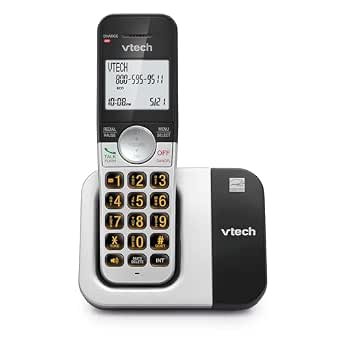
VTech Amplified Cordless Senior Phone with Answering Machine, Call Blocking, 90dB Ringer, Audio Assist, Big Buttons
This VTech is the clearest choice here for someone who may miss calls because of hearing or vision changes. Its 90dB ringer and visual indicator add more than one way to notice an incoming call, and adjustable volume boost, large buttons, and a bright display make daily use less dependent on precise hearing or eyesight. It also combines a digital answering machine, call blocking, hearing-aid compatibility, and photo speed dial. Compared with the Panasonic KX-TGM420W, it is less ambitious on speech tools: Panasonic adds voice-tone settings and Slow Talk, which can help users follow fast callers. This VTech’s main tradeoffs are its single-line setup and bulkier form; its listed recording capacity is 22 minutes.
Pros:- 90dB ringer and visual indicator provide audible and visual call alerts
- Large buttons and bright display support easier dialing and reading
- Digital answering machine records up to 22 minutes of messages
- Call blocking, hearing-aid compatibility, and photo speed dial support common senior needs
Cons:- Single-line operation does not suit homes that need multiple phone lines
- The larger form may take up more space than simpler cordless options
- Offers fewer speech-adjustment tools than the Panasonic KX-TGM420W
Best for: Seniors who need a very loud ringer, larger controls, visual call alerts, and photo speed dial in one phone
Not ideal for: People who want adjustable speech tone or Slow Talk, or who prefer a smaller handset and base
- Answering system:Digital
- Recording capacity:22 minutes
- Ringer:Up to 90dB
- Line operation:Single-line
- Standby time:5 days
- Conference calling:3-way
- Color:White
- Dimensions:8.46 x 7.28 x 4.72 inches
- Weight:1.5 pounds
Our verdict“Pick this VTech when a loud ringer, visual alerts, and large controls matter more than a compact design or advanced speech playback.”
Panasonic KX-TGM420W + (1) KX-TGMA44W Amplified Cordless Phone with Digital Answering Machine and Voice Volume Booster upto 40 dB (2 Handsets)
I’d put the Panasonic KX-TGM420W ahead of basic cordless systems for seniors who can hear the phone but struggle to understand particular voices or fast speech. Its volume boost up to 40dB, six voice-tone settings, noise reduction, and one-touch Slow Talk let the user adjust a call rather than relying on volume alone. Talking Caller ID and keypad prompts, visual ringers, and a digital answering machine add useful support around the conversation. Compared with the VTech amplified senior phone, Panasonic offers more ways to shape speech and includes power backup, while VTech has a listed 90dB ringer and photo speed dial. The Panasonic’s feature set may take more setup and learning, and its message capacity is 17 minutes. It is expandable to six handsets.
Pros:- Volume boost up to 40dB and six voice-tone settings help tailor calls
- Slow Talk can make fast speech easier to follow in live calls and messages
- Noise reduction and visual ringers support clearer, more noticeable calls
- Includes power backup, talking keypad, call blocking, and a digital answering machine
Cons:- The range of audio and phonebook features may require more setup and learning
- Answering-machine recording capacity is 17 minutes, less than the VTech amplified model’s listed 22 minutes
- Multi-line capability may be unnecessary complexity for a single-line household
Best for: Seniors with mild to moderate hearing loss who benefit from adjustable voice tone, slower speech, and amplified caller volume
Not ideal for: People who want the simplest possible controls or need the longest listed answering-machine recording capacity
- Handsets:2
- Volume boost:Up to 40dB
- Voice-tone settings:6
- Answering system:Digital
- Recording capacity:17 minutes
- Talk time:13 hours
- Standby time:9 days
- Expandable system:Up to 6 handsets
- Call blocking:Up to 250 numbers
Our verdict“Choose the Panasonic when customizable speech clarity and Slow Talk are more useful than a simpler interface or longer message capacity.”
VTech Cordless Phone with DECT 6.0, Full-Duplex Speakerphone, Lighted Display, Backlit Keypad, Caller ID/Call Waiting, Volume Control, Hearing Aid Compatible, Wall Mount
The VTech VG131-11 is the most suitable pick here when counter space is limited or the phone needs to sit on a wall. Its wall-mountable design, backlit keypad, and lighted display make it easier to place where a senior can see and reach it, while hearing-aid compatibility and volume control serve basic accessibility needs. DECT 6.0 and a full-duplex speakerphone round out everyday calling. Compared with the two-handset VTech CS6719-2, this is a more flexible placement choice but comes with only one handset and no handset intercom. It also lacks an answering machine, so missed calls cannot be recorded on the phone. The listed standby time is two days, a shorter figure than the other VTech’s four days.
Pros:- Wall-mount capability offers flexible placement and frees a surface
- Backlit keypad and lighted display aid use in low light
- Full-duplex speakerphone supports natural hands-free conversation
- Hearing-aid compatibility and volume control address basic audio needs
Cons:- No built-in answering system for missed-call messages
- One handset and no listed intercom are less versatile than the VTech CS6719-2
- Listed standby time is two days
Best for: Seniors who need one cordless handset mounted near a doorway, kitchen, or other reachable wall location
Not ideal for: Households needing multiple handsets, built-in message recording, or longer listed standby time
- Handsets:1
- Technology:DECT 6.0
- Answering system:No
- Line operation:Single-line
- Conference calling:2-way
- Standby time:2 days
- Talk time:1 day
- Color:Black
- Weight:0.42 kg
Our verdict“Choose this VTech for a single, wall-mounted phone with accessible lighting and speakerphone features, but skip it if you need multiple handsets or message recording.”
AT&T BL102-2 DECT 6.0 Cordless Phone System with 2 Handsets, Answering Machine, Call Blocking, Caller ID Announcer, and Unsurpassed Range
The AT&T BL102-2 makes the most sense for a senior who wants two handsets, message recording, and fewer unwanted calls in one setup. Its call blocking and caller ID announcer can help identify or screen calls before answering, while the answering machine stores up to 22 minutes of messages. A large display, lighted keypad, visual ringer, and intercom also support everyday use around the home. Compared with the VTech CS6719-2, AT&T adds an answering machine and call-screening tools, making it more capable for missed calls and nuisance calls. It does not offer the dedicated 90dB ringer of the VTech amplified senior phone, however. It remains a single-line landline system, and its range claim is not given as a measurable distance in the supplied specifications.
Pros:- Two handsets provide access to the phone in separate rooms
- Answering machine holds up to 22 minutes of messages
- Call blocking and caller ID announcer support call screening
- Large display, lighted keypad, visual ringer, and intercom improve everyday access
Cons:- Single-line landline operation does not support multiple lines
- Does not list a dedicated 90dB ringer or the adjustable speech tools of the Panasonic KX-TGM420W
- No Wi-Fi or mobile connectivity
Best for: Seniors who want two handsets, a built-in answering machine, and call-blocking tools for a single-line home
Not ideal for: People who need strong hearing amplification, a specified range measurement, or mobile and Wi-Fi calling
- Handsets:2
- Technology:DECT 6.0
- Answering capacity:22 minutes
- Caller ID storage:50 entries
- Standby time:6 days
- Talk time:10 hours
- Line operation:Single-line
- Additional features:Call blocking, intercom, ECO mode, visual ringer
- Power:Battery powered; batteries included
Our verdict“Choose the AT&T when two handsets, call screening, and recorded messages matter more than specialized hearing amplification or connected-phone features.”
Panasonic Amplified Cordless Phone with Large Display, Slow Talk, and Hearing Aid Compatibility
For a senior who has trouble following fast or quiet conversations, this Panasonic puts hearing support ahead of extra convenience features. Its volume boost reaches 40 dB, the ringer reaches 100 dB, and Slow Talk reduces speaking speed during calls and message playback. The talking keypad and caller ID can also help when reading a small screen is difficult. Compared with the VTech VG231, which offers large buttons and hearing aid compatibility, this model adds much stronger amplification and Slow Talk; the VTech is a simpler fit for people who do not need that level of audio assistance. The tradeoff is a more involved interface, plus AAA batteries are required. It is also a landline phone, not a replacement for a mobile-only setup.
Pros:- Volume boost up to 40 dB and ringer volume up to 100 dB
- Slow Talk can make fast speech easier to follow
- Talking keypad and caller ID support users who have difficulty reading the display
- Expandable to six handsets, with call blocking and intercom
Cons:- AAA batteries require replacement over time
- The range of features may make the interface harder to learn
- Designed for landline use rather than mobile-only households
Best for: Seniors with hearing loss who want adjustable call volume, a loud ringer, and spoken caller information on a landline.
Not ideal for: People who want a very simple handset, use only mobile service, or do not need amplified audio features.
- Handsets:1; expandable to 6
- Volume boost:Up to 40 dB
- Ringer volume:Up to 100 dB
- Display:1.8-inch backlit
- Answering system:Digital
- Audio and accessibility features:Slow Talk, talking caller ID, talking keypad, noise reduction
- Additional features:Call block, intercom, power backup
- Power:Battery powered; 2 AAA batteries included
Our verdict“Choose this Panasonic when hearing assistance matters more than having the simplest possible cordless phone.”
Panasonic Cordless Phone with Advanced Call Block, Bilingual Caller ID, Easy to Read Large High-Contrast Display, Expandable System with 1 Handset, KX-TGD810B (Black)
This Panasonic is a strong match for seniors whose main frustration is unwanted calls rather than difficulty hearing. Advanced call blocking and a one-ring scam alert address common household nuisances, while the high-contrast display and illuminated keypad make everyday dialing easier to see. Its bilingual caller ID is a useful extra for households that prefer caller information in either supported language. Compared with the amplified Panasonic B01LZV2HVG, the KX-TGD810B gives more attention to call screening and less to hearing support: it does not offer the same 40 dB volume boost or Slow Talk. The full-duplex speakerphone, intercom, and expandability to six handsets help it serve a household, but the supplied system has just one handset and a single phone line. Buyers who need an answering machine should look at a model that specifically includes one.
Pros:- Advanced call blocking and one-ring scam alert
- High-contrast display and illuminated keypad aid visibility
- Bilingual caller ID and full-duplex speakerphone
- Expandable to six handsets, with intercom and baby monitor functions
Cons:- Only one handset is included
- Does not list the substantial volume boost or Slow Talk found on the amplified Panasonic
- Single-line operation may not suit households needing multiple phone lines
Best for: Seniors who receive frequent robocalls or telemarketing calls and want a readable handset with call-screening features.
Not ideal for: People who need strong audio amplification, multiple handsets out of the box, or an included answering machine.
- Model:KX-TGD810B
- Handsets:1; expandable to 6
- Display and keypad:Large high-contrast display; illuminated keypad
- Caller ID:Bilingual caller ID
- Call protection:Advanced call block and one-ring scam alert
- Speakerphone:Full duplex
- Call features:Intercom, baby monitor, three-way conference calling
- Talk and standby time:Up to 10 hours talk; up to 120 hours standby
- Power:2 AAA batteries required; included
Our verdict“Pick the KX-TGD810B if call screening and a readable display matter more than amplified sound or an answering machine.”
VTech DECT 6.0 Cordless Phone with Large Display and Big Buttons
The VTech VG231 keeps the senior-friendly priorities straightforward: big lighted buttons, a 2-inch backlit display, and hearing aid compatibility. That makes it a sensible choice for someone who wants to dial and answer calls without learning a more feature-heavy system. Its stated range of up to 1,000 feet may also suit a larger home, and compatibility with landline, VoIP, and cable services gives it broader service flexibility than the landline-focused amplified Panasonic B01LZV2HVG. The tradeoff is a lean feature set: there is no answering machine or call blocking, so it cannot screen nuisance calls or save messages when nobody is home. Compared with the Panasonic KX-TGD810B, it offers more emphasis on large controls and broad service compatibility, but less help against unwanted calls.
Pros:- Large 2-inch backlit display and lighted oversized keypad
- Hearing aid compatible
- Compatible with traditional landline, VoIP, and cable services
- Full-duplex speakerphone and stated range up to 1,000 feet
Cons:- No answering machine is included
- No call blocking feature
- Basic feature set lacks the amplified audio and scam protections available on other picks
Best for: Seniors who want large controls, a readable screen, hearing aid compatibility, and a basic phone that can work with several phone services.
Not ideal for: People who need an answering machine, call blocking, multiple included handsets, or strong audio amplification.
- Technology:DECT 6.0
- Display:2-inch backlit
- Keypad:Large, lighted buttons
- Range:Up to 1,000 feet
- Caller ID storage:50 calls
- Speakerphone:Full duplex
- Battery life:Up to 10 hours talk; up to 7 days standby
- Hearing aid compatibility:Yes
- Answering machine:Not included
Our verdict“Choose the VG231 for easy-to-see dialing and service flexibility, but skip it if call screening or message recording is a priority.”
Panasonic Cordless Phone with Answering Machine, Advanced Call Block, Bilingual Caller ID and High-Contrast Display, Expandable System with 3 Handset Cordless Telephones – KX-TGD833M (Metallic Black)
For a senior household that needs phones in several rooms, the KX-TGD833M begins with a practical advantage: three handsets are included, rather than requiring extra handsets to be added later as with the one-handset KX-TGD810B. Its high-contrast display, illuminated keypad, and speed dial make routine use less fiddly, while the answering machine covers calls when nobody is near a handset. Automated and one-touch call blocking help reduce unwanted calls, and the system can block up to 1,000 numbers according to the product description. Conversation recording may help with remembering details, though an announcement tells callers recording has started. Compared with the amplified Panasonic B01LZV2HVG, this model favors household coverage and call management over hearing-specific features; the supplied details do not list a volume boost or Slow Talk.
Pros:- Three handsets included for use in different rooms
- Answering machine helps capture calls when the phone is unattended
- Automated call blocking, one-touch blocking, and one-ring scam alert
- High-contrast display, illuminated keypad, and speed dial
Cons:- Product details do not specify amplified volume or Slow Talk for hearing support
- Multiple call-management features may be more complicated than a basic phone
- Conversation recording announces itself to callers
Best for: Older adults or families who want handsets in multiple rooms, an answering machine, and extensive nuisance-call controls.
Not ideal for: Seniors who need strong amplification or Slow Talk, or buyers who only need one handset and want a simple setup.
- Model:KX-TGD833M
- Handsets:3 cordless handsets
- Answering system:Answering machine included
- Display and keypad:High-contrast display; illuminated keypad with large characters
- Call protection:Automated call blocking, telemarketing call block, one-ring scam alert
- Call block capacity:Up to 1,000 numbers with one-touch call block
- Recording:Two-way conversation recording with recording announcement
- Convenience features:Speed dial; wall-mountable design
Our verdict“Choose the KX-TGD833M for ready-to-use room coverage and call management, not for specialized hearing amplification.”
Panasonic Cordless Phone, 1.6″ Backlit Display, Call Block, Speakerphone, 10 Hours Talk Time, 1 Handset – KX-TGC200B (Black)
The KX-TGC200B is the uncomplicated choice in this group for a senior who wants a clear screen, speakerphone, and a modest way to block unwanted callers. Its 1.6-inch amber backlit display is intended to stay readable in low light, while DECT 6.0 and up to 10 hours of talk time cover ordinary home calling. Call blocking for up to 30 numbers is useful, though much narrower than the advanced call protection on the Panasonic KX-TGD810B or KX-TGD833M. It is also a single-handset system with no answering machine listed, so it suits a smaller setup better than the three-handset KX-TGD833M. Buyers should not choose it for large buttons or hearing amplification: those features are not specified here.
Pros:- Backlit display supports reading and dialing in low light
- Blocks up to 30 unwanted numbers
- Speakerphone allows hands-free calls
- Up to 10 hours talk time and 144 hours standby time
Cons:- Only one handset is included
- Call blocking is limited to 30 numbers, less extensive than the advanced Panasonic systems
- No answering machine or hearing amplification is specified
Best for: Seniors who want a straightforward single-handset phone with a backlit screen, speakerphone, and basic number blocking.
Not ideal for: Households that need multiple handsets, an answering machine, large buttons, or advanced scam and robocall screening.
- Model:KX-TGC200B
- Handsets:1
- Display:1.6-inch amber backlit
- Call blocking:Blocks up to 30 numbers
- Technology:DECT 6.0
- Speakerphone:Yes
- Talk time:Up to 10 hours
- Standby time:Up to 144 hours
- Power feature:Eco Mode
Our verdict“Pick the KX-TGC200B for basic home calling and simple call blocking; choose another model for larger controls or broader protection.”

How We Picked
I compared the 15 listed models against the needs that most often shape a senior’s phone choice: audibility, visibility, button usability, and everyday simplicity. I also looked at practical differences such as answering-machine access, call blocking, caller ID, speakerphone use, hearing-aid compatibility, handset count, wall mounting, and whether a model adds a useful feature for a specific need rather than simply more settings.
The ranking favors phones that address common access needs while remaining straightforward to choose and use. The Panasonic KX-TGM420W ranks highest for buyers who need strong audio support and an answering machine in one system; the VTech amplified senior phone is a distinct alternative for those who value a loud ringer and big buttons. Simpler VTech, AT&T, and Panasonic models rank lower for specialized accessibility but can be better fits when easy calling, readable controls, or call management matter more than amplification. I treated features as tradeoffs, not automatic upgrades: extra handsets and blocking options help some households but can add setup and menu complexity.
Factors to Consider When Choosing Cordless Phones For Seniors
Before choosing a model, start with the difficulty the phone needs to solve. A handset intended to help with hearing loss may not be the easiest choice for someone whose main concern is reading the keypad, and a feature-rich system can complicate calling if only basic functions are needed. These broader checks can help narrow the field before comparing individual models.
Match the audio support to the listening difficulty
Volume controls, amplified incoming voices, and a loud ringer address different problems. Someone who misses incoming calls may benefit most from a stronger ringer, while a person who can hear the ring but struggles during conversation may need voice amplification. Try to identify whether the difficulty is hearing the other caller, hearing the phone ring, or following fast speech; one feature does not automatically solve all three. If hearing aids are used, check the phone’s compatibility and consider whether speakerphone is a comfortable alternative. Avoid choosing solely by the largest amplification figure, since comfortable, clear sound matters more than maximum volume alone.
Judge visibility by more than screen size
A large display can make caller details easier to read, but keypad visibility and button spacing matter just as much during dialing. Look for clear contrast, backlighting, and labels that remain legible in the room where the phone will sit. A bright screen may be less helpful if the keys are small or difficult to distinguish by touch. Think about lighting at night and whether the user usually dials from a chair, bedside table, or wall-mounted location. Buyers should favor controls the user can recognize consistently over a long feature list.
Choose the handset count around the home
Extra handsets can make a cordless phone more convenient across a larger home, but they also need charging spots and initial setup. Count the places where calls are commonly answered before choosing a multi-handset package; a handset that stays unused in a drawer adds little value. A second handset can be particularly helpful when stairs or long hallways make reaching a single base inconvenient. For a compact home or a user who prefers one familiar handset, a single-handset system may be easier to manage. Check whether the included handsets share one phone line and how they communicate with the base before planning placement.
Decide whether an answering machine is still useful
An answering machine can keep missed messages available on the home phone, which is helpful if the user does not regularly check voicemail on a mobile device. It may be unnecessary when a carrier voicemail service or a family member already manages messages. Consider who will retrieve and delete recordings, and whether the controls are easy for that person to use. Call blocking and caller ID can reduce unwanted interruptions, but they are not the same as screening every unknown caller. A simpler handset may be a better fit if the household relies on another service for messages and wants fewer controls to learn.
Keep setup and daily operation manageable
Features such as call blocking, bilingual caller announcements, intercom, and mobile-phone connection can help particular households, but each adds choices and settings. Ask which features the user will actually use and who can help with setup or troubleshooting. A phone with fewer menus may be a better everyday tool than a more capable system that the user finds confusing. Place the base where it has a reliable connection to the phone line and easy access to power, with charging handsets in familiar locations. If multiple people will use the system, agree on a simple routine for charging, checking messages, and handling blocked calls.
Frequently Asked Questions
Should I choose an amplified phone or one with big buttons?
Choose based on the problem that disrupts calls most. Amplification can help someone hear conversation or ringing, while large buttons and a readable display help with dialing and seeing caller details. If both hearing and vision are concerns, compare models that combine these features rather than assuming one will compensate for the other. A family member can help identify whether missed calls, misunderstood speech, or dialing errors happen most often. That pattern is a better guide than choosing by a single headline feature.
Is a cordless phone a good choice if the user wears hearing aids?
It can be, but check the specific phone’s hearing-aid compatibility and consider how the user prefers to hold or position a handset. Speakerphone may be more comfortable for some people, while others prefer a handset for privacy. Amplification controls can help, but louder sound is not always clearer or more comfortable. If possible, let the user try the controls before relying on the phone as their main calling device. Also consider whether the handset and its charging base will be easy to find and use consistently.
Do I need an answering machine if the phone has caller ID and call blocking?
No. Caller ID identifies incoming calls, and call blocking can limit some unwanted calls; neither feature records messages from callers who reach the phone and get no answer. An answering machine is useful when the user wants messages stored on the home phone and does not regularly check voicemail elsewhere. Before buying, find out whether the landline provider already supplies voicemail and who will manage it. Avoid paying attention to feature count alone: the better choice is the one that fits the household’s existing message routine.
How many handsets should I get for an older adult living alone?
One handset can be enough in a small home when the user can comfortably reach it from the places where calls are answered. A second handset can make a noticeable practical difference across multiple floors or long distances between rooms. More handsets also mean more charging locations and another device to keep track of, so add them where they solve a real access problem. Think about mobility and the usual daily routine, not only the home’s square footage. If the user often cannot reach the phone in time, placing another handset nearby may matter more than adding advanced call features.
When does it make sense to choose a simpler cordless phone?
A simpler model makes sense when the user can hear and read ordinary phone controls and mainly needs reliable calling, caller ID, or speakerphone. Extra settings can be unnecessary if call blocking, message recording, or amplified audio will not be used. Simplicity can also make it easier for a family member to explain the phone and help troubleshoot it. On the other hand, do not skip an accessibility feature that addresses a recurring problem merely to reduce the feature count. Start with the user’s actual calling difficulties, then choose the least complicated phone that addresses them.
Conclusion
For most buyers seeking a balance of accessibility and useful everyday functions, my best overall recommendation is the Panasonic KX-TGM420W, particularly when amplified conversation and an answering machine are priorities. The best value in practical features is the VTech amplified senior phone for users who need a loud ringer, Audio Assist, and big buttons; the Panasonic large-display options are better when visibility matters more than strong amplification. For a best premium-style accessibility pick, choose the Panasonic KX-TGM420W; for beginners who want straightforward calling, consider a simpler VTech or AT&T handset with only the functions they will use. For specific needs, look to Panasonic’s large-display models for easier reading, a multi-handset system for a spread-out home, or an AT&T model with mobile-phone connection when integrating a cell phone matters. Match the handset to the person’s hearing, eyesight, and home layout, and the right choice should become clear.
Cold & flu season Picks
humidifiers
As an affiliate, we earn on qualifying purchases.