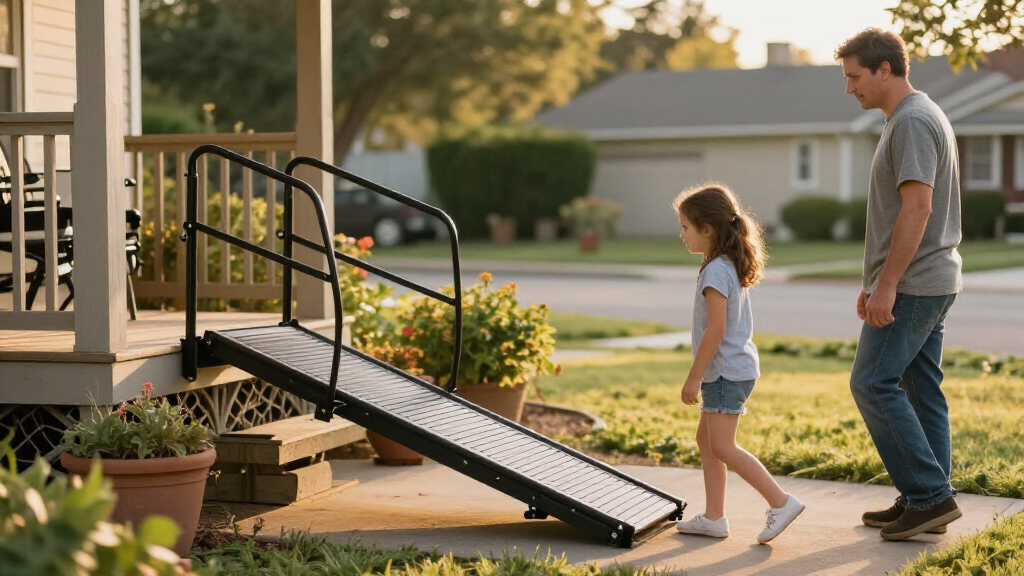

Portable wheelchair ramps solve one specific problem: getting a wheelchair, scooter, or walker over steps, curbs, and raised thresholds without permanent construction. After comparing 15 of the most popular options, the VNN 8FT Portable Wheelchair Ramp stands out as the best overall pick because its extra length keeps the incline gentle enough for safe self-propulsion over typical porch steps. The KOLOTOOL 7FT Telescoping Ramp 2-Pack is the standout for vehicle use, since telescoping channels adjust to different heights and store flat, while the EVA Threshold Ramp is the clear choice for indoor door thresholds too low for aluminum folding ramps. The main tradeoff in this category is length versus portability: longer ramps are safer and easier to push up but heavier to lift and harder to fit in a car trunk. Keep reading for the full breakdown by use case, including which ramps justify paying more and which budget models cut the right corners.

Turn quiet afternoons into listening time
- Thousands of audiobooks, podcasts and originals
- Listen on your phone, tablet or Echo — also offline
- Cancel anytime
Complete the kit


Key Takeaways
- Length was the single biggest differentiator in this roundup: the 8-foot ramps (VNN and TaiH Leo) produced the only inclines gentle enough for a wheelchair user to self-propel up a standard two-step porch, while every 2–3 foot ramp here is threshold or single-step territory only.
- Roughly half the lineup is variations of the same folding aluminum channel design (VNN alone appears six times), so the real differences came down to hinge quality, surface grip texture, and included transition plates — not the basic format.
- The KOLOTOOL telescoping 2-pack is the only vehicle-focused option in the group; every other ramp is a full-width platform designed for steps and doorways, making it the pick to beat for van and SUV loading.
- Support legs (only on the TaiH Leo 8FT) added noticeably more weight capacity confidence at long lengths, which explains why it ranked near the top despite being the least convenient to move.
- All 800 lb-capacity aluminum ramps in this comparison weigh between 20 and 45 pounds — buyers should calculate whether the caregiver can actually lift and position the ramp before choosing a longer model.
- The EVA threshold ramp plays a completely different role than the other 14: it handles 1–2 inch door thresholds that folding ramps can’t address, so it’s a complement to, not a substitute for, an aluminum ramp.
| EVA Threshold Ramp for Wheelchairs, Scooters, and Walkers, 36 x 28.5 x 5 Inches |  | Best for Door Thresholds | Material: EVA foam | Dimensions: 36 x 28.5 x 5 inches | Alternate size: 36 x 24 x 4 inches | VIEW LATEST PRICE | See Our Full Breakdown |
| KOLOTOOL 7FT Telescoping Aluminum Portable Wheelchair Ramp (2-Pack) |  | Best for Vehicle Loading | Material: Aluminum alloy | Length: 48″ to 84″ telescoping | Weight capacity: 600 lbs | VIEW LATEST PRICE | See Our Full Breakdown |
| VNN Portable Wheelchair Ramp 8FT |  | Best Overall | Length: 8 feet | Material: Aluminum | Max weight capacity: 800 lbs | VIEW LATEST PRICE | See Our Full Breakdown |
| VNN Portable Aluminum Wheelchair Ramp (3 ft) |  | Best for Low Steps | Length: 3 ft | Material: Aluminum | Load capacity: 800 lbs | VIEW LATEST PRICE | See Our Full Breakdown |
| WHALEMOTOR Portable Wheelchair Ramp 5FT, Anti-Slip Aluminum Folding Ramp with Transition Plates |  | Best Mid-Length Value | Length: 5 feet | Material: Aluminum | Weight capacity: 603 lbs (listing also claims 800 lbs) | VIEW LATEST PRICE | See Our Full Breakdown |
| Portable 3 ft Aluminum Wheelchair Ramp |  | Best for Medium Home Steps | Length: 3 ft | Weight capacity: 800 lbs | Product weight: 18.7 lbs | VIEW LATEST PRICE | See Our Full Breakdown |
| FACHNUO 3 ft Portable Aluminum Wheelchair Ramp |  | Best Carried-Anywhere 3-Footer | Unfolded size: 36 × 29 × 2 in | Folded size: 36 × 14.5 × 3.2 in | Recommended step height: 3–9 in | VIEW LATEST PRICE | See Our Full Breakdown |
| FACHNUO 2 ft Portable Aluminum Wheelchair Ramp |  | Best Lightweight Threshold Pick | Unfolded size: 24 × 29.2 × 2 in | Folded size: 24 × 13.2 × 3.2 in | Weight: 10.9 lbs | VIEW LATEST PRICE | See Our Full Breakdown |
| VEVOR 5FT Portable Wheelchair Ramp |  | Best for Steeper Entry Steps | Length: 5 ft (59.8 in) | Width: 29.3 in | Weight capacity: 800 lbs | VIEW LATEST PRICE | See Our Full Breakdown |
| VNN 6-Foot Portable Aluminum Wheelchair Ramp |  | Best for High Steps and Porches | Length: 6 ft | Compatible step height: 6–18 in | Maximum weight capacity: 800 lbs | VIEW LATEST PRICE | See Our Full Breakdown |
| VNN 4-Foot Portable Wheelchair Ramp |  | Best for Standard Home Steps | Length: 4 ft | Compatible step height: 4–12 in | Maximum weight capacity: 800 lbs | VIEW LATEST PRICE | See Our Full Breakdown |
| 2 ft Portable Wheelchair Ramp, 800 lb Capacity |  | Best Lightweight Option | Length: 2 ft | Weight capacity: 800 lb | Compatible step height: 2–6 in | VIEW LATEST PRICE | See Our Full Breakdown |
| VNN 5-Foot Portable Non-Slip Aluminum Wheelchair Ramp |  | Best for Gentle Slopes | Brand: VNN | Length: 5 ft | Material: Aluminum | VIEW LATEST PRICE | See Our Full Breakdown |
| TaiH Leo 8FT Portable Aluminum Wheelchair Ramp with Support Legs |  | Best for High Rises and Heavy Loads | Brand: TaiH Leo | Length: 8 ft (96 in) | Width: 29 in | VIEW LATEST PRICE | See Our Full Breakdown |
| VNN Portable Wheelchair Ramp 7FT |  | Best for Vehicle Loading | Length: 7 ft | Material: Aluminum | Weight capacity: 800 lbs | VIEW LATEST PRICE | See Our Full Breakdown |
| portable wheelchair ramp | Material | Length | Weight capacity |
|---|---|---|---|
| EVA Threshold Ramp for Wheelch | EVA foam | — | 880 lbs |
| KOLOTOOL 7FT Telescoping Alumi | Aluminum alloy | 48" to 84" telescoping | 600 lbs |
| VNN Portable Wheelchair Ramp 8 | Aluminum | 8 feet | — |
| VNN Portable Aluminum Wheelcha | Aluminum | 3 ft | — |
| WHALEMOTOR Portable Wheelchair | Aluminum | 5 feet | 603 lbs (listing also claims 800 lbs) |
| Portable 3 ft Aluminum Wheelch | Aluminum alloy | 3 ft | 800 lbs |
| FACHNUO 3 ft Portable Aluminum | Aluminum with stainless steel hinge | — | — |
| FACHNUO 2 ft Portable Aluminum | Aluminum with corrosion-resistant stainless steel hinge | — | — |
| VEVOR 5FT Portable Wheelchair | Aluminum alloy | 5 ft (59.8 in) | 800 lbs |
| VNN 6-Foot Portable Aluminum W | Aluminum | 6 ft | — |
| VNN 4-Foot Portable Wheelchair | Aluminum | 4 ft | — |
| 2 ft Portable Wheelchair Ramp | Corrosion-resistant aluminum | 2 ft | 800 lb |
| VNN 5-Foot Portable Non-Slip A | Aluminum | 5 ft | 800 lbs |
| TaiH Leo 8FT Portable Aluminum | Aluminum | 8 ft (96 in) | 800 lbs |
| VNN Portable Wheelchair Ramp 7 | Aluminum | 7 ft | 800 lbs |
More Details on Our Top Picks
EVA Threshold Ramp for Wheelchairs, Scooters, and Walkers, 36 x 28.5 x 5 Inches
Most ramps in this roundup tackle full steps, but this EVA foam threshold ramp solves a different problem: the annoying 2-to-5 inch lip at a sliding door, garage threshold, or bathroom entry. Unlike the VNN 3 ft aluminum ramp, which is built for stair-style steps, this one simply sits in place — no carrying, no folding, no setup at all. Its 880 lb capacity easily handles power wheelchairs and scooters, a category the KOLOTOOL telescoping ramps explicitly exclude. The tradeoff is range: anything taller than roughly 5 inches needs a longer folding ramp instead. The grooved surface gives decent wet-weather grip, though foam will wear faster than ribbed aluminum over years of daily outdoor use.
Pros:- Zero setup — just set it down and roll over it
- 880 lb capacity accepts power chairs and scooters
- Lightweight foam is easy to reposition or store vertically
- Grooved traction works indoors and out
Cons:- Only covers low barriers up to about 5 inches
- Foam will degrade faster than aluminum under heavy daily outdoor traffic
Best for: Homeowners bridging low door sills, sliding-door tracks, or curb lips for wheelchairs, scooters, or walkers
Not ideal for: Anyone bridging steps taller than about 5 inches — this is a threshold solution, not a stair ramp
- Material:EVA foam
- Dimensions:36 x 28.5 x 5 inches
- Alternate size:36 x 24 x 4 inches
- Weight capacity:880 lbs
- Surface:Textured, grooved, non-slip
- Use:Indoor and outdoor
Our verdict“Buy this if your obstacle is a low door sill or curb lip rather than a step; choose a folding aluminum ramp for anything taller.”
KOLOTOOL 7FT Telescoping Aluminum Portable Wheelchair Ramp (2-Pack)
The telescoping design is what sets this pair apart: each track extends from 48 to 84 inches, so one purchase covers van loading, porch steps, and everything between. Compared with the fixed-length VNN 8 ft ramp, the KOLOTOOL trades a full-width platform for twin channels — narrower, lighter at 20 lbs for the pair, and far easier to stash in a trunk. The triple anti-slip surface and included storage bag make it a natural travel companion. The catch is real, though: it is rated for manual wheelchairs only, so power chair and scooter users should look at the VNN or WHALEMOTOR options instead. You also need to measure carefully, since channel ramps demand accurate wheel spacing.
Pros:- Adjustable 48-84 inch length replaces multiple fixed ramps
- Very light at 20 lbs total for the pair
- Tool-free telescoping setup and included storage bag
- Triple anti-slip, waterproof, rustproof construction
Cons:- Manual wheelchairs only — no power chairs or scooters
- Requires precise measurement of wheel spacing and needed length before use
Best for: Manual wheelchair users who frequently load into a van, SUV, or trunk and want adjustable length in one package
Not ideal for: Power wheelchair or scooter owners — the 600 lb rating and channel design exclude heavier mobility devices
- Material:Aluminum alloy
- Length:48″ to 84″ telescoping
- Weight capacity:600 lbs
- Total weight:20 lbs (2-pack)
- Compatibility:Manual wheelchairs only
- Features:Anti-slip, waterproof, rustproof, storage bag included
Our verdict“The most travel-friendly pick here for manual chair users who need one ramp to cover multiple rise heights on the road.”
VNN Portable Wheelchair Ramp 8FT
This is the pick I would point most buyers toward first, because an 8-foot length keeps slopes gentle on taller steps — the biggest safety factor in any ramp purchase. The seamless center hinge eliminates the mid-ramp gap that trips wheels (and catches pet paws), a genuine advantage over the WHALEMOTOR 5 ft and other two-panel designs where a hump can form at the fold point. With an 800 lb capacity, it accepts power wheelchairs and scooters that the KOLOTOOL tracks cannot, and the raised-edge, double non-skid surface adds confidence on damp days. The tradeoff is bulk: 8 feet folded is still long, and mounting to a wooden platform means sourcing screws yourself. It covers step heights of 8 to 24 inches, so very low thresholds are better served by the EVA foam ramp.
Pros:- Gentle slope for tall steps up to 24 inches
- Seamless hinge removes trip points and paw traps
- 800 lb capacity suits power chairs and scooters
- Double non-skid surface with raised safety edges
Cons:- Bulkier to store and transport than shorter or telescoping ramps
- Screws for wooden-platform mounting are not included
Best for: Households with higher steps (up to 24 inches) and heavier mobility devices who can trade storage space for a gentler slope
Not ideal for: Anyone with limited storage or vehicle space — 8 feet folded is awkward to transport compared with telescoping tracks
- Length:8 feet
- Material:Aluminum
- Max weight capacity:800 lbs
- Compatible step height:8-24 inches
- Design:Folding with seamless center hinge
- Model:VNWR08
Our verdict“The safest all-around choice for tall steps and heavy mobility devices, provided you have room to store it.”
VNN Portable Aluminum Wheelchair Ramp (3 ft)
Not every entrance needs 8 feet of aluminum. For a single 3-to-9 inch step — a porch landing, garage entry, or doorway — this shorter VNN ramp gets the job done at a lighter weight and lower commitment than its big sibling, the VNN 8 ft. It keeps the same 800 lb capacity and double non-skid surface, and adds thoughtful touches the larger model lacks: reflective stickers on the side baffles for visibility at night, plus transition plates for a smoother lip. At 18.3 lbs it is manageable for most caregivers to carry one-handed by the handle. Be aware that some flex mid-ramp is normal under load — noticeable but not alarming — and like every short ramp, it cannot stretch to taller rises, so measure your step before buying.
Pros:- Compact 3 ft length fits doorways and single low steps
- 800 lb capacity matches much larger ramps
- Reflective side baffles improve nighttime visibility
- Transition plates and stainless hinges create a smoother entry
Cons:- Noticeable flex or sinking under load before rebounding
- Capped at 9-inch step heights
Best for: Anyone bridging one modest step (3-9 inches) at a doorway, garage, or porch who wants high capacity in a compact package
Not ideal for: Homes with steps taller than 9 inches — the slope would be dangerously steep
- Length:3 ft
- Material:Aluminum
- Load capacity:800 lbs
- Weight:18.3 lbs
- Dimensions:36″ L x 29.2″ W x 2″ H
- Features:Folding, double non-skid, side baffles, reflective stickers, transition plates
Our verdict“The right size when one low step is your only obstacle — anything taller calls for the VNN 8 ft instead.”
WHALEMOTOR Portable Wheelchair Ramp 5FT, Anti-Slip Aluminum Folding Ramp with Transition Plates
The 5-foot length is the sweet spot many homes need: tall enough for 5-to-15 inch steps, short enough to store in a closet. Compared with the VNN 3 ft, the WHALEMOTOR covers roughly double the rise range, making it the better bet for a two-step porch. It includes transition plates with anti-slip mats, which firm up the entry and exit lips better than bare edges on some rivals. Two issues hold it back from a higher rank. First, the stated weight capacity conflicts — the title claims 800 lbs while the description says 603 lbs, so cautious buyers should assume the lower figure, which still covers most chairs but not all power chairs. Second, a center hump can develop where the ramp folds, requiring effort to flatten before it rolls true.
Pros:- Covers a wide 5-15 inch step height range
- Jagged anti-slip surface maintains traction when wet
- Transition plates with anti-slip mats stabilize entry and exit
- Folds compactly for closet or car storage
Cons:- Weight capacity is inconsistently listed (800 vs 603 lbs)
- Center hump can form at the fold point and needs flattening
Best for: Buyers facing two-step rises (5-15 inches) who want a middle-length ramp and don’t need more than roughly 600 lbs of capacity
Not ideal for: Heavier power wheelchair users — given the conflicting capacity claims, the conservative 603 lb figure may not be enough
- Length:5 feet
- Material:Aluminum
- Weight capacity:603 lbs (listing also claims 800 lbs)
- Step height compatibility:5 to 15 inches
- Surface:Jagged anti-slip
- Features:Folding, transition plates with anti-slip mats included
Our verdict“A sensible middle-length choice for typical two-step rises, provided your chair and rider stay under the safer 603 lb figure.”
Portable 3 ft Aluminum Wheelchair Ramp
This 3-footer occupies the middle ground of the lineup: more reach than the FACHNUO 2 ft ramp, far less bulk to lug around than the VEVOR 5FT. Its 800 lb capacity comfortably covers powered wheelchairs and scooters, and the reflective strips plus side baffles make it one of the more safety-focused options at this length. What stands out is how the fold-flat design shrinks it to just over 3 inches thick — it slides behind a door or into a car trunk without a fight. The tradeoff is inherent to the length: it only handles rises of 3–9 inches, so porch steps taller than that will need the VEVOR 5FT or VNN 6-foot instead. At 18.7 lbs, it is carry-able but not effortless for one person to move repeatedly.
Pros:- 800 lb capacity handles power wheelchairs and scooters with headroom
- Folds to just 3.2 inches thick for trunk storage
- Reflective strips and side baffles add visibility and edge protection
- Non-slip surface on both the tread and the underside
Cons:- Capped at a 9-inch rise, limiting use on taller steps
- At 18.7 lbs it is awkward for frequent repositioning by one person
Best for: Households with standard porch or entry steps in the 3–9 inch range who want a balance of reach and portability
Not ideal for: Anyone dealing with high deck or porch steps above 9 inches — the slope would be too steep to use safely
- Length:3 ft
- Weight capacity:800 lbs
- Product weight:18.7 lbs
- Compatible rise:3–9 in
- Folded size:36 × 14.6 × 3.2 in
- Unfolded size:36 × 29.2 × 2 in
- Material:Aluminum alloy
Our verdict“A sensible middle-length pick if your entry steps fall in the 3–9 inch range and you want a foldable ramp that stores almost anywhere.”
FACHNUO 3 ft Portable Aluminum Wheelchair Ramp
Compared with the Portable 3 ft Aluminum Wheelchair Ramp above, this FACHNUO model covers the same 3–9 inch rise and 800 lb capacity, but its built-in carrying handle changes the ownership experience — this is the 3-footer you actually take with you. The extended guide rails run longer than the baffles on the generic 3-footer, which helps keep chair wheels centered during the push up. The pleated non-slip texture gives dependable wet-weather grip too. Two honest tradeoffs: some buyers report the deck sinking slightly under load before rebounding, which is normal flex for this build but can feel unsettling the first time, and like its sibling it stops at a 9-inch rise, so taller porches push you toward the VEVOR 5FT.
Pros:- Integrated carrying handle makes transport genuinely one-person easy
- Extended guide rails keep wheels tracked better than short baffles
- Pleated non-slip texture holds up in damp conditions
- Stainless steel hinge resists corrosion outdoors
Cons:- Slight sinking-and-rebound flex under load can feel unstable
- Same 9-inch rise ceiling as shorter, cheaper rivals
Best for: Caregivers and travelers who move the ramp between locations and want a 3-foot length that is genuinely easy to carry
Not ideal for: Users bothered by flex underfoot — the slight sinking during use may undermine confidence even though it is harmless
- Unfolded size:36 × 29 × 2 in
- Folded size:36 × 14.5 × 3.2 in
- Recommended step height:3–9 in
- Maximum load:800 lbs
- Material:Aluminum with stainless steel hinge
- Key features:Portable handle, non-slip surface, side baffles, reflective strips, extended guide rails
Our verdict“The 3-foot ramp to pick when portability matters as much as the climb — just do not expect a rock-solid deck under load.”
FACHNUO 2 ft Portable Aluminum Wheelchair Ramp
At 10.9 lbs, this is the lightest ramp in this batch by a wide margin — nearly half the weight of its own FACHNUO 3 ft sibling — and that changes who can use it. Older users or caregivers who cannot manage an 18-lb panel can move this one daily without strain. It is built for the small stuff: thresholds, doorways, and low steps up to 4 inches for wheelchair access, where a longer ramp would be awkward overkill. The folding design with handle keeps it trunk-friendly. Be realistic about the limits: it is not a porch-step solution, the deck can flex slightly under heavy power chairs, and the extension plate may catch on sliding door tracks, so check your doorway layout before buying.
Pros:- At 10.9 lbs, easy for nearly anyone to carry and reposition
- Built-in handle and fold-flat design for daily transport
- Textured surface plus guide rails keep wheels on track
- Corrosion-resistant hinge suits outdoor doorway use
Cons:- Wheelchair-safe rise tops out around 4 inches
- Extension plate can interfere with sliding doors and thresholds
- Noticeable flex under heavier power chairs
Best for: Anyone managing low household thresholds and 2–4 inch door steps who needs a ramp light enough to move every day
Not ideal for: Porch or entry steps above 4 inches — the slope becomes unsafe, and exterior rises call for a 3-foot or longer ramp
- Unfolded size:24 × 29.2 × 2 in
- Folded size:24 × 13.2 × 3.2 in
- Weight:10.9 lbs
- Maximum load:800 lbs
- Recommended wheelchair step height:Up to 4 in
- Maximum wheelbase:27 in
- Material:Aluminum with corrosion-resistant stainless steel hinge
Our verdict“The right tool for small thresholds and doorway lips where a full-size ramp is unnecessary weight.”
VEVOR 5FT Portable Wheelchair Ramp
When your rise sits between 5 and 10 inches, a 3-foot ramp simply cannot produce a safe slope — that is where this VEVOR earns its slot. The extra 2 feet of length relative to the FACHNUO 3 ft flattens the angle on taller porches, and the double non-slip surface — grooved aluminum plus a textured coating — grips better than the single-texture decks on the shorter ramps here. Capacity stays at 800 lbs, so heavy scooters are covered. The costs are real, though: at 28 lbs folded into a 5-foot-long case, it is a two-handed carry that will not fit in a small sedan trunk easily, and installation demands flush ground and clearance behind the door, which not every entryway offers.
Pros:- 5-foot length creates a manageable slope on taller rises
- Double non-slip surface grips better than single-texture rivals
- 800 lb capacity suits heavy scooters and power chairs
- Reflective strips and raised baffles for low-light safety
Cons:- Heaviest and longest folded package in this batch at 28 lbs
- Requires flush ground placement and door clearance to install safely
- Slight sinking and rebound under load may worry cautious users
Best for: Homeowners with 5–10 inch porch or threshold rises who need a gentler slope than a 3-footer can provide
Not ideal for: Frequent travelers or small-car owners — a 28 lb, 5-foot folded panel is a hassle to load and store on the go
- Length:5 ft (59.8 in)
- Width:29.3 in
- Weight capacity:800 lbs
- Product weight:28 lbs
- Recommended height range:5–10 in
- Folded dimensions:59.8 × 14.65 × 3.35 in
- Material:Aluminum alloy
Our verdict“The length you need when steps are too tall for a 3-footer — as long as you can live with the bulk.”
VNN 6-Foot Portable Aluminum Wheelchair Ramp
This is the reach champion of the batch: a 6–18 inch compatible rise means it handles raised porches, landing steps, and even some deck heights that would leave the VEVOR 5FT and every 3-footer here unusable. The transition plates at top and bottom smooth out the lip where shorter ramps like the FACHNUO 2 ft can catch a caster wheel, and the non-skid layer over textured aluminum gives solid traction. It is also versatile beyond wheelchairs — carts, strollers, and scooters all work. The flip side: 6 feet of aluminum is a long, heavy carry, the 800 lb ceiling is a hard limit rather than guidance, and for low thresholds it is simply too much ramp — a 2-footer does that job with far less hassle.
Pros:- Handles rises up to 18 inches, the tallest in this batch
- Transition plates prevent wheel catches at the top and bottom
- Textured surface with non-skid layer for reliable traction
- Works for wheelchairs, scooters, strollers, and hand trucks
Cons:- Long and unwieldy to carry and store compared with shorter ramps
- 800 lb capacity is an absolute limit, not headroom to rely on
Best for: Properties with high porch, deck, or landing steps in the 6–18 inch range where shorter ramps cannot safely reach
Not ideal for: Low thresholds and small doorsteps — the extra length is wasted bulk, and a 2 or 3-foot ramp handles those better
- Length:6 ft
- Compatible step height:6–18 in
- Maximum weight capacity:800 lbs
- Material:Aluminum
- Surface:Textured with non-skid layer
- Hinges:Stainless steel
- Foldable:Yes
Our verdict“Buy it because your steps are genuinely tall — otherwise a shorter, lighter ramp will serve you better day to day.”
VNN 4-Foot Portable Wheelchair Ramp
The VNN 4-footer hits a sweet spot for typical porch and doorway rises, covering 4 to 12 inches of step height without the length (or price) of the bigger ramps in this lineup. Compared with the shorter 2 ft Portable Wheelchair Ramp, this model handles taller entrances that a compact ramp simply can’t approach at a safe angle, while remaining far more manageable than the VNN 7FT for everyday carrying. The double non-slip surface and reflective stickers translate to real confidence on wet mornings, and the 800 lb capacity easily covers a powered chair plus occupant. The tradeoff: some flex under load — the surface can sink slightly mid-use before rebounding, which feels unnerving the first time but doesn’t affect safety.
Pros:- Covers a wide 4–12 inch step height range, fitting most residential entrances
- 800 lb capacity handles power wheelchairs and scooters with room to spare
- Double non-slip surface with reflective stickers improves traction and visibility
- Folds in half with a carry handle for storage between uses
Cons:- Surface can flex and sink under heavy loads before rebounding
- Not long enough for vehicle loading or rises above 12 inches
Best for: Homeowners with porch or entry steps between 4 and 12 inches who want one ramp for daily wheelchair or scooter access
Not ideal for: Anyone loading into raised trucks or SUVs — the 4-foot length forces too steep an angle for vehicle use
- Length:4 ft
- Compatible step height:4–12 in
- Maximum weight capacity:800 lbs
- Material:Aluminum
- Surface:Textured with non-skid layer
- Foldable:Yes
- Hinges:Stainless steel
Our verdict“This pick makes the most sense for buyers solving a standard home-step problem who want proven capacity without hauling an 8-foot ramp.”
2 ft Portable Wheelchair Ramp, 800 lb Capacity
At 10.9 pounds, this is the ramp a single caregiver can grab with one hand — a claim nothing else in this batch can make. The VNN 4-Foot doubles the length but also the bulk, so for low curbs, sliding door tracks, or a single sunken threshold, this short model is the more sensible buy. It still carries the full 800 lb rating and the same textured, non-skid surface as its longer siblings, so nothing about safety is sacrificed for the lighter frame. The tradeoff is purely geometric: it works on steps of 2–6 inches only, with around 4 inches being the ideal rise. Measure before ordering — a 7-inch step will make this ramp unusably steep.
Pros:- Featherlight 10.9 lb weight makes one-handed carrying realistic
- Full 800 lb capacity despite the compact size
- Textured surface, baffles, and reflective strips match the safety kit of longer ramps
- Works for wheelchairs, scooters, walkers, and strollers indoors or out
Cons:- Limited to step heights of 6 inches or less
- Requires careful measurement of the rise before purchase
Best for: Caregivers and seniors dealing with low curbs, thresholds, or single steps of roughly 4 inches who need a ramp they can carry effortlessly
Not ideal for: Anyone with porch steps or vehicle loading — the 2-foot length only suits very low rises
- Length:2 ft
- Weight capacity:800 lb
- Compatible step height:2–6 in
- Recommended step height:4 in
- Weight:10.9 lb
- Material:Corrosion-resistant aluminum
- Hinges:Rust-proof stainless steel
- Design:Foldable with carrying handle
Our verdict“This option stands out for low-threshold problems where portability matters more than reach.”
VNN 5-Foot Portable Non-Slip Aluminum Wheelchair Ramp
The 5-foot length is where slope angle becomes comfortable for self-propelled wheelchair users — the same 10-inch rise that feels precarious on the VNN 4-Foot becomes a manageable grade here. This model carries over VNN’s full safety package: side barriers, reflective stickers, and transition plates at top and bottom that eliminate the lip-jolt of cheaper ramps. It’s also the length class where the VEVOR 5FT competes directly, and VNN’s non-slip coating plus barrier system is the more complete safety kit. Like the other unsupported VNN ramps, it will flex under load — if that concerns you, the leg-equipped TaiH Leo 8FT solves it, at the cost of considerable extra weight. Buyers should verify their rise suits 5 feet before committing.
Pros:- 5-foot length creates a gentler, safer slope than 3–4 foot options
- Transition plates on both ends smooth out entry and exit bumps
- Side barriers and reflective stickers add visibility and edge protection
- Folds with a handle for storage and works for carts, strollers, and scooters
Cons:- Deck flexes under heavier loads before rebounding
- Requires accurate step measurement to confirm 5 feet is the right length
Best for: Self-propelled wheelchair users or families with mid-height entrances (roughly 8–13 inches) who need an easier push angle
Not ideal for: Higher porches or vehicle decks — at taller rises the angle gets steep, and there’s no leg support to firm up the deck
- Brand:VNN
- Length:5 ft
- Material:Aluminum
- Weight capacity:800 lbs
- Surface:Textured aluminum with non-slip coating
- Features:Foldable, carrying handle, side barriers, reflective stickers, transition plates
Our verdict“The right choice when the goal is an easier grade for active users rather than the shortest ramp that technically fits.”
TaiH Leo 8FT Portable Aluminum Wheelchair Ramp with Support Legs
Most foldable ramps in this roundup share one weakness: mid-span sag. The TaiH Leo 8FT is the only one here that fixes it outright with adjustable support legs spanning 11 to 15.8 inches, turning a flexing deck into a rigid platform. That makes it the pick for tall rises — it handles 8 to 24 inches, covering high porches and SUV loading that the VNN 4-Foot or VNN 7FT can’t reach safely. The 29-inch width also accommodates wider power chairs comfortably. The cost is real, though: at 55 pounds, moving it is a two-person job, and the legs require assembly before the ramp is fully stable. Portability here means ‘folds into a car’, not ‘carries like a suitcase’.
Pros:- Adjustable support legs eliminate the mid-span sag common to unsupported ramps
- Handles step heights from 8 to 24 inches, the widest range in this batch
- Extra-wide 29-inch deck suits larger power wheelchairs
- Folds to compact 48 x 14 x 6.3 inch dimensions for transport
Cons:- Heavy at 55 lbs — realistically needs two people to move
- Support legs require assembly before the ramp is fully stable
Best for: Owners of high porches, raised decks, or SUVs who need a rigid, sag-free ramp and have a second person to help move it
Not ideal for: Solo caregivers or anyone needing to reposition the ramp frequently — 55 pounds demands a two-person lift
- Brand:TaiH Leo
- Length:8 ft (96 in)
- Width:29 in
- Folded dimensions:48 x 14 x 6.3 in
- Weight capacity:800 lbs
- Product weight:55 lbs
- Material:Aluminum
- Step height compatibility:8–24 in
- Support leg height:11–15.8 in
Our verdict“This model is better suited to permanent-ish setups at tall rises where rigidity and capacity matter more than easy carrying.”
VNN Portable Wheelchair Ramp 7FT
Seven feet is the practical minimum for rolling a wheelchair into a minivan or SUV without an alarming climb, and this VNN model delivers that reach while staying genuinely portable — unlike the 55-pound TaiH Leo 8FT, it folds in half with comfortable handles and one person can manage it. The double non-skid surface (textured folds plus a bonded grip layer) matters most on vehicle ramps, where dew and rain are facts of life, and the stainless hinges won’t seize after a wet winter. Compared with the VNN 5-Foot, you gain roughly 40 percent more run for taller rises, but the flex issue is more pronounced over the longer unsupported span — expect a slight dip under a heavy power chair.
Pros:- 7-foot length keeps vehicle-loading angles within safe range
- Lightweight aluminum with folding handles makes solo use realistic
- Double non-skid surface grips well in wet conditions
- Stainless steel hinges resist rust for outdoor storage
Cons:- Longer unsupported span sags more noticeably under heavy loads
- Requires careful size checking against your specific step or vehicle height
Best for: Wheelchair or scooter owners who load into minivans and SUVs and want a ramp they can handle without help
Not ideal for: Buyers with only a single low step — 7 feet is more ramp than a 6-inch rise needs, and it’s awkward to store
- Length:7 ft
- Material:Aluminum
- Weight capacity:800 lbs
- Surface:Double non-skid (folded aluminum + non-skid layer)
- Hinges:Stainless steel
- Safety features:Side baffles, reflective warning stickers, transition plates
- Portability:Foldable with handles
Our verdict“The strongest pick in this batch for van and SUV access, balancing reach with a weight one person can actually carry.”
How We Picked
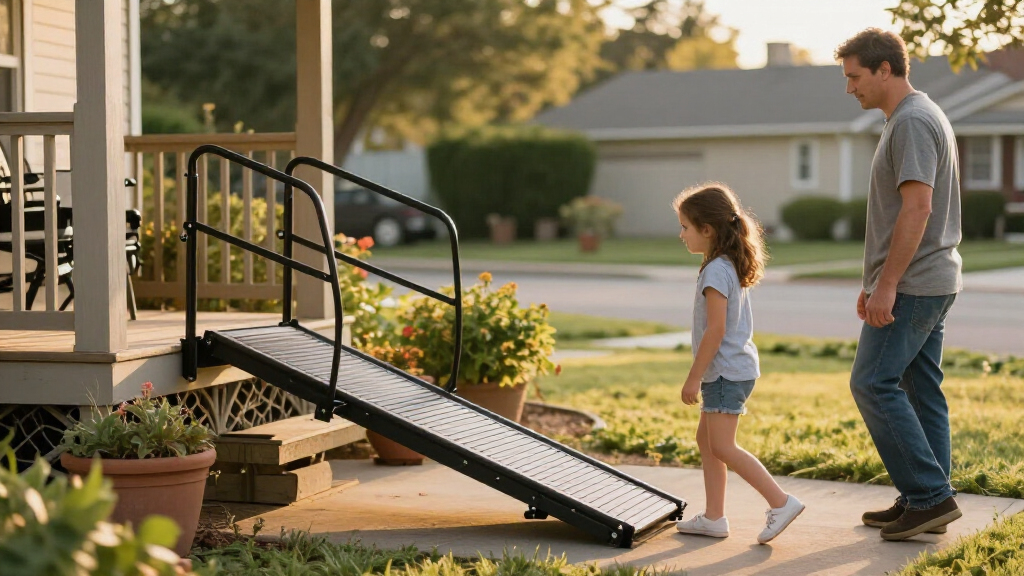
I evaluated each ramp against four criteria that directly affect safety and daily usability. Incline math came first: I calculated the actual slope each ramp produces at typical residential rise heights, because a 3-foot ramp over two steps is dangerously steep even if the spec sheet looks fine. Weight capacity relative to ramp length came second — an 800 lb rating means little if the ramp flexes across a long unsupported span, which is why models with center support legs ranked differently than identical-length channel ramps. Third, I assessed portability: folded dimensions, carry weight, and whether a handle or carrying bag was included, since a ramp too heavy to load defeats its purpose. Finally, I compared surface grip and edge protection, including anti-slip texture, raised side rails, and transition plates at the top and bottom lips where most tip-over incidents occur.
The ranking order reflects a simple principle: the safest usable incline for the most common scenario wins. That pushed longer ramps with quality hinge design to the top, mid-length folders into the value tier, and short threshold-style ramps into a specialized role rather than the middle of the pack. Where two ramps were nearly identical on paper, I favored the one with better transition plates and grip texture, because those details are what separate a ramp people trust from one they hesitate at.
| portable wheelchair ramp | Material |
|---|---|
| EVA Threshold Ramp for Wheelch | EVA foam |
| KOLOTOOL 7FT Telescoping Alumi | Aluminum alloy |
| VNN Portable Wheelchair Ramp 8 | Aluminum |
| VNN Portable Aluminum Wheelcha | Aluminum |
| WHALEMOTOR Portable Wheelchair | Aluminum |
| Portable 3 ft Aluminum Wheelch | Aluminum alloy |
| FACHNUO 3 ft Portable Aluminum | Aluminum with stainless steel hinge |
| FACHNUO 2 ft Portable Aluminum | Aluminum with corrosion-resistant stainless steel hinge |
| VEVOR 5FT Portable Wheelchair | Aluminum alloy |
| VNN 6-Foot Portable Aluminum W | Aluminum |
| VNN 4-Foot Portable Wheelchair | Aluminum |
| 2 ft Portable Wheelchair Ramp | Corrosion-resistant aluminum |
| VNN 5-Foot Portable Non-Slip A | Aluminum |
| TaiH Leo 8FT Portable Aluminum | Aluminum |
| VNN Portable Wheelchair Ramp 7 | Aluminum |
Factors to Consider When Choosing Portable Wheelchair Ramps
Choosing a portable wheelchair ramp is mostly geometry plus logistics. Before buying any of the models above, work through the factors below — most returns and safety problems in this category come from skipping one of these steps, not from picking a bad product.Measure Your Rise Before Anything Else
The most common mistake in this category is buying a ramp that’s too short for the height it needs to cover. The widely recommended guideline is 12 inches of ramp length per 1 inch of vertical rise for a comfortable incline, or a minimum of 8:1 if space is tight and the user has assistance. A 3-foot ramp therefore tops out around a 4–5 inch rise for safe use — enough for a single step or a low curb, but not a porch with two steps. Measure from the landing surface to the ground at every entrance where you’ll use the ramp, and if those measurements differ, buy for the tallest one. Also measure the available horizontal run: a 6-foot ramp needs 6 feet of clear, level space in front of the step, and a sidewalk or narrow walkway may not offer it. Buyers who skip this step often end up with a steep ramp the user can’t climb independently, which quietly negates the whole point of the purchase.
Weight Capacity Must Cover User Plus Equipment Plus Helper
Capacity ratings on ramps assume the total load, and it’s easy to underestimate. A power wheelchair or heavy-duty scooter alone can weigh 250–350 pounds before anyone sits in it, and if a caregiver will be pushing from behind while walking on the ramp, their weight counts too in practice. I’d treat 800 lb as the sensible floor for any powered mobility equipment, which is what most — but not all — ramps in this roundup offer. Also check whether the capacity is rated for a single axle or distributed load: narrow channel-style ramps like the telescoping models rate differently than full-width platforms. A margin of at least 100–150 pounds above your realistic maximum load gives you room for a second helper, a bag on the chair, or gradual equipment changes. Buying right at the limit isn’t cheaper in any meaningful way, since most well-rated ramps in this category already sit at the same capacity tier.
Folding vs. Telescoping vs. Threshold: Match the Format to the Job
Folding suitcase-style ramps, telescoping channel pairs, and foam threshold ramps solve different problems, and they don’t substitute for each other well. Folding ramps are the all-rounder choice for steps, porches, and occasional vehicle use — they set up in seconds but only work at one fixed length. Telescoping channels shine for vehicles and varying heights, but they require the user’s wheels to stay aligned in each channel, which makes them less forgiving for walkers or users with limited steering control. Threshold ramps handle the 1–2 inch door bumps that no aluminum ramp can address without becoming a trip hazard itself. If you’re buying for multiple locations, a fixed-length folding ramp you leave in place plus a telescoping pair for the car is often a better pairing than one compromise ramp. The buyers who complain most about ramps in this category usually bought one format and expected it to do another’s job.
Portability Is About the Caregiver, Not the Ramp
Every ramp in this roundup is technically portable, but ‘portable’ means very different things at 20 pounds versus 45. A two-piece folding design that splits into two manageable halves is worth real money if the person loading it into a trunk has limited strength — a single 40-pound folded slab is genuinely awkward even for able-bodied adults. Consider the folded footprint too: an 8-foot ramp folds to roughly 4 feet, which fits most SUVs but not every sedan trunk. If the ramp will mostly live on the porch and only travel occasionally, weight matters far less and you should prioritize length and stability instead. If it’s coming out of the car at every appointment, prioritize two-piece construction, a carry handle, and lighter gauge aluminum. Be honest about who will be moving the ramp and how often; that single question eliminates half the options instantly.
Surface Grip and Transition Plates Are the Safety Details
Ramp accidents usually happen at the top and bottom lips, not in the middle, which is why transition plates — the small angled flaps that bridge the gap between ramp and step — are one of the most underrated features on the spec sheet. A ramp without them tends to rock or leave a lip that catches small front casters. Grip texture matters just as much in wet climates: most aluminum ramps here use a pressed or coated anti-slip surface, but the depth of that texture varies, and a smooth ramp with morning dew on it is a real hazard. Raised side rails help keep wheels tracked, especially for users with tremor or one-handed propulsion. If you’re choosing between two otherwise similar ramps, these details are where the better product separates itself — and they’re exactly why nearly identical-looking ramps in this roundup landed at different positions.
When It Pays to Spend More — and When It Doesn’t
The price floor in this category buys you a functional ramp, and honestly the budget 3–5 foot folding ramps reviewed here are perfectly safe for light-duty use. Paying more earns you three specific things: longer lengths with support legs (necessary once you need 7–8 feet of run), telescoping adjustability for multi-height use, and heavier-duty hinges and hardware that survive daily folding cycles. Where more money does NOT help: a 2-inch door threshold (the foam ramp handles it), or a single low step used once a week — an entry-level 3-footer is the right call there. Daily-use and powered-equipment buyers should buy at the top tier once rather than upgrading twice. Occasional-use buyers should resist upselling and put the difference toward a second short ramp for another entrance, which solves more real problems than a premium finish does.
Frequently Asked Questions
How long of a portable ramp do I need for two standard porch steps?
Two standard steps typically rise 12–14 inches total, which calls for a 12–14 foot ramp at the recommended 1:12 slope — longer than anything in this roundup. Since most buyers don’t have that much walkway, the practical compromise is a 1:8 slope, which means an 8-foot ramp like the VNN 8FT or TaiH Leo 8FT for a two-step rise. That incline requires a helper for many users, especially in manual chairs, but it stays within generally accepted assisted-use guidelines. Anything under 6 feet over two steps creates a slope steeper than most safety guidance supports, even with assistance. If you can only fit a shorter ramp and the user cannot manage a steep incline with help, a semi-permanent solution or a vertical platform lift is the honest answer rather than an unsafe portable one.
Are telescoping channel ramps or full-width folding ramps better for loading into a car?
For vehicle loading, telescoping channels like the KOLOTOOL 7FT 2-Pack are usually the better tool, because they adjust to different bumper heights and store flat behind a seat. They also weigh less overall and don’t demand the trunk space a folded suitcase ramp needs. The tradeoff is precision: each wheel must enter and stay in its own channel, which works well for wheelchairs and scooters with predictable tracking but poorly for walkers, or users who struggle to steer a straight line. Full-width folding ramps are more forgiving — the whole vehicle width is usable — but you must measure your door threshold height and buy the exact right length, since they don’t adjust. If the vehicle is the primary use case and the user’s equipment tracks well, go telescoping; if the ramp doubles as a porch ramp, the full-width folder is the smarter buy.
Can I use a portable wheelchair ramp permanently on my front steps?
You can, but with realistic expectations. Portable ramps are designed for periodic repositioning, so leaving one outdoors full-time exposes the hinges, grip coating, and aluminum to weather — expect the anti-slip surface to degrade faster and hardware to need occasional tightening. Full-time outdoor use calls for the longest ramp you can accommodate, since you’ll be using it in rain and possibly ice when slope tolerance drops sharply. Secure it against wind and shifting, either with the included pins or a bracket, because an unsecured light ramp can slide under braking wheels. If the ramp will never move again, that’s really a signal to price a modular aluminum ramp system, which is built for permanent exposure and typically costs only modestly more than a top-tier portable. The portable route makes most sense when permanence is temporary — a recovery period, a rental home, or a seasonal entrance.
Is an 800 lb weight capacity necessary if the wheelchair user only weighs 180 pounds?
Often yes, because the user’s weight is only part of the load. A powered wheelchair commonly adds 200–350 pounds by itself, and a caregiver pushing from behind — even partially stepping on the ramp — contributes as well. That 180-pound user in a power chair with a helper can easily put 500-plus pounds on the surface. Beyond the raw number, capacity ratings also correlate with frame stiffness: higher-rated ramps flex less across their span, and flex is what makes users feel unsafe and what eventually fatigues hinges. For a manual chair, a solo user, and no helper, a lower-rated ramp is genuinely fine and there’s no reason to pay extra. For powered equipment or two-person assistance, treat 800 lb as the standard, which conveniently is what nearly every aluminum folding ramp in this roundup already offers.
What’s the difference between the EVA threshold ramp and the aluminum ramps — do I need both?
They solve entirely different problems, and many households genuinely benefit from owning both. The EVA threshold ramp is a firm foam wedge that compresses to fit vertical rises of roughly 1–2 inches — sliding door tracks, raised door sills, bathroom transitions — the gaps too small for any hinged aluminum ramp to address without creating its own edge. Aluminum ramps start being useful at about 3 inches of rise and dominate above that. If your obstacles are all under 2 inches, the foam ramp alone is the right and much cheaper answer. If you’re dealing with porch steps plus interior door thresholds, the two products work as a set, since neither covers the other’s range. The main caution with foam: it’s for thresholds, not steps, and it should never be stacked or used on a rise taller than its rated height.
Conclusion
The right pick here depends entirely on your rise height and who’s moving the ramp. For best overall, the VNN 8FT Portable Wheelchair Ramp delivers the gentlest incline in the roundup for standard porch steps, with solid capacity and grip. The TaiH Leo 8FT with support legs is my best premium pick — the added center support makes it the sturdiest long ramp here for heavier power chairs, at the cost of extra weight. For best value, the VEVOR 5FT and WHALEMOTOR 5FT folding ramps hit the sweet spot of price, capacity, and included transition plates for single-step rises.
For beginners and first-time buyers, the FACHNUO 3 ft is the low-risk entry point — cheap enough to test whether a ramp solves your problem before committing to a longer, pricier model. For vehicle use specifically, the KOLOTOOL telescoping 2-pack is the only real option in this lineup and does the job well. And for indoor door thresholds, skip aluminum entirely and get the EVA threshold ramp, which handles the 1–2 inch bumps nothing else here addresses. Measure your rise first, be honest about who lifts the ramp, and one of these fifteen will fit — the wrong length is the only truly bad outcome in this category.
Cold & flu season Picks
humidifiers
As an affiliate, we earn on qualifying purchases.