
For seniors comparing hearing aids, the Audien Atom X stands out as the best overall pick in this lineup for its touchscreen control, while the 16-channel DSP model offers more sound-adjustment options and the beginner-friendly white model emphasizes simpler operation. The main tradeoffs are control complexity, fit, charging routine, and how much product detail is available to judge performance. Battery claims range widely, but a longer stated runtime does not tell you whether a device will feel comfortable or make speech clearer in your daily settings. I compare all 14 options by their stated features, usability cues, and practical compromises. Read on for the full breakdown and guidance on choosing among them.

Turn quiet afternoons into listening time
- Thousands of audiobooks, podcasts and originals
- Listen on your phone, tablet or Echo — also offline
- Cancel anytime
Complete the kit



Key Takeaways
- Touchscreen controls distinguish the Audien Atom X; buyers who prefer physical volume buttons may find another model easier to operate.
- The 16-channel DSP option offers the clearest stated path to sound adjustment, while many listings mention noise reduction without describing how settings can be changed.
- Long battery claims are common in this group, including 80-plus and 100-hour claims, so compare what the runtime refers to and how the case fits your charging routine.
- Several product names point to similar priorities—rechargeability and noise reduction—making fit, controls, and available support more useful differentiators than broad feature labels.
- Audien Atom One and Atom Pro 2 provide recognizable alternatives within the same brand, while the Oricle listing emphasizes easy volume control and a portable charging case.








More Details on Our Top Picks
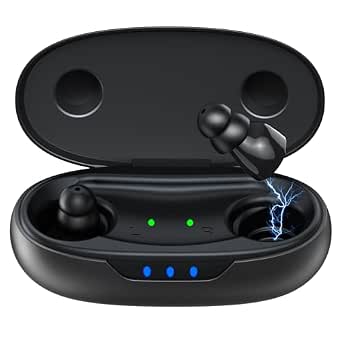
Hearing Aids Hearing Amplifiers for Seniors Rechargeable with Noise Cancelling Hearing Aid Loss Amplifier Seniors – Rechargeable with 48+ Hour Battery & Charging Case -Blue Red
For a senior who wants an in-ear fit and fewer charging interruptions, this model’s listed battery claims are its main distinction: up to 60 hours per charge and more than 110 hours of backup from the case. Those figures exceed the stated runtimes for the Karthus OTC Rechargeable Hearing Aids and its charging case, though the listings may use different measurement conditions. A single button cycles through five volume levels, and the case is described as powering the aids on and off when stored, which may simplify daily handling. The tradeoff is limited control: there are no named listening modes or personalized adjustments in the supplied details. The tiny, deep-canal design may also be harder to place and remove for people with reduced dexterity, and the product data does not specify a hearing-loss range.
Pros:- Up to 60 hours of use per charge is claimed
- Charging case is claimed to provide more than 110 hours of backup
- One button cycles through five volume levels
- Case is described as supporting automatic power on and off
Cons:- Small in-ear shape may be difficult to insert or remove
- No named listening modes or app-based personalization are specified
- Product data does not state a hearing-loss range
Best for: Seniors who prefer a discreet in-ear device and want long intervals between charging, with someone available to help if small devices are difficult to handle
Not ideal for: People with reduced finger dexterity, those who need clear physical handling cues, or buyers seeking documented hearing-loss suitability and adjustable listening modes
Our verdict“Choose this for its claimed extended battery life and discreet fit if you can comfortably handle small in-ear devices.”
Audien Atom X OTC Hearing Aid For Seniors & Adults with Touchscreen Control
The touchscreen charging case gives this model a distinctive advantage for seniors who dislike tiny controls on the hearing aids or do not want to manage a phone app. Its four named modes—Conversation, Crowd, TV, and Comfort—make it more adaptable across common situations than the Karthus OTC Rechargeable Hearing Aids, which lists two modes and a single-button control. The included guided setup may also help a first-time wearer learn the case and settle on a volume. The tradeoff is that adjustments depend on the case, so it may need to stay nearby when you want to change modes. The listed 16-hour device runtime is shorter than several options in this group, including Karthus’s stated 30 hours. Its in-ear fit may not suit people who prefer a behind-ear design.
Pros:- Touchscreen case provides controls without a phone app
- Four named listening modes cover conversation, crowds, TV, and quieter use
- Guided setup is included
- Rechargeable aids and portable charging case are included
Cons:- Device runtime is listed as up to 16 hours per charge
- Mode and volume changes rely on access to the case
- In-ear style may be less suitable for those who prefer behind-ear devices
Best for: First-time OTC users who want named presets and prefer making adjustments on a larger case touchscreen instead of using an app
Not ideal for: People who need longer device runtime between charges, prefer behind-ear aids, or want to adjust settings without carrying the case
Our verdict“Pick the Atom X if easy-to-read case controls and situation-specific modes matter more to you than longer runtime between charges.”
Karthus OTC Rechargeable Hearing Aids for Seniors with Noise Reduction
This Karthus model puts simple physical controls and a behind-ear fit ahead of app features. Its one-button operation and two modes—Quiet for home or TV and Noise for busier places—give seniors a straightforward way to change the listening setting. The listed runtime of up to 30 hours per charge, with 100 hours from the case, is longer per charge than the Audien Atom X listing, which specifies up to 16 hours. The behind-ear shape may also be easier to locate and handle than tiny in-ear aids, and the listing says it works with glasses. The tradeoff is less flexibility: it offers only two modes and no wireless connectivity or app customization. Its suitability is stated for mild to moderate hearing loss, but buyers who need more detailed fitting controls may want professional guidance.
Pros:- One-button operation avoids app setup
- Behind-ear fit is described as compatible with glasses
- Two modes distinguish quiet settings from noisier environments
- Up to 30 hours per charge and 100 hours with the case are stated
Cons:- No wireless connectivity or app-based customization
- Only two listening modes are listed
- The supplied data does not specify detailed fitting adjustments
Best for: Seniors with mild to moderate hearing loss who want a behind-ear device, physical controls, and a small set of clear listening options
Not ideal for: People who want app or wireless adjustments, several specialized listening presets, or a compact in-ear style
Our verdict“Choose this Karthus for a manageable behind-ear design and basic mode switching without smartphone controls.”
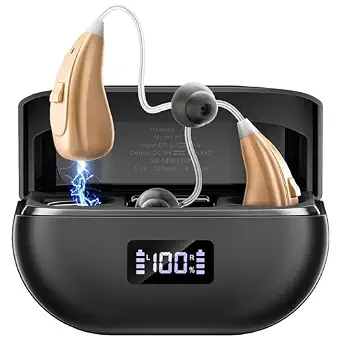
Hearing Aids for Seniors Rechargeable with Hearing Loss Noise Cancelling
Five volume levels, listed as 24–40 dB, and a volume memory function make this a practical choice for seniors who want to set a preferred level and avoid resetting it each time. Its behind-ear RIC design is described as lightweight and suitable for daily wear with glasses, giving it a more visible, potentially easier-to-handle profile than the discreet in-ear Hearing Aids Hearing Amplifiers for Seniors. The rechargeable aids are rated for up to 25 hours per charge, with 80–100 hours from the case, so they fall between that product’s longer stated runtime and the 30-hour claim for the Karthus OTC Rechargeable Hearing Aids. The listing provides no named listening modes or app controls, and the five volume levels may not provide enough adjustment for every wearer. The stated noise reduction is not a substitute for a personalized hearing assessment.
Pros:- Five listed volume levels provide straightforward physical adjustment
- Volume memory retains the preferred setting
- Behind-ear RIC style is described as comfortable with glasses
- Up to 25 hours per charge and 80–100 hours with the case are stated
Cons:- No named listening modes are specified
- No Bluetooth or app controls are listed
- Five fixed volume levels may not offer enough adjustment for some users
Best for: Seniors who want a behind-ear fit, one-handed physical volume adjustment, and their preferred volume remembered between uses
Not ideal for: Buyers who need several environment-specific modes, app-based tuning, or a very discreet in-ear device
Our verdict“This is a sensible pick for someone who values remembered volume settings and a familiar behind-ear form.”
OTC Hearing Aids for Seniors & Adults, Rechargeable Hearing Aids with Noise Cancelling & Clear Sound, 16-Channel Digital DSP & 3-Level Volume Control, 80+ Hour Battery Life (Light Black)
The clearest stated differentiator here is three-level volume control paired with a 16-channel digital signal processor. For a senior who finds many adjustments confusing, three steps may be easier to learn than the five levels on the Hearing Aids for Seniors Rechargeable with Hearing Loss Noise Cancelling. The listing also mentions transient and wind-noise management and amplification up to 30 dB, which may matter during ordinary conversations outdoors, although the supplied information does not explain how those features perform in practice. Its title claims more than 80 hours of battery life, but the product details provided do not clarify whether that figure refers to one charge or includes the case. That makes battery comparisons less certain than for the Karthus OTC Rechargeable Hearing Aids, which gives separate runtimes. Fit, included controls, and charging details are also sparse here.
Pros:- Three-level volume control offers a limited, simple adjustment range
- 16-channel digital signal processing is specified
- Transient-noise and wind-noise management are stated
- Amplification up to 30 dB is listed
Cons:- Battery claim does not clarify whether it includes charging-case capacity
- The supplied description omits detailed fit and control information
- No listening modes or app customization are specified
Best for: Seniors who want a simple three-step volume range and are comparing devices based on stated noise-management features
Not ideal for: Buyers who need a clearly documented fit style, separated device and case battery runtimes, or multiple listening modes
Our verdict“Consider this model if simple volume steps appeal to you, but compare its unclear battery details with better-documented options such as Karthus.”
Bigprot M802 Rechargeable Hearing Aids (White)
Bigprot M802 is the most straightforward fit here for seniors who want a few listening choices without an app. Its single button switches among Quiet, Social, and Outdoor modes, while the charging case stores the pair between uses. Compared with the Blue Deer, which offers four modes and more frequency-focused adjustment, Bigprot asks less of a new user but gives less control over sound tailoring. The product description claims up to 120 hours of runtime, though it does not clarify how much comes from the aids versus the case. Six pairs of ear tips provide more sizing options than the three-pair set listed for the Blue Deer. The tradeoff is limited fit and performance detail: the listing gives no amplification range or clear explanation of how its noise cancellation behaves in different settings.
Pros:- One-button control switches among three listening modes.
- Includes six pairs of ear tips in three sizes.
- Rechargeable pair comes with a display charging case.
- USB-C cable and cleaning tools are included.
Cons:- The claimed 120-hour runtime is not clearly split between the aids and case.
- No amplification range or detailed noise-cancellation performance is provided.
- A behind-the-ear fit may be less discreet than the Blue Deer’s in-ear design.
Best for: Seniors who want app-free operation, a small set of listening modes, and several ear-tip sizes to try.
Not ideal for: Buyers who need precise sound adjustments, verified performance details, or Bluetooth and app features.
- Style:Behind-the-ear
- Sound processing:16-channel digital chip
- Listening modes:Quiet, Social, Outdoor
- Claimed runtime:Up to 120 hours; listing does not clarify case contribution
- Battery:Lithium-ion, included
- Charging:USB-C charging case with display
- Ear tips:Six pairs in S, M, and L
- Included accessories:Two cleaning brushes, cloth, USB-C cable, manual
Our verdict“Choose the Bigprot M802 if simple mode changes and multiple ear-tip sizes matter more to you than detailed sound adjustment.”
Blue Deer Hearing Amplifiers for Seniors OTC Hearing Aids Rechargeable
Blue Deer suits a senior who wants more ways to tune listening than a basic mode switch provides. It offers Normal, Low F, High F, and TV modes, plus seven volume levels, giving the wearer room to adjust for different situations. Compared with the Bigprot M802, its in-ear form is more discreet, but its extra choices may take longer to learn. The listing says the aids run for 24 hours per charge and also mentions a 50-hour battery-life highlight, so the total-runtime claim is unclear. At three grams each according to the description, the aids are designed to feel light, and six pairs of ear tips help with fit. The tradeoff is that buyers should clarify the battery figures and should not treat noise cancellation as a substitute for individualized hearing care.
Pros:- Four listening modes include a dedicated TV mode.
- Seven volume levels allow finer adjustment than the Bigprot M802’s three modes.
- In-ear design and three-gram stated weight favor a discreet fit.
- Includes six pairs of adjustable ear tips.
Cons:- The listing gives conflicting runtime information: 24 hours per charge and a 50-hour battery-life highlight.
- More modes and volume steps may be harder for some first-time users to manage.
- No detailed amplification range or clinical fitting information is provided.
Best for: Seniors comfortable trying several sound modes who want a discreet in-ear aid with physical volume buttons.
Not ideal for: Beginners who want the fewest possible settings, or buyers who need a clearly documented total runtime.
- Fit:In-ear
- Sound processing:8-channel processing
- Listening modes:Normal, Low F, High F, TV
- Volume:Seven-level volume control
- Runtime:24 hours per charge stated; 50-hour battery-life highlight also listed
- Charging time:2 hours
- Weight:3 g per aid, according to description
- Ear tips:Six pairs
Our verdict“Pick Blue Deer if you want more listening adjustments and an in-ear fit, and can accept unclear total-runtime claims.”
Hearing Aids for Seniors & Adults, 5-Level Volume, 100-Hour Battery Life
This model stands out for seniors who prefer to set a comfortable volume and have it retained between uses. Its five-level control and volume memory reduce repeated adjustment, while the listing specifies up to 25 hours per charge and roughly 100 hours with the case. That is a clearer battery breakdown than the Blue Deer listing, whose runtime figures conflict. The receiver-in-canal design places the speaker near the ear canal, which the manufacturer says supports more natural sound; the description does not provide independent performance evidence. Unlike the Karthus, which has two listening modes and six volume levels, this option puts its emphasis on remembered volume and a charging display. The tradeoff is a fixed set of five steps and no app-based fine tuning.
Pros:- Remembers the last volume setting after power-off.
- Five volume levels provide a simple adjustment range.
- Claimed 25-hour use per charge and up to 100 hours with the case.
- Multiple silicone tip sizes support fit adjustment.
Cons:- Five fixed volume steps may not provide enough adjustment for some listeners.
- No app or Bluetooth connectivity is described.
- The natural-sound benefit is a manufacturer claim without supporting performance data in the listing.
Best for: Seniors who want volume memory, a visible case battery display, and a simple control scheme for daily wear.
Not ideal for: People who need fine-grained personalization, Bluetooth features, or a low-profile option with independently documented performance.
- Design:Receiver-in-canal
- Sound processing:16-channel chip
- Volume:Five levels with memory
- Amplification:Up to 40 dB ±5 dB, as listed
- Runtime per charge:Up to 25 hours
- Runtime with case:Up to 100 hours; case described as providing 3–4 full charges
- Battery display:LED display on charging case
- Ear tips:Four included tips: one S, two M, one L
Our verdict“Choose this model if remembered volume and a clearly described case-assisted runtime matter more than advanced personalization.”
OTC Hearing Aids for Seniors with Noise Cancelling and 100 Hours Battery Life
This OTC in-ear pair is aimed at seniors who want a short learning curve: one-button operation, five volume levels, and a stated 25-plus hours of use per charge. Its claimed case-assisted runtime of 100-plus hours makes it easier to plan several days of use between case recharges. Compared with the Hearing Aids for Seniors & Adults, 5-Level Volume, it offers a similar core setup, but this listing specifically describes adaptive noise cancellation and medical-grade silicone. The supplied weight field says 34 g per aid, while the product description says 3 g; that discrepancy makes the weight claim unreliable. The main tradeoff is limited personalization: there is no listening-mode range or app control listed, and OTC amplification may not fit every degree or pattern of hearing loss.
Pros:- One-button operation with five volume levels.
- Listing states 25-plus hours per charge and 100-plus hours with the case.
- Adaptive noise cancellation is specified.
- Medical-grade silicone is listed as the material.
Cons:- The listed weight conflicts with the description: 34 g in specs versus 3 g in the text.
- No app, Bluetooth, or multiple listening modes are specified.
- A general OTC amplifier may not suit severe or complex hearing loss.
Best for: Seniors who value simple button controls and long case-assisted use over detailed sound customization.
Not ideal for: Listeners who need a verified lightweight specification, more listening modes, or professional fitting for complex hearing needs.
- Fit:In-ear
- Sound processing:16-channel
- Noise control:Adaptive noise cancellation
- Volume:Five levels
- Runtime per charge:25+ hours
- Runtime with case:100+ hours
- Charging time:2 hours
- Battery and material:Included lithium-ion battery; medical-grade silicone listed
Our verdict“Consider this pair if you want simple controls and extended case use, but verify its fit and weight details before choosing it.”
Karthus Rechargeable In-Ear Hearing Aids with Noise Reduction
Karthus makes its intended audience unusually explicit: adults with perceived mild to moderate hearing loss. Its six volume levels offer more adjustment steps than the five-level B0H8RNRMCD, and two modes separate noise reduction from quiet listening. Automatic power-on and a single control keep daily handling simple, while the Type-C case is rated for up to 96 hours total. That battery claim sits close to the 100-hour claims of other options here, but Karthus provides less detail about a single charge, describing it as up to 24 hours. Its in-ear shape and white finish may appeal to someone seeking a discreet alternative to the Bigprot’s behind-the-ear form. The tradeoff is limited connectivity: there is no app or Bluetooth, and the listing does not describe fine-tuned fitting.
Pros:- Six volume levels offer more steps than the five-level B0H8RNRMCD.
- Two modes address quiet listening and noise reduction.
- Automatic power-on and a single control simplify operation.
- Type-C case is stated to provide up to 96 hours total use.
Cons:- The stated user range is limited to perceived mild to moderate hearing loss.
- No app or Bluetooth connectivity is provided.
- The listing gives limited detail about fitting adjustments and sound processing.
Best for: Adults with perceived mild to moderate hearing loss who want an in-ear rechargeable pair with simple controls and several volume steps.
Not ideal for: People who need prescription-level fitting, Bluetooth or app control, or support beyond the stated mild-to-moderate use case.
- Fit:In-ear
- Intended users:Adults 18+ with perceived mild to moderate hearing loss
- Listening modes:Noise Reduction, Quiet
- Volume:Six levels
- Runtime per charge:Up to 24 hours
- Runtime with case:Up to 96 hours
- Charging:Type-C rechargeable case
- Connectivity:No app or Bluetooth
- Color:White
Our verdict“Choose Karthus if you want a simple in-ear option with six volume steps for perceived mild to moderate hearing loss.”
Karthus Rechargeable Hearing Aids for Seniors, Ice Silver
The Karthus is the strongest fit here for seniors who want simple physical controls and extended battery coverage. Its behind-the-ear RIC design may be easier to handle than the tiny in-ear Audien Atom Pro 2, while seven volume levels give more steps for dialing in loudness than the Atom Pro 2’s five. The case raises stated use to up to 100 hours, and a 15-minute quick charge can provide up to six hours when a full recharge is not practical. Quiet and Noise modes offer a straightforward way to adjust for different settings without an app.
The tradeoff is its more visible behind-the-ear fit, and two listening modes are less tailored than the Atom Pro 2’s four. It is intended for mild to moderate hearing loss; fit and results can vary.
Pros:- Physical switch and one-button operation require no app or Bluetooth
- Up to 30 hours per charge and up to 100 hours with the case
- 15-minute quick charge provides up to six hours of use
- Seven volume levels and two listening modes
Cons:- Behind-the-ear design is more visible than the in-ear Audien models
- Only two listening modes, compared with the Atom Pro 2’s four
- Not intended for severe or profound hearing loss, and fit and results vary
Best for: Seniors with mild to moderate hearing loss who prefer a light behind-the-ear fit, button controls, and fewer charging interruptions.
Not ideal for: People seeking a discreet in-canal style, more than two environment modes, or support for severe or profound hearing loss.
- Design:Behind-the-ear RIC
- Weight:0.1 oz
- Sound processing:16-channel DSP
- Volume levels:7
- Listening modes:Quiet Mode and Noise Mode
- Battery life:Up to 30 hours per charge; up to 100 hours with charging case
- Quick charge:15 minutes provides up to 6 hours of use
- Controls:Physical switch and one-button operation; no app or Bluetooth required
- Intended hearing loss:Mild to moderate
Our verdict“Choose the Karthus if long stated battery life and straightforward behind-the-ear controls matter more than a discreet fit or a wide choice of listening modes.”
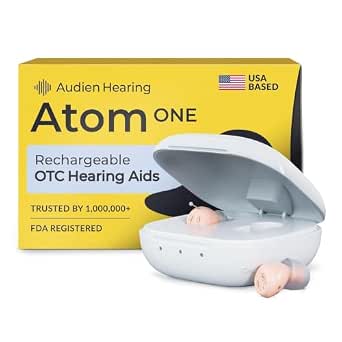
Audien Atom One OTC Hearing Aids
The Atom One’s defining advantage is two tactile analog dials: one adjusts volume and the other frequency, without an app or button menus. That gives a first-time user direct control over two settings, while the Karthus offers seven volume levels and two listening modes but no stated frequency dial. Its in-ear design is also less visible than Karthus’s behind-the-ear RIC style, and three dome sizes offer some choice in fit.
The compromises are a stated 24-hour battery and a charging dock that takes about three hours to recharge, with no extra case capacity specified. Unlike the Atom Pro 2, it has no listed environment-specific modes or UV-C case. The included guided setup may help with insertion and dial adjustment, but the supplied information does not establish an individualized hearing assessment.
Pros:- Separate analog dials adjust volume and frequency without an app
- Small in-ear design with three silicone dome sizes
- Automatic power on removal and power off when docked
- Guided setup session is included
Cons:- Stated battery life is 24 hours, with no extra case capacity specified
- About three hours are needed for a full recharge
- No listening modes or noise-control feature is specified
Best for: First-time OTC users who want discreet in-ear aids and hands-on volume and frequency adjustment without smartphone setup.
Not ideal for: People who need multiple environment presets, extended backup charging away from an outlet, or a fit that avoids placing an aid in the ear canal.
- Fit:In-ear
- Controls:Separate analog volume and frequency dials
- Battery:Rechargeable lithium-ion; two batteries included
- Battery life:Up to 24 hours per charge
- Charging time:About 3 hours
- Charging connection:USB-C charging dock
- Ear domes:Small, medium, and large silicone sizes
- Intended hearing loss:Mild to moderate
- Warranty:1 year
Our verdict“Pick the Atom One if you value discreet wear and direct dial adjustments more than environment presets or a larger charging reserve.”
Audien Atom Pro 2 OTC Hearing Aids for Seniors & Adults
Among these four, the Atom Pro 2 offers the clearest setup for people who move between different listening situations: its four named modes cover conversation, restaurant, TV, and outdoor use. That is more tailored than the Karthus’s Quiet and Noise modes, though the Karthus offers more volume steps and a longer stated total runtime with its case. The Pro 2 pairs its presets with five volume levels adjustable for each ear, so users can make separate adjustments without navigating a phone app.
The small in-canal design and automatic power behavior suit someone who values discretion and a simple dock routine. Its case adds up to 48 hours beyond the stated 24-hour charge and runs a five-minute UV-C cycle when docked. The tradeoff is a smaller control surface than the Atom One’s separate dials, plus in-ear placement that may not suit everyone.
Pros:- Four modes for conversation, restaurants, TV, and outdoors
- Volume can be adjusted independently for each ear
- Charging case adds up to 48 hours of stated battery life
- On-device controls, automatic power behavior, and UV-C case cycle
Cons:- Five volume levels offer fewer steps than the Karthus’s seven
- In-canal placement may not suit users who dislike in-ear aids
- Single-button controls combine mode and volume changes
Best for: Seniors who regularly alternate between TV, conversation, restaurants, and outdoor settings and want discreet aids with on-device mode changes.
Not ideal for: People who prefer separate volume and frequency dials, want the Karthus’s stated 100-hour case total, or find in-canal devices uncomfortable.
- Design:In-canal, nearly invisible style
- Listening modes:Conversation, Restaurant, TV, and Outdoor
- Volume levels:5, adjustable independently for each ear
- Battery life:Up to 24 hours per charge
- Case capacity:Up to 48 additional hours
- Controls:On-device button; quick press changes volume and long press changes mode
- Ear domes:Small, medium, and large silicone sizes
- Charging case:Portable case with a 5-minute UV-C cycle when docked
- Warranty:1 year
Our verdict“Choose the Atom Pro 2 if environment-specific presets are more useful to you than separate dials or the Karthus’s longer stated case runtime.”
Oricle Hearing Aids for Seniors – Oricle Hearing Aids for Adults with Advanced Noise Cancellation – Easy Volume Control with Portable Charging Case
Oricle is the simplest pick for a buyer who wants an in-canal fit, five sound levels, and a stated 60 hours of use per charge. Its smart memory retains the initial and desired settings, while automatic on/off when removed from or placed in the case may reduce routine handling. Compared with the Audien Atom One, Oricle does not list separate frequency adjustment or a guided setup session; compared with the Atom Pro 2, it offers no named environment presets. Its appeal is a shorter feature list and a claimed long single-charge runtime.
That simplicity also leaves practical questions: the provided product information does not explain how its noise cancellation is controlled, specify charging time, or state how much extra battery the portable case holds. A five-second press for manual power adds another step despite automatic power behavior. The soft tips are intended for comfort, but fit can still vary by wearer.
Pros:- Five sound levels for adjusting output
- Smart memory retains initial and desired settings
- Automatic on/off when placed in or removed from the case
- Soft silicone tips and compact in-canal design
Cons:- No named environment-specific listening modes are listed
- Charging time and additional case capacity are not specified
- Manual power requires a five-second press
Best for: Seniors who prefer an in-canal aid with a small set of volume levels, remembered settings, and automatic case-based power.
Not ideal for: Buyers who need named listening modes, independent frequency controls, or clear details about charging time and case capacity.
- Design:Completely-in-canal
- Fit material:Soft silicone ear tips
- Battery life:Up to 60 hours per charge
- Charging case:Portable charging case; additional capacity not specified
- Sound levels:5
- Controls:Long press for 5 seconds to turn on or off
- Power behavior:Automatic on removal and off when placed in case
- Memory:Smart memory for initial and desired settings
Our verdict“Choose Oricle if a basic in-canal fit and remembered volume settings suit you, and the unspecified case capacity is not a deciding factor.”

How We Picked
I ranked these products for senior buyers by the practical details stated in their listings: control simplicity, charging approach, stated battery life, sound-adjustment features, and how clearly the product description explains its intended use. Features such as multiple channels or volume levels can give buyers more ways to tailor listening, but they may also add steps; simpler controls can be easier to learn, though they offer less stated flexibility.
The order favors products with a clearer differentiator and enough detail to help a buyer understand the tradeoff. The Audien Atom X leads for its touchscreen, and the 16-channel DSP model ranks highly for describing sound controls; models focused on long runtime or basic noise reduction rank by those narrower strengths. Product names and listing claims alone cannot establish clinical suitability, measured sound quality, or fit, so I treat them as comparison points rather than verified performance results.
Factors to Consider When Choosing Hearing Aids For Seniors
Before choosing among OTC hearing aids, I would start with the listening problems and daily routines the wearer actually has. A feature list can narrow the options, but fit, comfort, support, and realistic expectations shape whether a device is useful day after day.
Match the Device to the Hearing Need
OTC hearing aids are intended for adults with perceived mild to moderate hearing loss, so the first decision is whether that description fits the wearer. Difficulty hearing speech in a quiet room can call for a different approach than trouble following conversation in noisy settings. Sudden hearing changes, pain, drainage, dizziness, or hearing loss that is much worse in one ear call for advice from a hearing professional or clinician. A common mistake is buying amplification to address every listening problem without checking for an underlying condition. I would use the product comparison to choose among OTC styles only after the hearing need seems appropriate for that route.
Choose Controls the Wearer Can Manage
Think through how the wearer will adjust volume, change programs, and confirm that the device is on. Touchscreens and multiple adjustment levels may offer flexibility, but they can be harder for someone with limited dexterity, vision, or comfort with small controls. A simple control scheme can reduce daily friction, although it may offer fewer ways to tailor sound. If possible, check whether controls are on the device, a case, or a phone, and whether the wearer can use them without help. Avoid choosing a feature-rich model just because it sounds more advanced; easy, repeatable operation often matters more.
Treat Battery Claims as One Part of the Routine
Listings may describe battery life for the aids, the charging case, or a combination, so clarify what a stated total covers before comparing numbers. A long runtime can reduce charging interruptions, but it does not matter much if the case is inconvenient to open or remember to charge. Consider whether the wearer can connect the charger, see charging indicators, and keep the case in a consistent place. Rechargeable models avoid routine battery replacement, while they still depend on a charging habit and a working power source. Build charging into an existing daily routine rather than relying on a headline runtime alone.
Consider Fit, Handling, and Maintenance
A hearing aid that is uncomfortable or difficult to insert may spend more time in its case than in the ear. Small in-ear styles can be discreet, yet their size may challenge users who have arthritis or reduced fingertip control. Ask what ear tips are included, how to clean the device, and whether replacement parts can be obtained. Keep wax and moisture care in mind because maintenance affects comfort and performance over time. When fit is uncertain, favor a seller with a clear return and support process so the wearer can judge comfort during ordinary use.
Compare Noise Features With Real Listening Situations
Terms such as noise reduction and noise cancellation appear across this lineup, but those labels alone do not show how speech will sound in a restaurant, car, or family gathering. Think about the environments that matter most and whether the wearer needs different listening settings or mostly wants help in quieter conversations. More channels or adjustment levels may provide greater control, yet they can take time to learn. A common buying mistake is expecting noise processing to remove all background sound while leaving every voice untouched. Look for clear instructions and a way to adjust the aid when an environment changes.
Check Support and Return Terms Before Buying
Hearing aids need an adjustment period, and questions about fit, charging, or sound can arise after the package is opened. Before buying, check the return window, warranty terms, access to customer support, and availability of replacement tips or accessories. These details can matter more than a small difference in a stated battery figure because they affect the buyer’s ability to resolve a poor fit or setup problem. Ask whether support is available by phone or only online if the wearer may need hands-on guidance. Do not assume every seller offers the same level of help just because the products share similar feature language.
Frequently Asked Questions
How can I tell whether an OTC hearing aid is suitable for a senior?
OTC models are intended for adults who believe they have mild to moderate hearing loss, but a product listing cannot diagnose the cause or degree. If the change in hearing came on suddenly, affects one ear much more, or comes with pain, drainage, or dizziness, seek clinical advice before buying. A hearing evaluation can help clarify whether amplification is appropriate and what kind of device may fit the need. For a suitable OTC candidate, choose based on comfort, usable controls, and support as well as stated features.
Should I choose the longest stated battery life?
Not by itself. Listings can describe runtime in different ways, and the stated total may include the charging case rather than continuous use of the aids. A longer claim can mean fewer charging interruptions, but comfort, sound adjustment, and simple charging may matter more to the wearer. Check what is included in the battery figure and whether the case is easy to handle. Pick the device that fits the person’s routine, not just the largest number.
Are more channels or volume levels always better?
More adjustment options can help a wearer tailor sound across different situations, as suggested by the 16-channel DSP model and products advertising several volume levels. They can also add complexity, especially for someone who has difficulty seeing small controls or remembering settings. A simpler model may be easier to use consistently, even if it offers less stated control. Consider who will make adjustments and how often before treating extra settings as an advantage. If possible, confirm that instructions and support make those settings manageable.
What should I check if a senior has trouble inserting or charging small hearing aids?
Look closely at the device size, included ear tips, charging connector, case opening, and visibility of any charging indicators. Small in-ear aids may be discreet, but they can be challenging for someone with arthritis or limited dexterity. A family member can help with setup, though daily use should be manageable by the wearer or a consistent caregiver. Check cleaning steps and replacement tip availability before purchase. A clear return process is useful if the fit or handling proves impractical at home.
When is it worth paying more for extra controls or features?
Extra controls make sense when the wearer will use them to handle specific listening situations, such as switching between quiet conversation and background noise. They add little value if changing settings is confusing or if the wearer prefers a stable, simple setup. Compare what the additional control actually changes, how it is operated, and whether support is available to explain it. In this roundup, the touchscreen and multi-channel descriptions offer distinct control approaches, while many other listings emphasize rechargeability or noise reduction. Prioritize a feature only when it solves a real daily problem.
Conclusion
For the best overall balance of a distinct control approach and a clear listing differentiator, I would start with the Audien Atom X; the touchscreen suits buyers comfortable with that interface. For more stated sound adjustment, the 16-channel DSP model is the stronger candidate, while the high-runtime listings may suit someone whose priority is fewer charging interruptions after confirming how their battery claims are measured. The beginner-friendly white model is the natural starting point for a wearer who wants a simpler setup, and the Oricle merits a look for its stated easy volume control and portable case. I cannot name a verified best value or premium choice from the supplied product details alone, since they do not provide consistent information about price, warranty, support, or measured performance; compare those terms before deciding.