
Falls are the leading cause of injury among older adults, and the right elderly fall prevention device can mean the difference between a safe night and an emergency room visit. After comparing ten of the most popular options for 2026, the Lunderg Bed Assist Rail with Motion Light stands out as the best overall pick because it physically prevents falls rather than just alerting caregivers after the fact. For families who need remote monitoring, the Smart Caregiver Bed Exit Alarm with Wireless Pager delivers reliable alerts up to 300 feet away, while the Smart Caregiver Floor Mat Alarm is the strongest choice for dementia patients who wander. The main tradeoff in this category is between physical support (rails) and alert-based systems (sensors and pagers) — most households benefit from pairing one of each. Read on for the full breakdown of what each device does well, where it falls short, and which one fits your situation.

Turn quiet afternoons into listening time
- Thousands of audiobooks, podcasts and originals
- Listen on your phone, tablet or Echo — also offline
- Cancel anytime
Complete the kit


Key Takeaways
- Physical support (the Lunderg bed rail) beat alert-only systems for preventing falls outright — an alarm tells you someone is getting up, but a rail can stop the fall before it happens.
- Wireless pager range varied dramatically across the lineup: the Smart Caregiver systems reliably reached 300+ feet, while budget wired options like the Patient Aid pad lock the caregiver into one room.
- Early-alert models like the Lunderg Wireless Early Alert Bed Alarm trigger as weight shifts, not just at full bed exit — a meaningful safety edge for fast-moving dementia patients.
- False alarm rates separated the top tier from the rest; chair pad sensors without adjustable sensitivity (the Vive Magnet Pull Cord) generated complaint-worthy noise that led families to disable them.
- Corded alarms remain the value pick — the Patient Aid wired system costs roughly half of wireless alternatives, but only makes sense when a caregiver sleeps in the same room.
| Lunderg Bed Assist Rail with Motion Light and Non-Slip Handle |  | Best Overall | Material: Steel | Weight Capacity: 300 lbs | Installation: Tool-free, 5-minute setup | VIEW LATEST PRICE | See Our Full Breakdown |
| Smart Caregiver Bed Exit Alarm with Wireless Pager |  | Best Expandable System | Pad Size: 30″L x 10″W x 0.5″H | Power Source: 2 AA batteries (included) | Sensor Technology: Pressure sensor | VIEW LATEST PRICE | See Our Full Breakdown |
| Vive Magnet Pull Cord Chair Alarm |  | Best Budget Pick | Cord Length: 27.56–55.12 inches, adjustable | Power Source: 9V battery | Mounting Options: U bracket, wall bracket, adhesive hook and loop | VIEW LATEST PRICE | See Our Full Breakdown |
| Lunderg Wireless Chair Alarm System |  | Best for Chair and Wheelchair Monitoring | Range: 400 ft | Connectivity: Wireless, no Wi-Fi required | Adjustable Volume: Yes | VIEW LATEST PRICE | See Our Full Breakdown |
| Lunderg Wireless Early Alert Bed Alarm System |  | Best for Nighttime Bed Monitoring | Sensor Pad Size: 10 x 33 inches | Range: 400 ft | Battery Life: 15 months | VIEW LATEST PRICE | See Our Full Breakdown |
| Upgraded Bed Sensor Alarm and Fall Prevention System for Elderly and Dementia Patients |  | Best Long-Range Monitoring | Power Source: 3 AAA batteries (included) | Sensor Type: Wireless motion / contact sensor | Wireless Range: Up to 182 meters (open area) | VIEW LATEST PRICE | See Our Full Breakdown |
| Smart Caregiver Fall Prevention Monitor and Weight Sensing Chair Pad |  | Best for Chair Monitoring | Pad Size: 10in x 15in | Material: Soft vinyl | Battery: 1 x 9V (not included) | VIEW LATEST PRICE | See Our Full Breakdown |
| Smart Caregiver Floor Mat Alarm and Pager System | 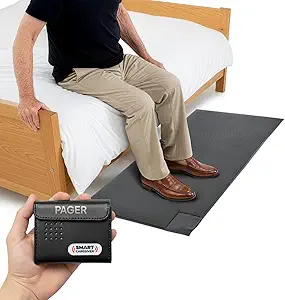 | Best for Hallway and Wandering Coverage | Mat Dimensions: 24in x 48in | Battery: 2 x AA (not included) | Wireless Range: Up to 300 feet | VIEW LATEST PRICE | See Our Full Breakdown |
| Patient Aid Bed Alarm with 10″ x 30″ Motion Sensor Pad |  | Best Value Bed Alarm | Sensor Pad Size: 10″ x 30″ | Connection: Wired | Alarm Sounds: Ring chimes, alarm, music | VIEW LATEST PRICE | See Our Full Breakdown |
| Smart Caregiver Bed Alarm for Elderly Adults |  | Best Basic Bed Alarm | Sensor Pad Size: 10″ x 30″ | Power: 1 x 9V battery (included) | Alarm Features: Two volume levels, silencing button | VIEW LATEST PRICE | See Our Full Breakdown |
More Details on Our Top Picks
Lunderg Bed Assist Rail with Motion Light and Non-Slip Handle
Most fall prevention devices in this roundup tell you a fall is about to happen — this one actually physically prevents it, which is why it earns the top spot. The Lunderg rail combines a non-slip grip handle for sitting up and standing with a motion-activated night light, addressing the two most dangerous moments: the transfer itself and the dark walk to the bathroom. Setup is genuinely tool-free and takes about five minutes, a contrast to alarm systems like the Smart Caregiver Bed Exit Alarm, which requires ongoing battery management and a caregiver within earshot.
The tradeoff is honest but narrow: adjustable beds are off the table, and the 300 lb capacity may exclude heavier users. Compared with sensor pads that only alert after movement begins, this rail gives the senior independence rather than surveillance.
Pros:- Physically supports transfers rather than just alerting after the fact
- Motion-activated light prevents nighttime fumbling in the dark
- Tool-free installation in about five minutes
- Fits a wide range of bed sizes from twin to king
Cons:- Not compatible with adjustable beds
- 300 lb weight capacity limits heavier users
- Batteries for the motion light need periodic replacement
Best for: Seniors who can still transfer with light support and want independence at bedtime without a caregiver on alert
Not ideal for: Adjustable bed owners and users over 300 lbs — the rail simply won’t fit or hold safely
- Material:Steel
- Weight Capacity:300 lbs
- Installation:Tool-free, 5-minute setup
- Compatibility:Twin–King, 7–13″ mattresses
- Adjustable Bed Compatible:No
- Safety Light:Motion-activated
Our verdict“Buy this if you want to prevent the fall itself instead of just being alerted to one starting.”
Smart Caregiver Bed Exit Alarm with Wireless Pager
What separates this Smart Caregiver system from every other alarm here is scalability. Beyond the bed pressure pad, it accepts chair pads, floor mats, door exit sensors, and motion sensors — meaning one pager becomes the hub of a whole-home monitoring setup. For families managing dementia wandering alongside fall risk, that expandability matters more than anything a single-purpose device offers.
Compared with the Lunderg Wireless Chair Alarm, which covers exactly one chair, this system can grow as needs change, though the upfront cost reflects that. The 300-foot range is slightly shorter than Lunderg’s 400 feet, and the pad’s pressure-sensor design detects weight leaving the bed rather than subtle pre-exit shifting. Buyers should also budget for AA batteries over time.
Pros:- Supports multiple sensor types: chair pads, floor mats, door and motion sensors
- 300-foot wireless pager range with sound and vibration alerts
- Engineered to reduce false alarms
- Backed by a US-based company with customer support
Cons:- Higher price than simpler single-pad alarm systems
- Pressure sensor may miss movements that don’t fully leave the pad
- Ongoing AA battery replacements required
Best for: Families building a multi-room monitoring setup for a senior with dementia or wandering behavior
Not ideal for: Budget-conscious buyers who only need basic bed coverage — cheaper single-pad systems do that job fine
- Pad Size:30″L x 10″W x 0.5″H
- Power Source:2 AA batteries (included)
- Sensor Technology:Pressure sensor
- Maximum Range:300 feet
- Compatible Devices:Call buttons, chair pad, door exit sensor, floor mat, motion sensor
- Color:White
Our verdict“The right pick if fall risk is part of a broader wandering and monitoring problem that will grow over time.”
Vive Magnet Pull Cord Chair Alarm
At the value end of this lineup, the Vive Magnet Pull Cord takes the simplest possible approach: a cord clips to the senior’s clothing, and when they stand, the magnetic connection breaks and the alarm sounds. No pressure pad positioning, no wireless pairing — just mount it and go. That simplicity is its greatest strength against pricier wireless systems like the Lunderg Wireless Chair Alarm, which costs more for the convenience of a remote pager.
The tradeoff is that the alarm sounds at the chair, not in the caregiver’s pocket, so someone needs to be within hearing distance. It works for both chairs and beds thanks to the adjustable 27–55 inch cord, and the three mounting options (bracket, wall, adhesive) fit most furniture. Just keep a 9V battery on hand.
Pros:- Lowest-cost entry point in the category
- Adjustable cord length fits chairs, wheelchairs, and beds
- Three mounting options including damage-free adhesive
- Customizable alert sounds for home versus facility use
Cons:- No wireless pager — alarm only sounds at the unit
- Magnetic connection can be triggered accidentally by incidental movement
- Only detects when the cord detaches, offering no early warning
Best for: Budget-conscious caregivers who stay in the same home or facility wing as the senior
Not ideal for: Caregivers who move around a large house or need remote alerts — there’s no pager option at all
- Cord Length:27.56–55.12 inches, adjustable
- Power Source:9V battery
- Mounting Options:U bracket, wall bracket, adhesive hook and loop
- Alert Trigger:Magnetic cord separation
- Construction:Rubber boot for protection
- Use Cases:Chairs, wheelchairs, beds
Our verdict“A solid, affordable choice when the caregiver is nearby and remote alerts aren’t needed.”
Lunderg Wireless Chair Alarm System
Falls don’t only happen at the bedside, and this Lunderg system is the strongest chair-specific option in the roundup. The sensor pad slips under any chair or wheelchair cushion, and the portable pager — with adjustable volume plus a vibration mode — reaches up to 400 feet, outpacing the Smart Caregiver system’s 300-foot range. Because there’s no alarm at the chair itself, the senior isn’t startled by a sudden noise, a real advantage for dementia patients prone to panic.
Where the Vive Magnet Pull Cord costs less and requires no pad positioning, it demands a nearby caregiver; this system trades a higher price for true remote coverage. The included call button and lanyard are a thoughtful touch, letting the senior summon help proactively. Note that walls and appliances can eat into the advertised range.
Pros:- 400-foot wireless range, the longest in this batch
- No startling in-chair alarm — discreet pager alerts only
- Incontinence-resistant pad stands up to real-world spills
- Includes call button and lanyard so the senior can request help
Cons:- No local alarm at the chair to deter the senior from standing
- Range can drop with walls and obstacles
- Alerts caregivers only; does nothing to stop the fall itself
Best for: Caregivers monitoring a senior who spends most of the day in a recliner or wheelchair while they work elsewhere in the home
Not ideal for: Anyone expecting the device to physically prevent a fall — it alerts only, and the alarm never sounds at the chair
- Range:400 ft
- Connectivity:Wireless, no Wi-Fi required
- Adjustable Volume:Yes
- Vibration Mode:Yes
- Incontinence Resistant:Yes
- Included Accessories:Call button, lanyard, batteries
- Setup:Tool-free
Our verdict“The clear choice for wheelchair and recliner monitoring when the caregiver isn’t always in the same room.”
Lunderg Wireless Early Alert Bed Alarm System
This is the bed-focused counterpart to Lunderg’s chair alarm, and its defining feature is pad placement: positioning at hip level means the pager fires as the senior begins shifting toward the edge, not after both feet hit the floor. That early warning window is what separates real fall prevention from fall notification, and it’s something pressure pads placed lower on the bed can’t match.
Compared with the Smart Caregiver Bed Exit Alarm, this system offers a longer 400-foot range and a remarkably long 15-month battery life, versus the Smart Caregiver’s standard AAs. The incontinence-resistant pad wipes clean easily, and the quiet pager preserves dignity overnight. The lack of app or Wi-Fi integration will frustrate tech-minded families, but for many buyers that simplicity is precisely the appeal.
Pros:- Hip-level pad placement triggers alerts before the senior fully exits the bed
- 15-month battery life minimizes maintenance
- Incontinence-resistant pad is easy to clean
- Quiet, adjustable pager with vibration mode preserves dignity
Cons:- No Wi-Fi or app integration for remote monitoring
- Effective range reduced by walls and large appliances
- Battery swaps still required roughly every 15 months
Best for: Overnight caregivers who need to reach a restless sleeper before she’s fully out of bed
Not ideal for: Remote family members — with no app or Wi-Fi, someone must physically carry the pager within range
- Sensor Pad Size:10 x 33 inches
- Range:400 ft
- Battery Life:15 months
- Incontinence Resistance:Yes
- Connectivity:Wireless, no Wi-Fi or apps
- Pad Placement:Hip level for early alert
Our verdict“The best dedicated bedside alarm for caregivers who can carry a pager and want the earliest possible warning.”
Upgraded Bed Sensor Alarm and Fall Prevention System for Elderly and Dementia Patients
Most alarms in this category only work within a single room, which is fine for a live-in caregiver but useless if you’re downstairs doing laundry. This system’s 182-meter wireless range is the standout differentiator — the caregiver pager can travel with you across a large home or even into a yard, a reach none of the wired options like the Patient Aid Bed Alarm can match. I also like the dual placement flexibility: the motion sensor works under the bed or at doorways, so it doubles as a wandering alert for dementia patients who tend to leave rooms at night. The tradeoff is complexity. Compared with a pressure pad like the Smart Caregiver Bed Alarm, which is essentially plug-and-play, this one demands careful positioning and testing, and the instructions aren’t always clear. Battery dependence with no low-battery indicator is another gap worth weighing.
Pros:- Exceptional 182-meter wireless range covers large homes and yards
- Motion sensor works at bedsides or doorways for wandering alerts
- Caregiver pager with adjustable volume keeps alerts off the patient
- Dual LED light and sound alerts for different environments
- Batteries included, so it works immediately
Cons:- Setup requires careful sensor placement and testing for reliable performance
- No clear specs on sensor durability or water resistance
- Instructions can be confusing for non-technical caregivers
Best for: Caregivers in multi-story or large homes who need alerts far from the bedroom, especially for dementia patients who wander
Not ideal for: Caregivers who want a zero-setup solution — placement testing and less intuitive instructions make it frustrating out of the box
- Power Source:3 AAA batteries (included)
- Sensor Type:Wireless motion / contact sensor
- Wireless Range:Up to 182 meters (open area)
- Alerts:Dual alert with LED light and sound
- Volume:Adjustable
- Mounting:Door mount, under-bed placement
- Control Method:App, touch
Our verdict“This is the pick for caregivers who can’t stay within earshot of the bedroom and need whole-property alert coverage.”
Smart Caregiver Fall Prevention Monitor and Weight Sensing Chair Pad
Every other entry in this roundup guards a bed or a doorway — this is the one that covers the chair, which matters because chair-to-standing transfers are among the most common fall moments for seniors with weak legs. The weight-sensing pad sits discreetly on the seat and triggers automatically when pressure lifts, so there’s no button to press and no behavior change required from the patient. Compared with the Smart Caregiver Floor Mat Alarm, which catches someone mid-journey across a room, this pad intervenes at the exact moment of standing, buying caregivers those few extra seconds. The vinyl surface wipes clean easily, a genuine advantage in incontinence situations. The tradeoffs: the 9V battery isn’t included, the power adapter costs extra, and repositioning or leaning in the chair can produce false alarms that train caregivers to tune alerts out.
Pros:- Automatically detects the moment a patient stands from their chair
- Soft vinyl surface wipes clean and handles incontinence accidents
- Adjustable volume plus a low battery indicator
- One-year warranty from an established caregiving brand
Cons:- 9V battery not included and AC power adapter sold separately
- Prone to false alarms from normal shifting or repositioning
- Only covers one seat — additional chairs need additional pads
Best for: Families caring for seniors who nap, read, or spend daytime hours in a favorite chair and need stand-up alerts
Not ideal for: Bed-bound patients or restless sitters — frequent shifting triggers false positives that undermine trust in the alarm
- Pad Size:10in x 15in
- Material:Soft vinyl
- Battery:1 x 9V (not included)
- Alert Type:Automatic weight-sensing chair exit alarm
- Volume:Adjustable
- Indicators:Low battery, reset button
- Warranty:1 year
Our verdict“If falls happen during the day when your loved one rises from a chair, this fills a gap bed alarms simply can’t address.”
Smart Caregiver Floor Mat Alarm and Pager System
This is the only option in the lineup that guards a pathway rather than a piece of furniture. The 24×48-inch pressure mat goes beside the bed or across a hallway, and stepping on it sends a wireless alert to a pager up to 300 feet away — closer to a tripwire for wandering than a bed alarm. That makes it a natural fit for dementia care, where the danger isn’t just standing up but walking unattended toward stairs or exits. Compared with the Upgraded Bed Sensor Alarm, which detects motion at a doorway, this mat catches someone physically mid-route, giving a more reliable trigger that doesn’t depend on sensor angle or placement tuning. The vibrate mode is a thoughtful touch for nighttime monitoring when a loud chime would wake the whole house. Just note the batteries aren’t included, and the pad itself doesn’t alarm — it depends entirely on the pager being carried.
Pros:- Large 24×48-inch mat covers bedside and hallway pathways
- Wireless pager works up to 300 feet with audible or vibrate alerts
- Vibrate mode avoids startling patients or waking the household
- Compatible with other Smart Caregiver devices for a growing system
Cons:- Batteries not included and pressure mats drain them fairly quickly
- Fully dependent on the caregiver carrying the pager
- Expanding beyond basic alerts requires buying additional compatible devices
Best for: Dementia and Alzheimer’s caregivers who need to intercept wandering before it reaches stairs or exterior doors
Not ideal for: Those wanting a self-contained alarm — if the pager isn’t on your person, the mat triggers nothing audible
- Mat Dimensions:24in x 48in
- Battery:2 x AA (not included)
- Wireless Range:Up to 300 feet
- Alert Modes:Audible or vibrate
- Use Case:Fall and wandering prevention
- Expandability:Works with other Smart Caregiver devices
- Warranty:1 year
Our verdict“For intercepting a wanderer before they reach the stairs, this mat-plus-pager combo beats any bed or chair pad.”
Patient Aid Bed Alarm with 10″ x 30″ Motion Sensor Pad
For straightforward bedside monitoring on a budget, this wired system gets the fundamentals right where it counts: the 9V battery comes included, the pad is water-resistant and latex-free, and the three sound options — chime, alarm, or music — let you pick an alert that warns the caregiver without panicking the patient. Compared with the Smart Caregiver Bed Alarm, which locks you into two volume levels and in-room use, this one offers 80dB/90dB flexibility plus mounting on bed rails, walls, or any flat surface. The obvious limitation is the wire. Unlike the Smart Caregiver Floor Mat System with its 300-foot pager, you must stay within earshot of the alarm unit — there’s no way to receive alerts elsewhere in the house. One genuinely serious caveat: it cannot be used with pacemakers or defibrillators, which rules out a meaningful share of the elderly audience.
Pros:- 9V battery included, so it’s ready to use out of the box
- Three alert sounds (chime, alarm, music) with two volume levels
- Water-resistant, latex-free vinyl pad stands up to accidents
- Versatile mounting on bed rails, walls, or flat surfaces
Cons:- Contraindicated for patients with pacemakers or defibrillators
- Wired only — no pager option, limiting the caregiver to one room
- Ongoing 9V battery replacement cost
Best for: Budget-conscious caregivers or facilities needing reliable in-room bed monitoring with included battery and no recurring costs
Not ideal for: Patients with pacemakers or defibrillators — the manufacturer explicitly excludes them — and caregivers who move around the house
- Sensor Pad Size:10″ x 30″
- Connection:Wired
- Alarm Sounds:Ring chimes, alarm, music
- Volume:80dB or 90dB
- Power:9V battery (included)
- Water Resistance:Yes
- Material:Vinyl, latex-free
- Mounting:Bed rails, wall, flat surface (velcro)
Our verdict“The most complete in-room bed alarm value here, provided no pacemaker is involved and the caregiver stays nearby.”
Smart Caregiver Bed Alarm for Elderly Adults
If you want the simplest possible answer to the question “did Mom get out of bed?”, this is it. The pad slips discreetly under the sheet, triggers when pressure lifts, and the alarm unit does one job without menus, apps, or pairing — a real advantage for technologically hesitant caregivers who found the Upgraded Bed Sensor Alarm’s setup demanding. The incontinence-protected vinyl pad with foam interior is built for daily caregiving routines, and a silencing button lets you quiet the alarm while assisting, rather than listening to it blare. The catch is scope: unlike the Patient Aid Bed Alarm, which includes its battery and offers three sound choices, this one needs a 9V battery purchase, offers only two volume levels, and confines alerts to the room unless you pay extra for the wireless pager add-on. It’s a solid foundation, but a limited one.
Pros:- Nearly foolproof setup with no apps or pairing required
- Discreet pad hides under the sheet without disturbing sleep
- Incontinence-protected vinyl pad with foam interior for daily use
- Silencing button and optional wireless pager add-on for future expansion
Cons:- Battery described as included in specs but replacement costs recur, and wired use is in-room only
- Only two volume levels with limited alert flexibility
- Meaningful whole-home coverage requires buying the wireless add-on separately
Best for: First-time family caregivers who want an affordable, foolproof bed-exit alert for overnight monitoring from an adjacent room
Not ideal for: Caregivers who leave the room or the house — wireless alerts require an additional purchase
- Sensor Pad Size:10″ x 30″
- Power:1 x 9V battery (included)
- Alarm Features:Two volume levels, silencing button
- Sensor Material:Vinyl with foam interior
- Incontinence Protection:Yes
- Expandability:Wireless pager available as add-on
- Coverage:In-room (wired base configuration)
Our verdict“A dependable, no-frills first alarm for bedside overnight monitoring — just don’t expect coverage beyond the bedroom without add-ons.”
How We Picked
I evaluated each device against four buyer-relevant criteria: reliability of the alert or support (does it trigger when it should, without constant false alarms), caregiver usability (setup difficulty, pager range, battery life, and whether volume is adjustable), comfort and dignity for the senior (pad thickness, cord intrusiveness, and how the device feels during normal use), and value over time (sensor pad replacement costs and warranty coverage). Because these devices serve very different care situations, I weighted the criteria differently by use case — a dementia wandering monitor lives or dies by alert speed, while a bed rail for a stroke recoverer depends on weight capacity and grip security.
The ranking order reflects a simple philosophy: prevention first, detection second, convenience third. The Lunderg Bed Assist Rail earns the top spot because it removes the fall risk entirely rather than reporting it. Wireless systems with long-range pagers and early-alert sensors rank above wired models because they keep caregivers effective across an entire home. Budget wired options still earn their place, but only for specific room-sharing scenarios — which I flag clearly in each review so readers can match the device to their actual living situation.
Factors to Consider When Choosing Elderly Fall Prevention Devices
Choosing among fall prevention devices is less about finding the “best” product and more about matching the technology to the specific risk. Below are the factors that matter most — and the mistakes families make when they skip them.Prevention vs. Detection: Know Which Problem You’re Solving
The single biggest mistake families make is buying a detection device when they need prevention, or vice versa. A bed rail physically stops a fall, which makes it the right tool for weakness, balance loss, or recovery from surgery — situations where the senior can’t reliably transfer alone but the fall itself is the danger. Alarms, by contrast, don’t stop anything; they summon help, which matters most for dementia and wandering, where the risk is an unsupervised exit rather than a weak transfer. Many families buy an alarm, watch their loved one fall before anyone can respond, and conclude alarms are useless — when the real error was a mismatch. If the senior has cognitive decline, pair a detection system with environmental changes (clear pathways, night lighting). If cognition is intact but strength is the issue, start with a rail. Budget for both if the situation is mixed, because the two approaches solve different halves of the problem.
Wired vs. Wireless: The Range and Reliability Tradeoff
Wired systems cost less and never lose signal, but the alarm sounds only in the room where it’s plugged in — fine when a caregiver sleeps nearby, useless for a two-story home. Wireless pagers typically reach 150 to 300 feet, letting a caregiver cook downstairs or sleep in another bedroom. The tradeoff is battery management: pager systems need regular battery checks, and a dead pager at 3 a.m. is a silent failure. Look for models with low-battery indicators, and set a recurring reminder to test the system weekly. Also check whether the pager has multiple alert tones — caregivers who wake to the same tone every night report tuning it out, a documented phenomenon in overnight care. If your home has thick walls or metal construction, test the pager range in the actual hallways before committing.
Sensor Type and Where It Triggers
Bed and chair pads trigger on weight release, floor mats trigger on pressure from footsteps, and motion sensors trigger on movement near the bed edge. The difference matters more than most buyers expect. Pressure pads only fire after the senior is already standing — too late for fast movers. Early-alert and motion-based systems trigger as weight shifts toward the edge, buying the caregiver an extra five to ten seconds. Floor mats placed bedside catch the exact moment of exit and work well for wanderers, but they’re a trip hazard if placed poorly and can confuse seniors with shuffling gaits. Sensor pads are also consumables: most last six months to a year of daily use before thinning out or failing, so factor roughly $30–50 per pad per year into the true cost of ownership.
Volume, Dignity, and Alarm Fatigue
An alarm loud enough to wake a heavy sleeper can also startle, disorient, and agitate a senior with dementia — and frightened seniors fall more, not less. Adjustable volume isn’t a luxury feature here; it’s central to whether the system stays in use. The best setups alert only the caregiver (via pager or a monitor placed in a hallway) and stay silent in the senior’s room. Alarm fatigue is real on both sides: caregivers who respond to constant false alerts begin ignoring them, and seniors exposed to repeated alarms may resist the system entirely. Choose sensors with adjustable sensitivity so a restless sleeper doesn’t trigger alerts every twenty minutes. If a device generates more than a couple of false alarms a night, families disable it within weeks — which is why sensitivity tuning mattered so much in my rankings.
Weight Capacity, Bed Compatibility, and Installation
Bed rails are not one-size-fits-all. Check the weight rating (most support 250–300 pounds, and using a rail beyond its rating creates a collapse risk worse than no rail), and verify the rail fits your bed type — adjustable beds, very plush mattresses, and platform frames all cause fit problems that reviews frequently mention. Also consider the gap risk: poorly fitted rails can trap limbs or heads, which is why modern designs extend under the mattress or strap to the frame. For alarm systems, installation is simpler but pad placement matters — a pad positioned too far from the bed edge triggers late, and one under a thick mattress pad may not trigger at all. Ten minutes spent on correct placement dramatically changes real-world performance, no matter which model you buy.
Frequently Asked Questions
Is a bed rail or a bed alarm better for preventing falls?
How far do wireless fall prevention pagers actually reach?
Do sensor pads wear out, and what do replacements cost?
Will a fall alarm startle or upset my loved one with dementia?
Are cheaper wired bed alarms worth buying?
Conclusion
After comparing all ten devices, the right choice comes down to what kind of risk you’re managing and where your caregiver sleeps. For best overall, the Lunderg Bed Assist Rail with Motion Light earns the top spot because it prevents falls directly, adds a motion-activated light for nighttime transfers, and requires no batteries or monitoring to keep working. The best value pick is the Patient Aid wired bed alarm — roughly half the cost of wireless systems and completely reliable, provided a caregiver is within earshot. For best premium protection, the Smart Caregiver Bed Exit Alarm with Wireless Pager combines long-range alerts with a proven sensor platform that scales to multiple pads and caregivers.
For beginners setting up a first system, the Lunderg Wireless Chair Alarm is the simplest to install and understand, with no programming and straightforward pad placement. And for specific needs: choose the Smart Caregiver Floor Mat Alarm for dementia wandering, the Lunderg Wireless Early Alert Bed Alarm for fast-moving seniors who need warnings before the exit, the Smart Caregiver Weight Sensing Chair Pad for wheelchair and recliner monitoring, and the Vive Magnet Pull Cord as a low-cost backup where a simple tug-alert is enough. Whatever you choose, test the system weekly and replace sensor pads on schedule — the best fall prevention device is the one that still works the night you need it.
Cold & flu season Picks
humidifiers
As an affiliate, we earn on qualifying purchases.