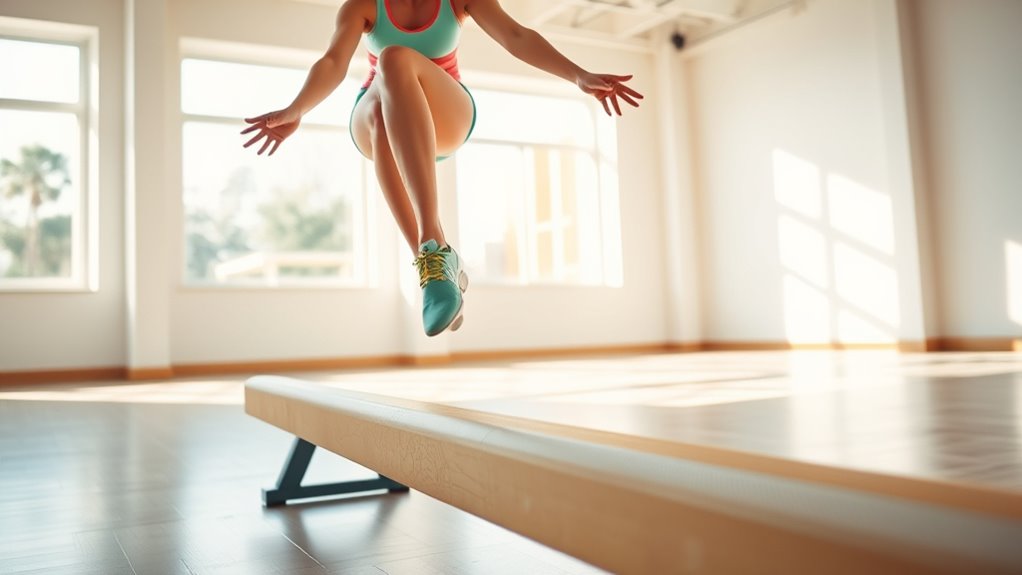

To improve your balance, start with simple drills like standing on one leg with eyes open, then close your eyes to challenge your proprioception. Use unstable surfaces such as foam cushions or balance pads to increase difficulty. Incorporate controlled movements like heel-to-toe walking, or catching a ball while balancing. Consistent practice enhances core stability and body awareness, which are key for better control and injury prevention. Keep going to discover even more effective ways to boost your balance skills.
Key Takeaways
- Practice single-leg stands with eyes open and closed to enhance proprioception and balance awareness.
- Use unstable surfaces like balance pads or foam cushions to challenge stability and improve core engagement.
- Incorporate heel-to-toe walking along a line for simple, effective dynamic balance training.
- Perform reaching exercises while balancing to develop coordination and body awareness.
- Gradually increase difficulty by adding movement or distractions, ensuring controlled, deliberate motions.
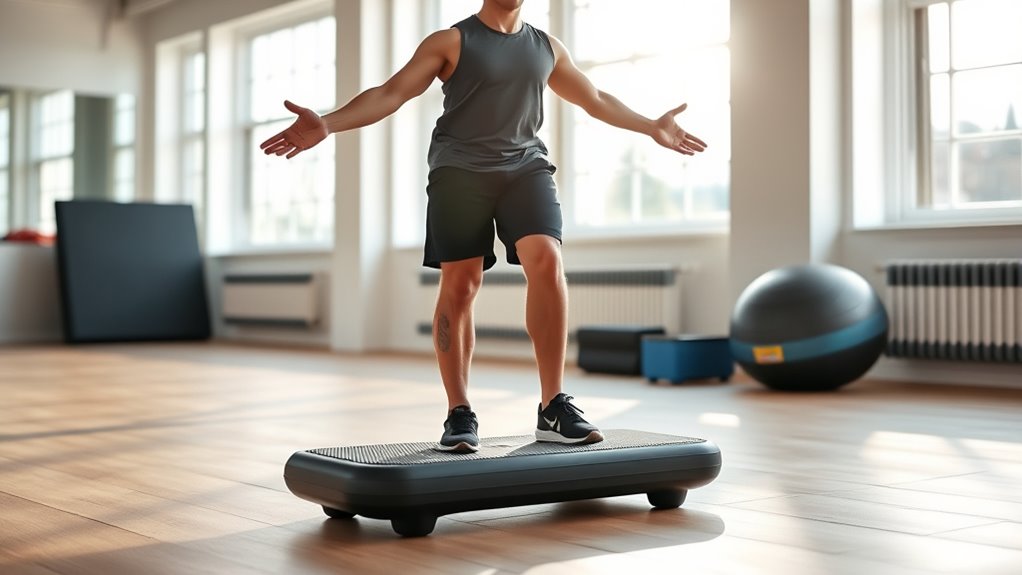
Have you ever wondered how some people move with effortless stability? It’s often because they’ve developed a strong sense of core stability and sharpened their proprioception. These elements are essential for maintaining balance and preventing falls, especially during daily activities or more intense workouts. When your core is stable, your body can better support itself, allowing for smoother, more controlled movements. Proprioception enhancement, on the other hand, heightens your awareness of your body’s position in space, helping you react quickly to shifts or disturbances. Together, these qualities form the foundation of effective balance training.
Strong core stability and sharp proprioception are key to effortless balance and injury prevention.
To improve core stability, focus on exercises that target your abdominal and lower back muscles. Simple drills like planks work wonders; hold a plank position with your elbows under your shoulders, keeping your body in a straight line from head to heels. This activates your deep core muscles and builds the strength needed to support your spine. As you progress, try side planks to engage your obliques, or incorporate dynamic movements like shoulder taps while maintaining a steady core. These variations challenge your stability and reinforce your core muscles, making your overall balance more resilient.
Proprioception enhancement can be achieved through drills that challenge your sense of position and movement. Try standing on one leg with your eyes open, then close your eyes to increase difficulty. When your vision is removed, your body relies more on proprioceptive feedback from your muscles, joints, and inner ear. To step it up, incorporate unstable surfaces like a balance pad or a foam cushion. Standing or performing gentle squats on these surfaces forces your body to constantly adjust, sharpening your proprioceptive skills. Incorporate movements such as reaching in different directions while balancing to further develop this heightened awareness. Additionally, integrating AI-driven security systems can help monitor your progress and ensure safety during your balance routines.
Consistency is key. Even just a few minutes each day dedicated to these drills can notably improve your balance over time. Focus on controlled, deliberate movements rather than rushing through exercises. Remember, the goal is to strengthen your core and heighten proprioception, so your body becomes better at maintaining stability in everyday situations and during complex activities. As you advance, challenge yourself with more dynamic exercises like walking heel-to-toe along a line or balancing on one foot while catching a ball. These drills not only boost your core stability and proprioception but also add a fun element to your routine.
Incorporating these simple balance training drills into your daily routine will help you move with more confidence and less risk of injury. Building a solid core and sharpening your sense of body awareness will serve you well in all aspects of life, empowering you to stay upright and steady no matter what challenges come your way.

ProsourceFit Exercise Balance Pad – Non-Slip Cushioned Foam Mat & Knee Pad for Fitness and Stability Training, Yoga, Physical Therapy 15.5”x12.75”, Black
- Enhances Balance and Core Strength: Unstable foam surface improves stability and rehabilitation
- Suitable for All Fitness Levels: Ideal for beginners, athletes, and seniors
- Non-Toxic and Slip-Resistant: Eco-friendly TPE material is sweat-proof and easy to clean
As an affiliate, we earn on qualifying purchases.
As an affiliate, we earn on qualifying purchases.
Frequently Asked Questions
How Often Should I Perform Balance Training Exercises?
You should perform balance training exercises 2 to 3 times a week, following the frequency guidelines for ideal improvement. Start with basic drills and gradually increase difficulty using progression strategies like longer holds or unstable surfaces. Consistency is key, so stick to your schedule and listen to your body. As your balance improves, challenge yourself more to continue making progress and prevent plateaus.
Can Balance Drills Prevent Falls in Older Adults?
Falls threaten your independence, but balance drills can be your safeguard. They’re proven to prevent falls by improving proprioception, helping you sense your body’s position better. Regular practice boosts strength and stability, reducing the risk of accidents. Think of balance exercises as a foundation—strengthening your ability to stay upright and confident. With consistent effort, you’re actively enhancing fall prevention and maintaining your mobility and safety longer.
What Equipment Is Necessary for Beginner Balance Training?
For beginner balance training, you mainly need balance aids like a sturdy chair, a balance beam, or a stability ball. Wearing supportive footwear choices, such as athletic shoes with good grip and proper fit, helps improve stability. You don’t need much equipment to start—just a safe space and these simple tools. As you progress, you can incorporate more advanced aids, but these essentials will give you a solid foundation.
Are There Specific Balance Exercises for Athletes?
Are you ready to push your limits? Athletes often target proprioception enhancement and core stability with specific balance exercises like single-leg stands, BOSU ball routines, or dynamic stability drills. These exercises challenge your coordination and strengthen key muscles, giving you that edge in competition. Incorporate them into your training to sharpen your awareness and control—your secret weapon for improved performance and injury prevention.
How Long Does It Take to See Improvements in Balance?
You can see improvements in your balance within a few weeks of consistent training. Tracking your progress helps you stay motivated and identify areas needing more focus. Regular balance exercises not only enhance stability but also play a vital role in injury prevention. Stick with your routine, perform drills correctly, and give yourself time—most people notice better balance and reduced injury risk after about 4 to 6 weeks.
Conclusion
By incorporating these simple balance drills into your routine, you enhance stability, boost confidence, and prevent falls. Consistency strengthens your core, sharpens your focus, and improves your coordination. With dedication, these exercises become habits that support your overall health, empower your movement, and elevate your quality of life. Embrace these small steps daily, and watch as balance, strength, and confidence grow—because when you practice regularly, you progress steadily, you transform gradually, and you succeed ultimately.